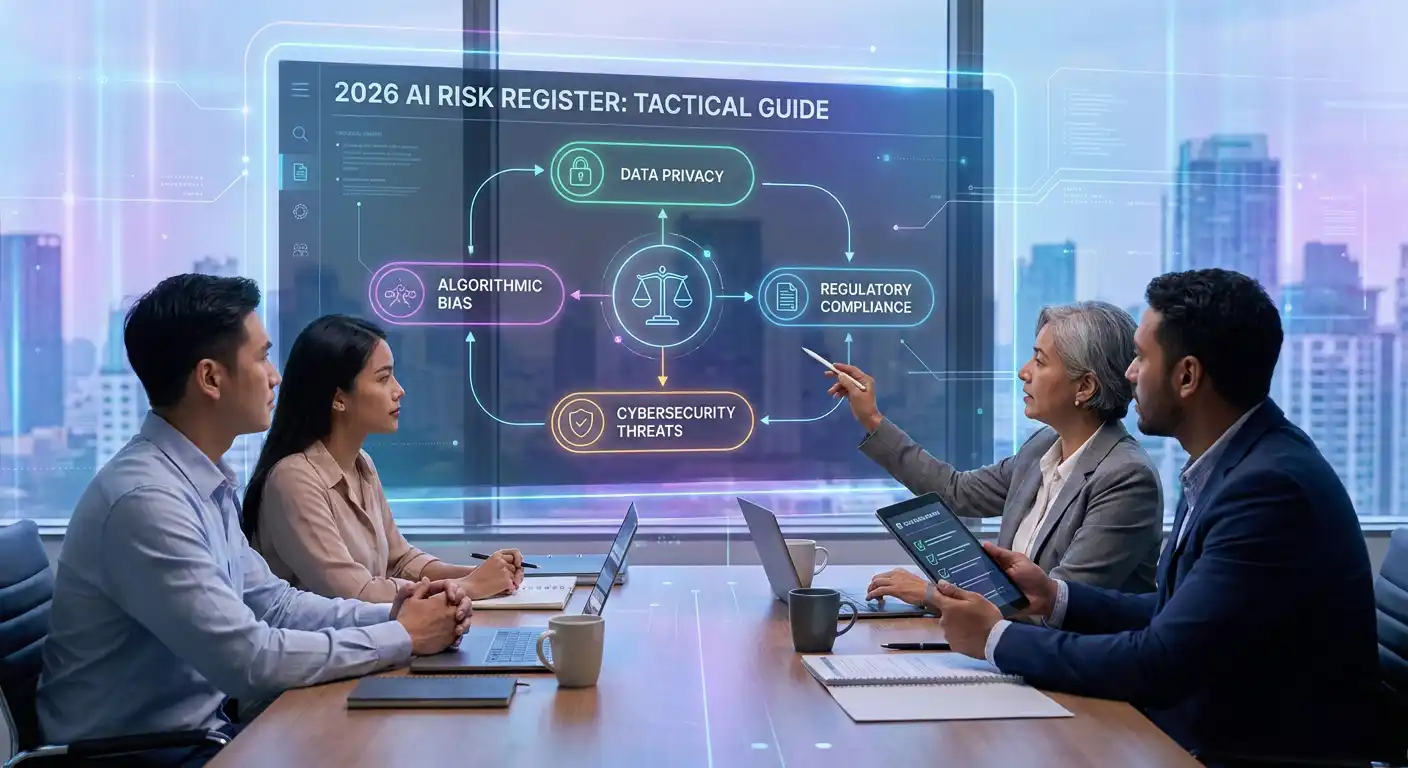
If the C-Suite Governance Guide is the compass, the AI Risk Register is the map. In 2026, a static spreadsheet is no longer sufficient. As AI models evolve into autonomous agents, your risk register must be a dynamic, live-monitored asset.
According to ISO/IEC 42001 standards, an AI Risk Register isn't just a list of "bad things that might happen." It is a structured database that maps specific AI use cases to their probability, impact, and mitigation owners.
The 2026 "Agentic" Shift
Traditional IT risk registers focus on "Uptime" and "Security." AI risk registers focus on "Probabilistic Behavior." You aren't just managing the risk of the system breaking; you are managing the risk of the system working exactly as told, but with unintended consequences.
1. The 5 Categories of AI Risk
Before you start auditing, you must categorize. In 2026, we use the NIST AI RMF 1.1 expanded categories:
2. The Anatomy of a High-Authority Risk Entry
A professional risk register in 2026 must move beyond simple descriptions. Every entry needs STRIDE-AI classification (Spoofing, Tampering, Repudiation, Information Disclosure, Denial of Service, and Elevation of Privilege).
Live AI Risk Register v2.0
2026 Compliance Ready| Risk ID | Category | Threat Description | Impact Level | Mitigation Strategy | Owner |
|---|---|---|---|---|---|
| AI-01 | Privacy | PII Leakage: Sensitive customer data accidentally included in fine-tuning datasets. | CRITICAL | Differential privacy filters & k-anonymity scrubbing prior to training. | DPO |
| AI-02 | Logic | Recursive Loop: Agentic AI gets stuck in a logic loop, draining API credits. | MEDIUM | Hard "Circuit Breaker" limits on API calls and per-session spending caps. | VP Ops |
| AI-03 | Security | Prompt Injection: Users bypass guardrails to extract internal system prompts. | HIGH | Implementation of "Dual-LLM" verification (Monitor model vs User model). | CISO |
| AI-04 | Ethics | Model Drift: Recruiting AI develops gender bias due to historical data patterns. | HIGH | Quarterly bias audits & synthetic data balancing for under-represented groups. | CHRO |
3. Creating the Mitigation "Playbook"
Mitigation isn't a one-time fix. In 2026, we utilize Red Teaming and Adversarial Testing.
- Red Teaming: Hiring ethical hackers to purposefully try to break your AI.
- Shadow AI Audit: Using discovery tools to find "unauthorized" AI apps employees are using.
- Model Lineage Tracking: Keeping a "birth certificate" for every model version so you can roll back if drift is detected.
4. The 90-Day Roadmap to a Live Risk Register
Don't aim for perfection on day one. Follow this cadence:
Document every tool (official and "shadow") currently in use. Categorize by risk level (Low, Medium, High-Impact).
Conduct STRIDE-AI audits on all "High-Impact" systems. Identify the specific points where data can leak or logic can fail.
Integrate automated dashboards. If a model's "Confidence Score" drops below 85%, an alert should go to the Risk Owner.
Conclusion: Risk Management as an Enabler
The goal of a risk register isn't to say "No." It’s to define the conditions under which you can say "Yes." By identifying and managing risks early, VPs and Directors can move faster than their competitors who are slowed down by uncertainty.
For more on how this impacts your broader corporate strategy, see our article on Ethical AI Leadership for the 2020s.
External Resources
Expert External Resources & Templates
The industry-standard federal framework for managing AI risks. Includes the highly recommended heavy-duty corporate Excel template.
A clean, functional template designed for documenting AI system adoption across government and enterprise levels.
The ultimate "cheat sheet" containing over 1,700+ categorized AI risks to help brainstorm and stress-test your internal register.
Technical security matrix for CISOs and developers focusing on adversarial attacks, prompt injection, and model safety.
An excellent simplified framework for small businesses and non-profits to start their AI governance journey.