
It’s funny how quickly we pivot. A few years ago, the mantra in digital marketing was "long-form is king." We were all writing these massive, 3,000-word definitive guides because the data seemed to suggest that search engines equated length with authority. But then, almost overnight, the conversation shifted. Suddenly, everyone started talking about "content chunking."
If you’ve spent any time in SEO circles lately, you know the drill. Break every paragraph into two sentences. Use a sub-heading every 100 words. Turn everything into a bulleted list. The idea was that we needed to make our content "machine-readable" for the age of Large Language Models (LLMs) and Generative Search.
I've been a solid believer that the latest fads should never be followed until someone can back these things up with solid proof, and seeing as I've not changed my content policy for the past 15 years, it would take a lot to steer me away from this course now.
Luckily, some people with way more clout than me have asked the deep questions and a report from Ars Technica regarding Google’s latest guidance, suggests many might have collectively run off a cliff. There’s a very real danger that in our rush to please the robots, many have started writing things that no human, and ironically, no high-performing search engine, actually wants to consume.
The Logic of the "Snackable" Article
I get why people fell for it. On the surface, chunking makes a lot of sense. If you look at how AI models like Gemini or GPT-4 process information, they don't exactly "read" the way we do. They break text down into tokens and often retrieve specific "chunks" of data to answer a user’s prompt.
The theory among SEOs—and let’s be honest, we’re often just trying to pin a tail on a moving donkey—was that if we served the information in tiny, discrete bites, it would be easier for an AI to "grab" a specific section and feature it in a generated response. It’s like pre-cutting a steak for a toddler; you’re just trying to make it easier to swallow.
There’s also the readability factor. We know that people scan. We know that on a mobile screen, a giant wall of text is the fastest way to get someone to hit the "back" button. So, the "short paragraphs, more headers" approach felt like a win-win. It seemed like we were helping the user and the AI at the same time.
Some big companies put their tuppence into the hat, notably SEMRush with their article Content Chunking: What Is It & Should You Care? However, it's interesting to note that their image of a "chunked" article vs non-chunked is actually a very good way to structure your content:
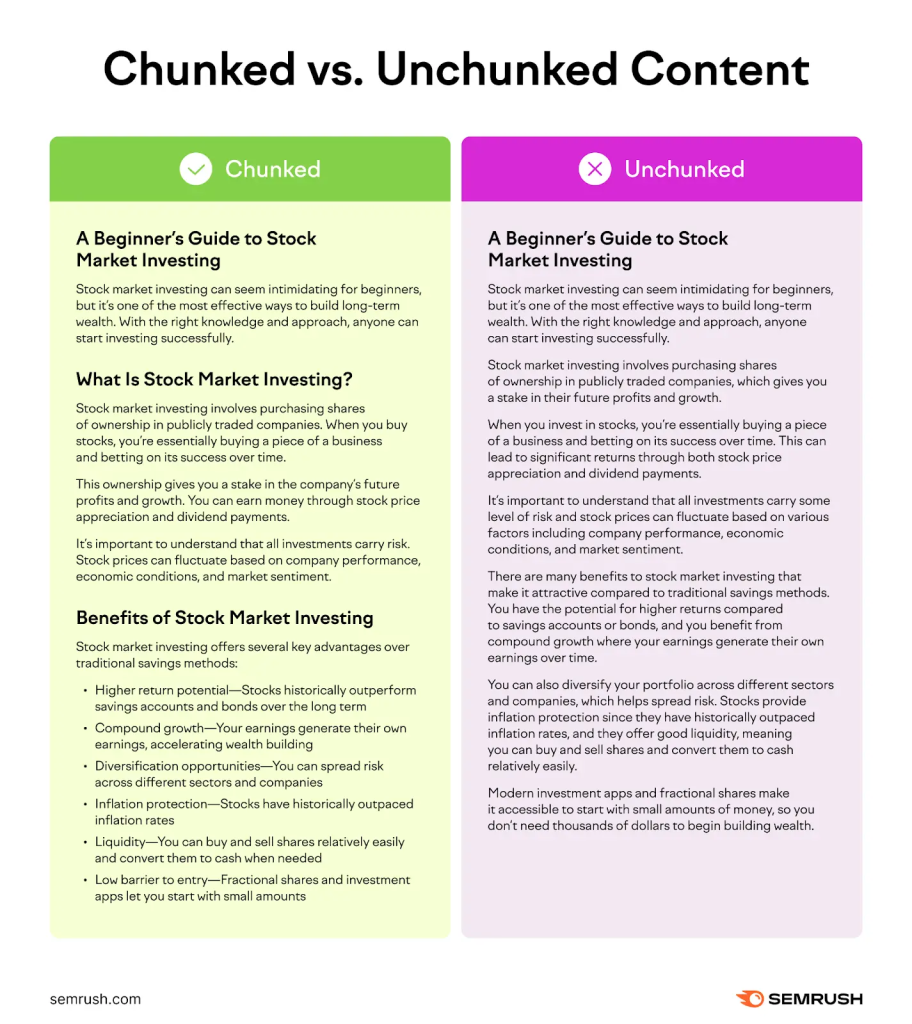
This type of chunking is a good thing. It makes an article easily readable to a human fleshbag, but also accessible to the Google Bot, LLMs and probably Elon Musk's evil Grok thing.
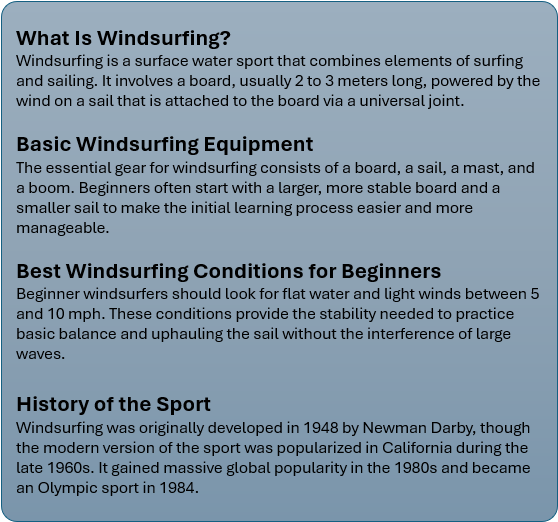
However, a lot of the new GEO tech bros have really been piling in and saying we should do crap like this:
Why It Seems Like It Should Work (The Technical Bit)
To get a bit technical for a moment—and I promise not to go too deep down the rabbit hole—this whole trend is rooted in how Retrieval-Augmented Generation (RAG) works. When an AI search engine looks for an answer, it’s essentially searching through a massive database of "vector embeddings."
If your content is one giant, rambling essay, the "vector" for that page might be a bit fuzzy. But if you have a very specific, isolated chunk of text under a header like "How to calibrate a torque wrench," the AI can identify that specific block as a high-match for a user's query.
Perhaps that’s why we saw such a massive shift toward this hyper-fragmented style. It wasn't just a stylistic choice; it was an attempt at architectural engineering for the LLM era. We thought we were being clever.
The Tipping Point: When "Bite-Sized" Becomes "Broken"
The problem is that we took it too far. We started creating pages that look more like grocery lists than articles. I've seen blogs lately where almost every single sentence is its own paragraph. It’s exhausting to read. Your eyes are constantly jumping, and you never get into a flow.
According to that Ars Technica report I mentioned, Google has started pushing back hard. They’ve basically told creators that if you care about your search rankings, you need to stop making "bite-sized" content specifically for LLMs.
The core of the issue is "Information Density" and "Context." When you break text down into tiny, isolated shards, you lose the connective tissue. A human reader needs transitions. We need to see how Idea A leads to Idea B. If you strip all of that out to make the content "chunkable," you’re left with something that feels robotic and, frankly, untrustworthy.
Google’s algorithms are increasingly focused on "Helpful Content," and as it turns out, humans don't find a list of 50 disconnected facts particularly helpful when they're looking for an explanation. If the AI can't see the relationship between your paragraphs because you've isolated them too much, it might actually struggle to understand the overall authority of your piece.
The SEO Guessing Game (The Weather-Vane Analogy)
I often think that being an SEO is a bit like trying to predict the path of a hurricane by watching which way the leaves are blowing in your own backyard. We see a small shift in the search results, and we immediately build an entire philosophy around it.
The "Ars" article used the phrase "throwing bones," which is a great way to put it, but I think of it more like trying to map a dark room by touch alone. You feel something cold and metal, and you decide the whole room is a walk-in freezer, only to realise later you were just touching a doorknob.
Most of the "best practices" for chunking were based on observations of what seemed to be working in the early days of AI Search. But SEOs were guessing. We saw a few bulleted lists appearing in AI Overviews and decided that everything had to be a bulleted list. We ignored the fact that Google’s primary goal is still to serve content that satisfies a human user's intent.
Finding the Middle Ground
OK, so what's a hapless website owner to do?
Here's what the research supports, and what I've been banging on about for years:
- Use Headers for Navigation, Not Just Keywords: Headers should act like a table of contents that helps a reader find what they need. They shouldn’t just be there to break up the page every two inches.
- Vary Your Paragraph Length: This is huge for realism. A few short, punchy sentences are great for emphasis. But follow them up with a longer, more explanatory paragraph. It creates a rhythm. It feels like a person talking.
- Keep the Connective Tissue: Don't be afraid of transition words like "however," "consequently," or "on the other hand." These are the things we often strip out when we're trying to be "concise," but they are exactly what give a piece of writing its logic and flow.
- Prioritise Narrative over Fragments: Even a technical article should tell a story. There should be a beginning, a middle, and an end.
The Irony of Optimising for AI
There is a delicious irony in all of this. We are trying so hard to optimise for AI that we are forgetting that the AI is being trained to recognise… us.
The goal of a modern LLM is to simulate human reasoning and communication. If we change our writing style to be more fragmented and "robotic" to help the AI, we are actually moving away from the very thing the AI is trying to find. Google’s "Helpful Content" updates are designed to filter out content that feels like it was written for a search engine.
When you over-chunk, you’re basically waving a giant red flag that says, "I wrote this for an algorithm!"
I’ve fallen into this trap myself. You start editing a draft and you think, "Maybe I should turn this paragraph into three bullet points so it’s easier to skim." But then you look at it and realise you’ve sucked all the personality out of the writing. You’ve turned an opinionated, interesting thought into a dry data point.
A More Human Approach to SEO
I think the move forward—and this is backed by the warnings coming out of Google lately—is to write for the person who is stressed, in a hurry, or genuinely curious.
Yes, use headers. Yes, keep your sentences relatively clean. But don't be afraid to be a little messy. Use a parenthetical aside (like this one). Let a thought trail off slightly before bringing it back to the main point. This kind of "natural variance" is something that AI still struggles to replicate perfectly, and it’s something that Google’s systems are getting very good at identifying as a sign of human authorship.
In the end, the "bite-sized" trend was a reaction to a new technology we didn't quite understand. We thought the AI wanted snacks, but it turns out it actually wants the whole meal—it just wants it to be well-organised.
If we keep chasing these extreme formatting trends, we're going to end up with a web that is technically "optimised" but totally unreadable. And if a human doesn't want to read it, eventually, the search engines won't want to find it either. It’s a bit of a self-correcting problem, I suppose. It just might be a painful correction for those who have already "chunked" their entire archives into oblivion.
Final Thoughts
Perhaps the best advice is the simplest: write the article you would actually want to read.
I know that sounds like "SEO heresy" to some, but look at the trajectory. Every single major update Google has released in the last three years has been a move away from mechanical optimisation and toward rewarding genuine, authoritative, and coherent writing.
Chunking is a tool, not a rule. Use it to provide clarity, not to replace context. If your article feels like a collection of fragments, it's probably time to start knitting those pieces back together. Your readers will thank you, and, if the latest data is anything to go by, your rankings will too.