
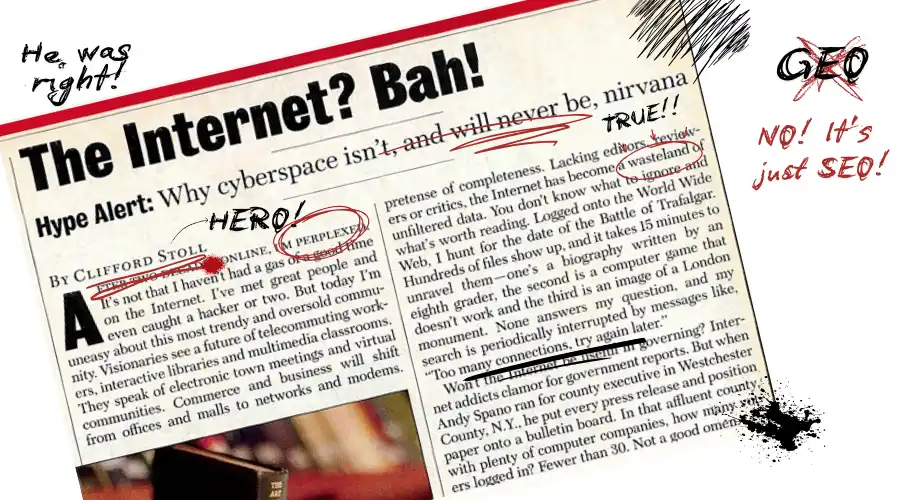
There is a long and embarrassing tradition in every industry of credible, intelligent professionals staring at something new and declaring it nonsense.
In 1995, Clifford Stoll, astronomer, cybersecurity pioneer and brilliant man by any measure, published a piece in Newsweek titled "The Internet? Bah!" He made the following predictions:
- Online shopping would never replace the local mall because the internet had no salespeople.
- No online database would replace your daily newspaper.
- Online communities were "a limp substitute for meeting friends over coffee."
- E-learning was pointless: "who needs teachers when you've got computer-aided education? Bah."
His exact response to the prediction that people would one day buy books and newspapers online?
Uh, sure.
When new technology arrives, the smart people in the old industry explain why it can't work. They're not stupid. They're matching what they see to everything they already know. The problem is that what they know was built for the world that existed, not the world that's forming.
In 1492, Johannes Trithemius, Abbot of Sponheim and respected scholar, wrote a treatise called In Praise of Scribes. His argument: monks must continue to hand-copy manuscripts, because printed books were made of paper, and paper doesn't last. Parchment lasts a thousand years. Printed paper? Two hundred, maximum.
He also argued that if monks stopped copying by hand, they'd have nothing to do all day, and idleness would corrupt their souls.
The crowning irony: he had it printed. On a printing press.
The scribes, meanwhile, spread rumours that Gutenberg was an alchemist doing "devilish" things in his workshop. The press was dangerous. Uncontrolled. Anyone could publish anything. Standards would collapse.
The scribes were out of work within a generation. The printing press did not care about their concerns.
Fast forward to 2022.
AI image generators arrive. Graphic designers and illustrators respond with fury, and to be fair, some of it with legitimate grievances. The artist Greg Rutkowski, whose work appeared in Dungeons & Dragons and Magic: The Gathering, discovered his name was being used as a generation prompt over 93,000 times. He called it "terrifying" and "ethically, stealing." Molly Crabapple and Marisa Mazria Katz published an open letter signed by by a broad coalition of artists calling AI art training "the greatest art heist in history."
Open letters were published. Petitions were signed. Legal cases were filed. Artists explained at length why AI-generated images had no soul, no craft, no human meaning. They were right about all of it in the ways that matter to artists.
The clients stopped caring anyway.
One commercial graphic designer reported losing 30% of their income from the moment the AI image wave hit. Not because AI art was better, but because clients stopped asking whether it was better in the way they defined better. An illustrator with 20 years in comics said their advertising agency work "disappeared overnight in 2023."
The open letter did not bring those commissions back. The ethical arguments did not bring those commissions back. The debate about artistic soul did not bring those commissions back.
The market is not a panel at a design conference. It does not sit in a room and weigh your arguments. It just moves. And if you're still arguing while it moves, you find out later, on your bank statement.
The designers doing well now are the ones who picked up the AI tools, understood them better than their clients, and turned that into a competitive edge. They didn't abandon their craft. They added a skill. The ones who dug in on principle are either working for much less or not working at all.
There's a lesson there. I'll let it sit.
Which brings me to the SEO community's current favourite argument.
GEO (Generative Engine Optimisation) is "snake oil with a shiny acronym." Nothing new to optimise for. Just SEO with better marketing. People are rebranding their services to charge more. The whole thing is a scam.
And they have a point. Sort of.
Yes, some people have plastered "GEO" on the same services they were selling six months ago and doubled their day rate. That is absolutely happening. Some of it is grift.
But here's what's also happening: a peer-reviewed academic paper from Princeton, Georgia Tech, and the Allen Institute for AI, published at ACM SIGKDD 2024, found that specific optimisation strategies could boost AI search visibility by approximately 40%. That's not a LinkedIn bro with a Canva carousel. That's a research institution.
A Semrush study also found that ChatGPT regularly cites pages sitting at position 21 or lower in Google rankings. The number one result on Google is not the primary signal for AI citation.
If the signals are different, the work is different. Call it whatever you like. The work is still different.
Rand Fishkin, and I say this with genuine respect for his track record, has a position on this that is both technically reasonable and strategically convenient.
His argument: stop proliferating new acronyms. Call it "Search Everywhere Optimisation" (still SEO, see, keeps the familiar letters) and expand the scope to include AI, Reddit, YouTube, Perplexity, and wherever else audiences search. Tidy. Unified. Sensible.
He's right that 90% of "GEO" content on LinkedIn is pattern-matched nonsense from people who read a thread and immediately made a course. He's right that the proliferation of AIO, AEO, GEO and LLMEO is partly a land-grab for territory that doesn't need new acronyms.
Here's what I'd also observe: Rand Fishkin has spent twenty-five years building one of the most recognisable personal brands in the industry, and that brand is built almost entirely on three letters. S. E. O.
When the argument for keeping those three letters is also the argument that protects your personal brand positioning, you have to ask yourself which one is doing the heavy lifting. I'm not saying he's wrong. I'm saying that when a position is both intellectually defensible and commercially convenient for the person holding it, it deserves a second look.
The interesting question isn't what to call it. It's whether the work is different. And the work is different. I've written about exactly why, the difference between ranking a document and being absorbed into a probabilistic pattern of expertise, if you want the technical argument rather than the branding one.
John Mueller from Google posted on Bluesky last August:
"The higher the urgency, and the stronger the push of new acronyms, the more likely they're just making spam and scamming."
Fair point, John. Some of them are.
But "some people are misusing a term" has never, in the history of technology, been a good reason to pretend the underlying shift isn't real.
Some people misused "the internet" to sell fraudulent investments in 1999. The internet still existed.
Some people used "AI" to slap a chatbot on a PDF and call it enterprise software. AI still exists.
Some people are using "GEO" to sell snake oil. The question of whether AI search requires different strategy still exists.
You don't dismiss electricity because some people sold fake miracle cures through electric belts in the 1880s.
None of this arguing is actually about what you think, though.
Your clients are going to ask for GEO.
Not because they've read the Princeton paper. Not because they've followed Rand Fishkin's branding debate. Because their colleague mentioned it at a leadership away-day, or it appeared in a trade headline, or the board wants a slide on their "AI search strategy." Doesn't matter how they got there. They're going to use the word. They're going to want someone to do the work.
Gary Halbert, one of the greatest direct response copywriters who ever lived, wrote this in 1984, from a prison camp:
"The only advantage I want is a starving crowd."
Stop trying to manufacture demand. Stop trying to convince people they should want what you have. Go to where the hunger already is and feed it.
Businesses are already asking for GEO. That is the starving crowd.
If you're an SEO professional refusing to engage with GEO because you've decided the label is beneath you, while clients are actively searching for someone to help them with it, you are Clifford Stoll telling people the internet has no salespeople.
Technically? You might be right about the nuance.
Commercially? You're losing the work to someone who isn't having this argument.
The name doesn't actually matter.
What matters is whether AI search requires different strategy from Google search. And it does. Not because of branding or acronym proliferation, but because of how large language models actually work. They don't rank documents. They synthesise answers from patterns absorbed across enormous amounts of human-generated text. The thing you're optimising is not a page. It's whether you've become part of the pattern of recognised expertise in your field.
I've written about this in detail, drawing on my own experience building Bayesian AI search systems in the 1990s and connecting it to how modern LLMs actually work, in a piece I'd point you towards if the mechanism interests you more than the acronym war.
The monks who learned to operate printing presses didn't stop understanding manuscripts. The designers who picked up AI tools didn't stop understanding composition. The people who win in this shift will be the ones who understand what SEO actually does, how AI search actually works, and why they are related but not the same thing.
Postscript
Clifford Stoll has spent the last 25 years cheerfully owning how wrong he was. He gives lectures now where he holds up the 1995 Newsweek article and laughs.
That kind of self-awareness is rarer than it should be.