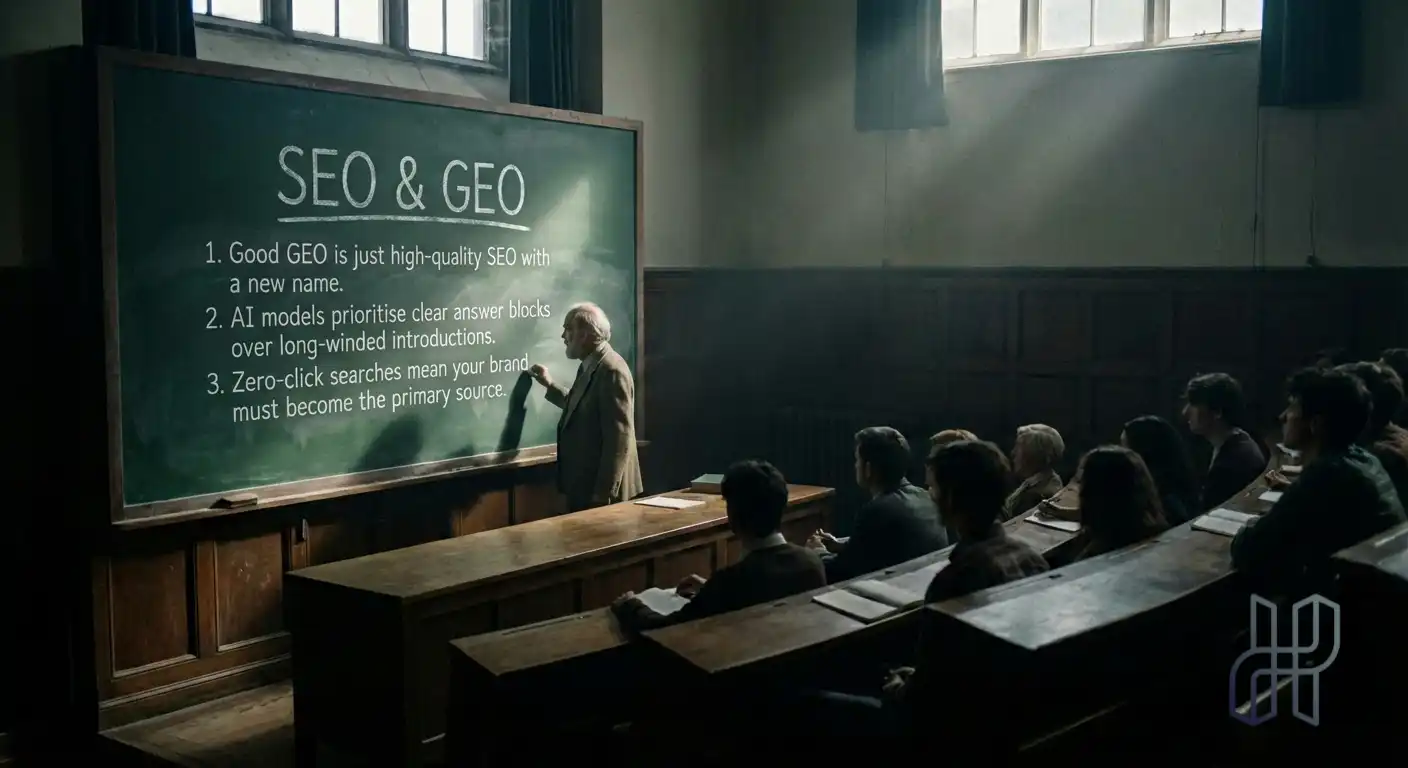
I’ll be the first to admit it: I love a good preamble. There’s something satisfying about setting the stage, building a bit of tension, and leading the reader toward a conclusion like a tour guide on a scenic route. But if 2026 has taught us anything about digital marketing, it’s that the AI models powering our search results don’t have time for the scenery.
They’re just looking for the destination.
If you want to win at GEO (Generative Engine Optimisation), you have to start thinking about your content in terms of "Answer Blocks." These are short, punchy, hyper-focused snippets of text—usually between 40 and 60 words—designed specifically to be scraped, cited, and read aloud by an AI.
The Death of the "Slow Burn"
We used to write for "Dwell Time." We wanted people to linger on the page, scroll through our clever subheadings, and maybe sign up for a newsletter after a 1,200-word journey. But in a world of Zero-Click searches, that strategy is starting to feel a bit... well, optimistic.
Perhaps the hardest pill to swallow is that if you don’t give the AI a clear answer to "scrape" within the first two paragraphs, it’ll just move on to your competitor who did. I’ve seen perfectly researched, 3,000-word whitepapers get completely ignored by Perplexity and Gemini because the "core answer" was buried on page three.
Why You Should Have Been Doing This Anyway
Here’s the part where I have to be a bit of a realist. While we’re dressing this up as a "new" GEO tactic, it’s actually just classic, high-level SEO. If you’ve been paying attention to Google’s evolution over the last decade, you’ll recognise this as the "Featured Snippet" strategy.
Google has been trying to give users the answer directly on the results page for years. The only difference now is that the AI takes those snippets and weaves them into a conversation. If you’re annoyed that you have to write more concisely for a bot, just remember that humans have always preferred this. Nobody ever landed on a blog looking for a specific answer and thought, "I really hope I have to read six paragraphs of fluff first."
Good SEO has always been about accessibility and clarity. By creating these blocks, you aren't just pleasing an algorithm; you're making your site more readable for the guy on his phone during a lunch break who just needs a quick stat. It’s funny how a "new" technology like Generative AI is basically just forcing us to follow the best practices we probably should have been following since 2018.
How to Build a Proper Answer Block
So, what does an Answer Block actually look like? It’s not just a summary; it’s a standalone unit of value.
- Lead with the "Is": Don't start with "In this article, we will explore..." Start with "GEO is the process of..."
- The 50-Word Sweet Spot: Aim for a length that fits comfortably in a chat bubble. If it’s too long, the AI will truncate it (and potentially get the facts wrong). If it’s too short, it lacks authority.
- Declarative Sentences: Avoid "I think" or "It might be." Use "It is" or "The data shows." Bots love certainty, even if humans find it a bit abrasive.

Example Answer Block: "Generative Engine Optimisation (GEO) is the practice of structuring website content to be easily indexed and cited by AI-powered search engines. By prioritising direct answers, factual density, and clear schema markup, brands can ensure they appear as primary sources in AI-generated overviews and summaries."
Does This Mean We Stop Being Creative?
This is where I get a little conflicted. As a writer, the idea of "writing for the bot" feels a bit like surrendering. I worry that if we all start leading with 50-word summaries, the internet is going to become a very dry, clinical place.
But I don't think it has to be a total loss. Think of the Answer Block as the "hook" that earns you the right to be creative later in the post. Once you’ve secured the citation and shown the user (and the AI) that you have the facts, you can spend the rest of the article adding the nuance, the personal stories, and the "un-AI-able" insights that actually build a brand.
I’m still struggling to find the perfect balance. Some days, it feels like I’m just writing headlines for a machine. Other days, I realise that being forced to be concise is actually making my writing better for humans, too.
The "Inverted Pyramid" 2.0
If you’re planning your content for the rest of the week, try this:
- Define the core question your post is answering.
- Write a 50-word Answer Block that addresses it directly.
- Place it at the very top, right after your introduction (or even as your introduction).
- Use the rest of the page to prove why you’re right.

It’s a shift in mindset, for sure. But if we want to stay relevant in 2026, we have to meet the users where they are—which is usually staring at a summary box, waiting for the quickest answer possible.