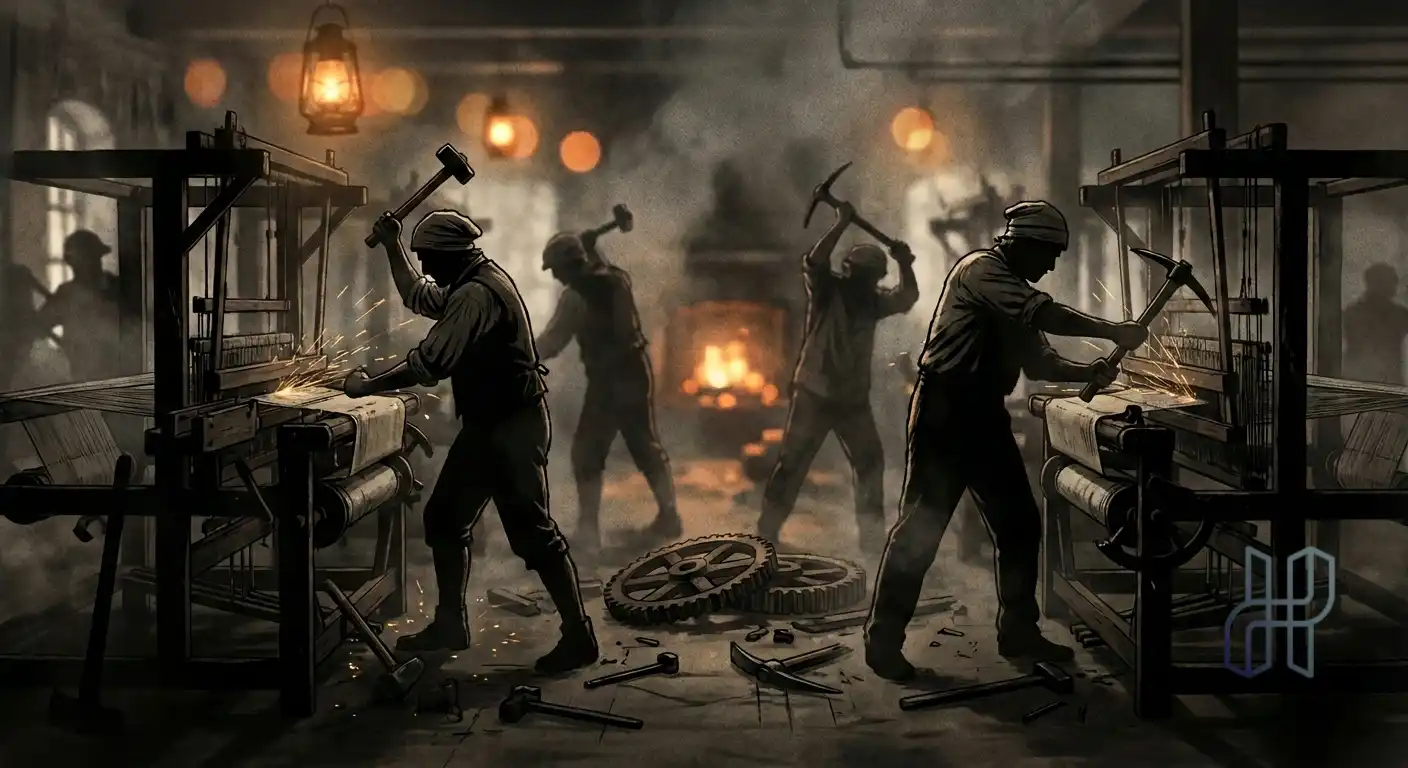
History has a funny way of repeating itself, especially when it comes to the "end of work." In the early 19th century, a group of English textile workers known as the Luddites famously smashed the power looms that threatened their livelihoods. They feared the machine would render the human obsolete. Fast forward to the 1970s, and the same panic resurfaced with the advent of the personal computer. Critics argued that the "Electronic Brain" would lead to mass white-collar unemployment.+1
Yet, in both instances, the opposite happened. The looms led to a global explosion in garment affordability and new retail roles, and the PC created entire industries—from software engineering to digital marketing—that were previously unimaginable. Today, as we stand at the precipice of the Artificial Intelligence revolution, the "Luddite Fallacy" is back in full force. But if history is our guide, AI won't kill work; it will simply dismantle our current job titles and replace them with something far more valuable.
Tasks vs. Roles: The Mechanics of Change
To understand why AI won't lead to a jobless future, we must distinguish between a job and a task. A job is a collection of tasks. AI is exceptionally good at automating specific tasks—data entry, basic scheduling, or initial drafting. However, it is remarkably poor at the high-level human oversight required to string those tasks into a successful business outcome.+1
When the ATM was introduced in the 1970s, the common consensus was that bank tellers were a dying breed. Instead, the number of bank tellers actually increased. Why? Because the ATM made it cheaper to open bank branches. The tellers stopped counting coins (the task) and started focusing on relationship management and financial advising (the role).
This is exactly what we are seeing with AI today. According to a report by Gartner, while AI will eliminate some roles, it is expected to create two million net-new jobs by 2025 (Gartner, 2024). The shift isn't about the disappearance of work; it's about the migration of human effort toward "Human-Centric" value.
The Rise of the Augmented Professional
The fear of AI often stems from the idea that it is a "replacement" technology. In reality, it is an "augmentation" technology. Forbes notes that rather than wholesale replacement, AI is more likely to augment the capabilities of the workforce, particularly in high-skill sectors (Forbes, 2024).
For the C-Suite and mid-career professionals, this means your job title might change from "Marketing Manager" to "AI Marketing Architect." Your value will no longer be measured by how many hours you spend writing copy, but by how effectively you can direct an AI to generate 50 variations of that copy, and how skillfully you can select the one that aligns with your brand’s soul. This is the essence of AI Literacy: moving from the "doer" to the "director."
The "Silver" Advantage in the New Economy
For professionals in their 40s and 50s, the Luddite Fallacy feels particularly personal. There is a fear that "digital natives" will have a natural advantage. However, history shows that when tasks are automated, judgment becomes the premium skill.
Younger workers may be faster at navigating a new interface, but they often lack the "Institutional Memory" and "Industry Intuition" that only comes with decades of experience. An AI can draft a legal brief or a merger strategy, but it cannot navigate the political nuances of a boardroom or understand the subtle shifts in a client’s body language. As the technical "how" becomes cheaper thanks to AI, the strategic "why" becomes exponentially more expensive.
Statistics of the Shift
The numbers back up this optimistic outlook. Research from the World Economic Forum suggests that by 2025, 85 million jobs may be displaced by a shift in the division of labour between humans and machines, while 97 million new roles may emerge that are more adapted to the new division of labour (WEF Future of Jobs Report).
- 60% of workers in advanced economies will be impacted by AI, with about half of those seeing a boost in productivity through augmentation (IMF, 2024).
- 80% of the US workforce could have at least 10% of their work tasks affected by LLMs, but only a tiny fraction will see their entire role automated (OpenAI Research).
Conclusion: Don’t Smash the Machine—Master It
The Luddites failed because they tried to stop a tide that was ultimately going to lift the global standard of living. The lesson for the modern professional is clear: do not fear the automation of your tasks; fear the failure to evolve your role.
AI is the most significant "re-titling" event in human history. It is stripping away the repetitive, the mundane, and the soul-crushing parts of our jobs, leaving behind the parts that require creativity, empathy, and high-level strategy. If you embrace AI Literacy today, you aren't just surviving the revolution—you are designing the new world that follows it.