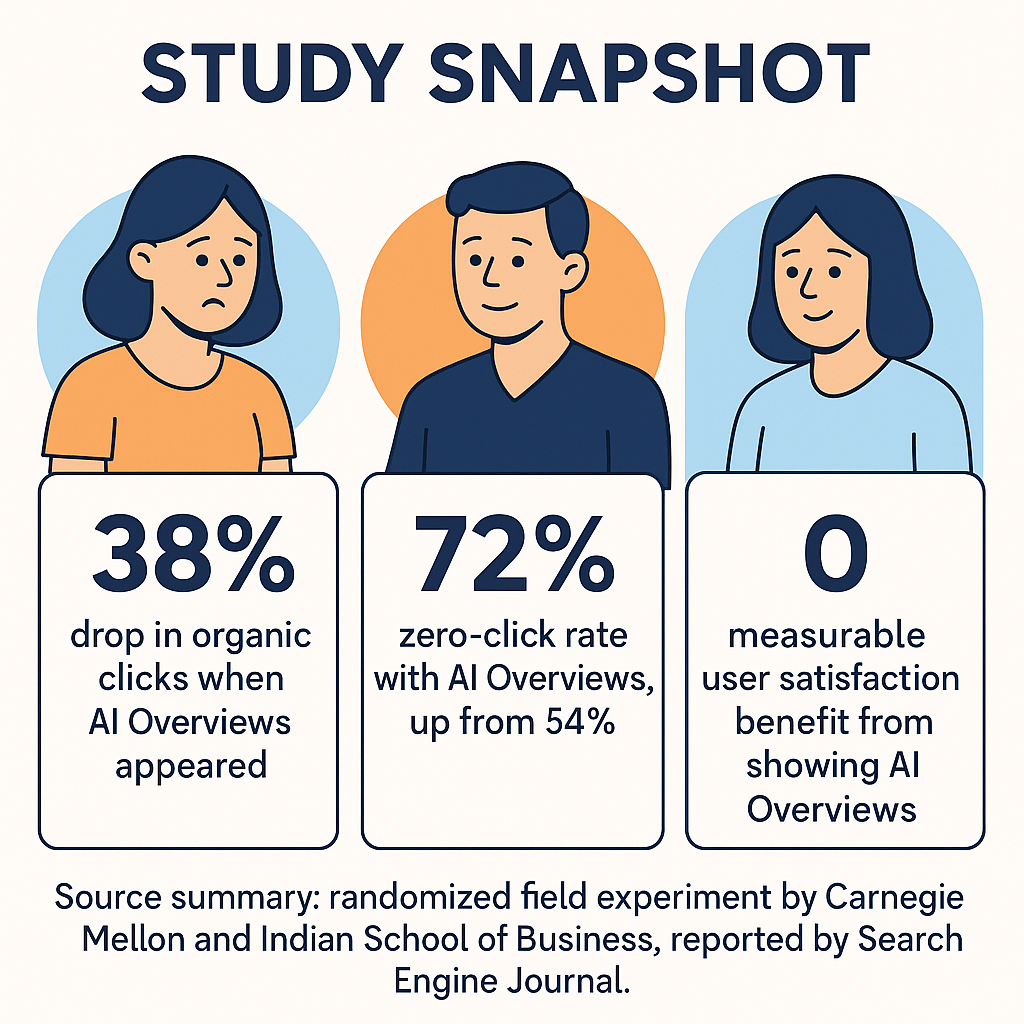
GEO has stopped being a slightly futuristic topic for marketing teams and has become a rather uncomfortable boardroom issue. A new randomised field experiment from Carnegie Mellon and the Indian School of Business, covered by Search Engine Journal, found that Google's AI Overviews reduced organic clicks by 38%. Not rankings. Not impressions. Clicks. The thing most SEO programmes were built to earn in the first place.
The study involved 1,065 US participants and, importantly, it was randomised. Some users saw AI Overviews. Others did not. That matters because most of the debate around AI search so far has been correlation, hand-waving, and a fair amount of corporate reassurance. This is different. It gives us causal evidence that AI Overviews divert traffic away from organic listings.
The headline number is bad enough. Organic clicks fell by 38%. But the quieter number may be worse: zero-click behaviour jumped from 54% to 72% when AI Overviews were present. In plain English, more users got what they needed, or thought they got what they needed, without visiting the sites that supplied much of the underlying information.
And then comes the kicker. Removing AI Overviews had no negative impact on user satisfaction. Users were not less happy. They did not report a worse search experience. That punctures the defence that AI Overviews are simply improving search quality in a way that justifies the collateral damage to publishers, specialist B2B sites, and technical brands.
Source summary: randomised field experiment by Carnegie Mellon and Indian School of Business, reported by Search Engine Journal.
Why this matters for GEO, not just SEO
Traditional SEO assumes that visibility in search results creates a reasonable chance of a click. It was never guaranteed, of course. Featured snippets, knowledge panels, maps, shopping modules and ads have been eroding that assumption for years. But AI Overviews change the shape of the problem because they summarise, repackage and often satisfy the query before a user reaches the open web.
That is where GEO, or generative engine optimisation, becomes more than a fashionable acronym. GEO is about making your expertise visible, citable and retrievable inside AI-mediated discovery systems. It does not replace SEO. I would be wary of anyone claiming that. But it does force a shift in emphasis, especially for companies selling complex technical products where the first search is rarely the final decision.
For high-tech and semiconductor companies, the risk is not only losing traffic on broad informational searches. The bigger risk is losing control of the first explanation. If an AI Overview summarises a topic such as advanced packaging, silicon photonics, quantum error correction, robotics perception systems or biotech automation, your company may be included, ignored, misrepresented or flattened into a generic answer.
That sounds dramatic, perhaps. But technical buyers do not arrive with a blank mind. They form early impressions from search, analyst content, documentation, specifications, comparison pages, standards bodies, GitHub repositories, papers, webinars and, increasingly, AI-generated answers. If those answers absorb your expertise but reduce the click, your reporting may say demand is soft when in reality the discovery layer has changed.
Practical point: GEO is not about tricking AI systems. For serious B2B technology companies, it is about making technical authority legible enough that AI search can understand it, cite it and connect it to commercial demand.
The old defence of AI Overviews is looking thin
Google has broadly asked publishers to trust the process while sharing limited click data on AI Overviews. The recurring argument has been that search is improving, users are happier, and the clicks that remain may be more qualified. Google VP Liz Reid has also argued, in effect, that some apparent losses are less meaningful because certain clicks are bounce clicks or low-value visits.
There is a small grain of truth there. Not every visit is valuable. Anyone who has looked at enterprise SEO data knows that some traffic is accidental, shallow or irrelevant. A student looking for a definition of EUV lithography is not the same as a procurement team evaluating a metrology platform. So yes, raw click volume can be a poor proxy for commercial impact.
But that argument does not rescue AI Overviews from this study's central finding. If users are equally satisfied without AI Overviews, then the click loss is not obviously the price paid for a better experience. It looks more like a transfer of value from the open web to the search interface. The websites still do the work of publishing and maintaining knowledge. The interface captures more of the user journey.
This is especially uncomfortable in technical markets. Semiconductor SEO, high tech marcoms and technical SEO services depend on a healthy relationship between discoverability and depth. A serious buyer often needs more than a summary. They need diagrams, data sheets, process notes, compliance detail, architecture explanations, benchmark caveats and sometimes a route to an engineer or product specialist.
If an AI answer reduces clicks without improving satisfaction, the issue is no longer simply search quality. It becomes a question of who gets to capture the value created by expert content.
Why high-tech companies should pay closer attention than most
Consumer publishers have understandably been the loudest voices in the AI search debate. News, travel, health and recipe sites can see immediate damage when answers are extracted into the results page. But high-tech B2B companies should not assume they are insulated just because their sales cycles are longer and their audiences are more specialised.
In fact, complex markets may be more exposed in a different way. Search is often used to build a mental shortlist before anyone fills out a form. Engineers, researchers, founders, investors and procurement teams all use Google to orient themselves. They compare terminology. They check who seems credible. They look for signs that a vendor actually understands the problem, not just the marketing language around it.
If that early discovery becomes compressed into an AI Overview, your brand needs to be present in the underlying information environment. This is where geo for semiconductor companies, geo for high tech companies, geo for biotech and geo for robotics become practical disciplines rather than abstract strategy slides.
A semiconductor equipment manufacturer, for example, may have excellent product pages but thin educational content around the process challenges those products solve. A robotics company may rank for a few branded terms but lack strong entity signals around autonomy, sensing, safety standards or deployment environments. A biotech platform may have deep scientific credibility but poor technical SEO, making its content hard for search systems to parse and trust.
| Sector | AI search risk | GEO priority |
|---|---|---|
| Semiconductors | Complex concepts summarised without vendor context or technical nuance. | Build authoritative explainers, schema-rich product content and entity clarity around processes, materials and applications. |
| Quantum computing | Over-simplified answers may blur hardware, software and research claims. | Clarify terminology, publish evidence-led content and connect research credibility to commercial use cases. |
| Robotics | Generic AI answers may ignore deployment constraints, safety and integration realities. | Create use-case clusters that explain systems, environments, standards and measurable outcomes. |
| Biotech | Scientific content may be paraphrased without appropriate caveats or attribution. | Strengthen expert authorship, structured evidence and content governance. |
The click is no longer the only signal of success
This is a difficult adjustment for SEO teams, because clicks have been the cleanest thing to report. Rankings fluctuate, impressions can be misleading, but organic sessions and conversions felt solid. Now the search journey is becoming more opaque. A user may see your brand in an AI answer, never click, and later search your name directly. Or they may see your competitor cited and never know you exist.
I do not think this means we should abandon organic traffic reporting. That would be an overreaction. But it does mean enterprise seo consulting needs a broader measurement model, especially in technical industries with long buying cycles. The question is not only 'how many visits did we get?' It is also 'are we present where AI systems form answers?' and 'does our content deserve to be the source?'
There is also a slightly awkward point here. Many high-tech websites are not ready for this shift. Their content is either too thin and sales-led, or so dense that only an internal subject-matter expert can understand it. AI systems, like human buyers, need structure. They need clear definitions, consistent terminology, well-marked evidence, internal linking, strong metadata and pages that answer questions without hiding every useful detail behind a PDF.
- Track organic click decline alongside branded search growth, assisted conversions and direct traffic changes.
- Audit whether key technical topics are explained on crawlable HTML pages, not only inside gated assets or PDFs.
- Map where your company is, and is not, mentioned in AI answers for commercially relevant queries.
- Strengthen entity signals: products, people, patents, standards, locations, partners, applications and research areas.
- Review content for answerability, not just keyword density. A good GEO asset is usually clear, specific and evidence-backed.
What a GEO strategy looks like for semiconductor and high-tech firms
A useful GEO strategy starts with accepting that AI search is not a separate universe. It is built on the same messy web of pages, links, entities, citations, structured data and reputation signals that SEO has always tried to improve. The difference is that generative interfaces reward content that can be extracted and synthesised into an answer.
For semiconductor SEO, that means moving beyond a list of target keywords. You need a topic architecture that mirrors how buyers and engineers investigate problems. Take a company selling inspection technology. The content should not only target product terms. It should explain defect types, process nodes, yield challenges, inspection methods, metrology trade-offs, integration points and where the company's approach fits without sounding like a brochure in every paragraph.
For seo for quantum computing, the challenge is often credibility and specificity. Are you talking about trapped ions, superconducting qubits, photonics, annealing, error correction, cryogenic control systems or quantum software? AI summaries can flatten these distinctions. Your site needs to make them explicit, repeatedly and consistently.
For seo for robotics and seo for biotech, the pattern is similar. The best pages tend to combine technical explanation with commercial relevance. They answer the question a buyer or researcher actually has, then provide enough context to support a next step. This sounds obvious, but many websites still separate 'thought leadership' from 'product' so completely that neither helps the other.
1. Make expertise extractable
Use clear definitions, concise summaries, diagrams with text explanations, FAQs and structured sections that AI systems can interpret.
2. Prove authority
Show named experts, research references, standards involvement, patents, case studies and technical validation where appropriate.
3. Connect topics to demand
Link educational content to applications, product pages, comparison resources and conversion paths without forcing the sale too early.
Do not treat this as an SEO apocalypse
It is tempting to read a 38% organic click reduction and declare the old model dead. I would be careful with that. The study was based on US participants and specific search tasks. Your market, query mix and audience may behave differently. Highly technical buyers may still click more often than casual searchers because they need primary sources, specifications and deeper evidence.
Still, the direction of travel is hard to ignore. Google is placing more answer-like content above organic listings. Users are becoming accustomed to search results that behave less like a directory and more like a conversational assistant. Even if some clicks become more qualified, there is no guarantee the remaining traffic will compensate for what is lost at the top of the funnel.
The sensible response is not panic. It is adaptation. Keep investing in technical SEO services, because crawlability, indexation, site architecture, performance, structured data and internal linking remain foundational. But layer GEO on top, because being findable in ten blue links is no longer the only game. The brands that win will be those whose expertise is both technically accessible and conceptually useful.
One thing I have noticed when reviewing high-tech sites is that the strongest companies often assume their market already understands them. They publish as if the reader is halfway through a sales conversation. AI search punishes that assumption. So do human buyers, frankly. Clear educational content is not dumbing things down. It is making expertise easier to trust.
A practical action plan for the next 90 days
If you are responsible for SEO, marcoms or demand generation in a high-tech company, the next step is not to rewrite your entire website. Start with the queries and topics that matter commercially. Then look at how they appear in AI Overviews, standard organic results and other generative search tools. You will usually find gaps fairly quickly.
- Select 25 to 50 priority non-branded queries across your main technical themes, applications and buyer questions.
- Record whether AI Overviews appear, which sources are cited, which competitors are mentioned and whether your brand is absent.
- Compare those findings with your current rankings, click-through rates and conversion paths in Google Search Console and analytics.
- Identify pages that need clearer explanations, stronger evidence, schema markup, expert review or better internal links.
- Create or improve content clusters around the topics where AI search is most likely to shape early buyer understanding.
- Build a reporting view that combines clicks, impressions, AI visibility observations, branded demand and pipeline influence.
This is not perfect measurement. Some of it is manual. Some of it feels a little unsatisfying compared with the clean dashboards marketers like to present. But waiting for Google to provide complete AI Overview click data is not a strategy. Publishers have been waiting for transparency for a long time, and the incentives are not exactly aligned.
Questions worth asking internally
- Which technical topics must we be associated with in AI-generated answers?
- Where are competitors being cited while we are invisible?
- Which of our best explanations are hidden in PDFs, webinars or gated documents?
- Do our product pages explain problems clearly enough for both humans and machines?
- Can we prove expertise through authorship, evidence and external validation?
Conclusion: GEO is now a defensive and offensive channel
The new AI Overviews study does not answer every question, but it answers one very important one. AI Overviews can cause a substantial drop in organic clicks, and in this experiment users did not prefer the AI Overview experience enough to justify that loss. That makes the old 'better search quality' argument much less convincing.
For high-tech and semiconductor companies, the lesson is not simply that Google is taking more clicks. The lesson is that discovery is being reassembled. Buyers may still search, but the interface between their question and your expertise is changing. If your content is not structured, authoritative and easy to synthesise, you may lose visibility before a prospect ever reaches your site.
GEO is therefore both defensive and offensive. Defensive, because you need to protect your presence in a lower-click search environment. Offensive, because companies that make their expertise clearer and more machine-readable can become the sources AI systems rely on. In technical markets, that may be the difference between being summarised, being cited, or being quietly left out.
The click is not dead. But it is no longer safe to build a strategy that assumes Google will keep sending users to the best source. For semiconductor SEO, high tech marcoms and specialised B2B search, that changes the brief. The job now is to earn visibility in the results page, in the AI answer and, eventually, in the buyer's shortlist.