
AI SEO gone wrong? We'll help you recover and future-proof your site.
If your traffic has vanished after following AI or automated SEO advice, you're not alone. We help UK businesses recover lost visibility and enquiries — with real expertise, not generic fixes.
Understanding the AI SEO trap
Over the past eighteen months we've seen the same story again and again: a business is told that "AI has changed SEO forever", hands over its content and technical decisions to a tool or an outsourced service, and watches rankings quietly erode. Nothing dramatic happens on day one. Then a core update lands, or Google's quality systems catch up with a library of near-identical blog posts, and six months of visibility disappears in a fortnight.
The good news is that this kind of damage is almost always self-inflicted rather than punitive — which means it can be unwound. Broken redirects can be rebuilt. Generic metadata can be rewritten with real positioning. Thin content can be consolidated into pages that actually earn their place. What it takes is diagnosis before action, and someone accountable for the outcome.
AI tools promise quick SEO wins, but generic advice can do more harm than good. If your site's traffic has dropped or enquiries have dried up, you're not alone — and it's fixable.
The automated SEO and AI advice problem
Three forces combine to produce almost every case we're asked to fix: a compelling sales story, a tool with no context, and nobody watching the numbers.
i.
The rise of "AI SEO" and automated promises
General-purpose AI tools and overseas agencies are selling a "new way" of doing SEO: bulk content, instant technical audits, rewritten metadata at the click of a button, all at a price that undercuts strategy work by an order of magnitude.
What's missing is the part that made SEO work in the first place — business context, prioritisation, and someone reviewing the output before it goes live.
ii.
Why generic AI advice fails
A model doesn't know your margins, your best-fit customer, or which of your five services actually pays the bills. It optimises for plausibility, not for your pipeline.
Applied at scale and unsupervised, that produces changes that break site structure, dilute a distinctive brand voice into something interchangeable, and confuse the search engines that had previously understood what each page was for. "Quick fixes" skip the analytics, the technical foundations, and any view of long-term growth.
iii.
It's not your fault
The pitches are convincing, the dashboards look impressive, and the promise of easy results is genuinely tempting when marketing budgets are tight. Sensible people make this decision every week.
Search is complex and it moves constantly. Mistakes here are common, understandable, and — with the right sequence of work — recoverable. We're not interested in who signed off what. We're interested in getting your enquiries back.
Real-world pitfalls we're asked to fix
Five patterns account for the overwhelming majority of AI-SEO damage. Open each one to see why it hurts — and what the fix looks like.
01 Following generic ChatGPT advice +
"AI told us what to do — but it didn't know our business."
Why it's a problem: with no business context the recommendations default to the average of the internet — the same keywords, the same page titles, the same three blog topics your competitors were told to write. Genuine commercial opportunities are missed entirely.
The fix: re-ground the strategy in your actual services, margins and buying cycle, then rebuild the keyword and content map around what converts.
02 Ruined metadata and H1s +
"Meta titles and H1s became bland and generic — we lost our competitive edge."
Why it's a problem: templated titles weaken topical relevance, strip out the differentiators that earned the click, and leave several pages looking interchangeable to search engines deciding which one to rank.
The fix: rewrite titles, descriptions and H1s page by page, with distinct intent and a reason to click on every one.
03 Broken URLs and internal linking +
"We renamed service page URLs, broke internal links, and tried to fix it with messy 301 redirects."
Why it's a problem: redirect chains and loops slow crawling, leak link equity at every hop, and strand users on error pages. Internal links pointing at old URLs quietly stop passing authority to the pages that sell.
The fix: map every legacy URL to a single-hop destination, repoint internal links at the live URL, and retire the chains.
04 Mass-produced, repetitive AI blog posts +
"Ten AI blogs a month — all covering the same three topics, just worded differently."
Why it's a problem: thin, near-duplicate content competes with itself for the same query, trips Google's quality systems, and in the worst cases leads to pages being dropped from the index altogether. Volume without originality is a liability, not an asset.
The fix: consolidate overlapping posts into single authoritative pages, remove what can't be saved, and rebuild depth around questions your buyers actually ask.
05 Neglecting analytics and Search Console +
"No one checked analytics or Search Console for months — we didn't spot the drop until it was too late."
Why it's a problem: every one of the mistakes above announces itself early — in crawl stats, indexing reports, or a slide in impressions weeks before revenue notices. Without monitoring, a fixable dip becomes a lost quarter.
The fix: verify tracking, reconnect Search Console, set alerts on the metrics that matter, and report on them in plain English every month.
Not sure if your site's been affected? Get a free, expert review — no jargon, no blame.
Check my siteHow we help you bounce back
A defined sequence, in the right order. Diagnose first, stabilise the technical foundation, then rebuild content and authority — with measurement switched on from day one.
Not sure if your site's been affected? Get a free, expert review — no jargon, no blame.
Check my site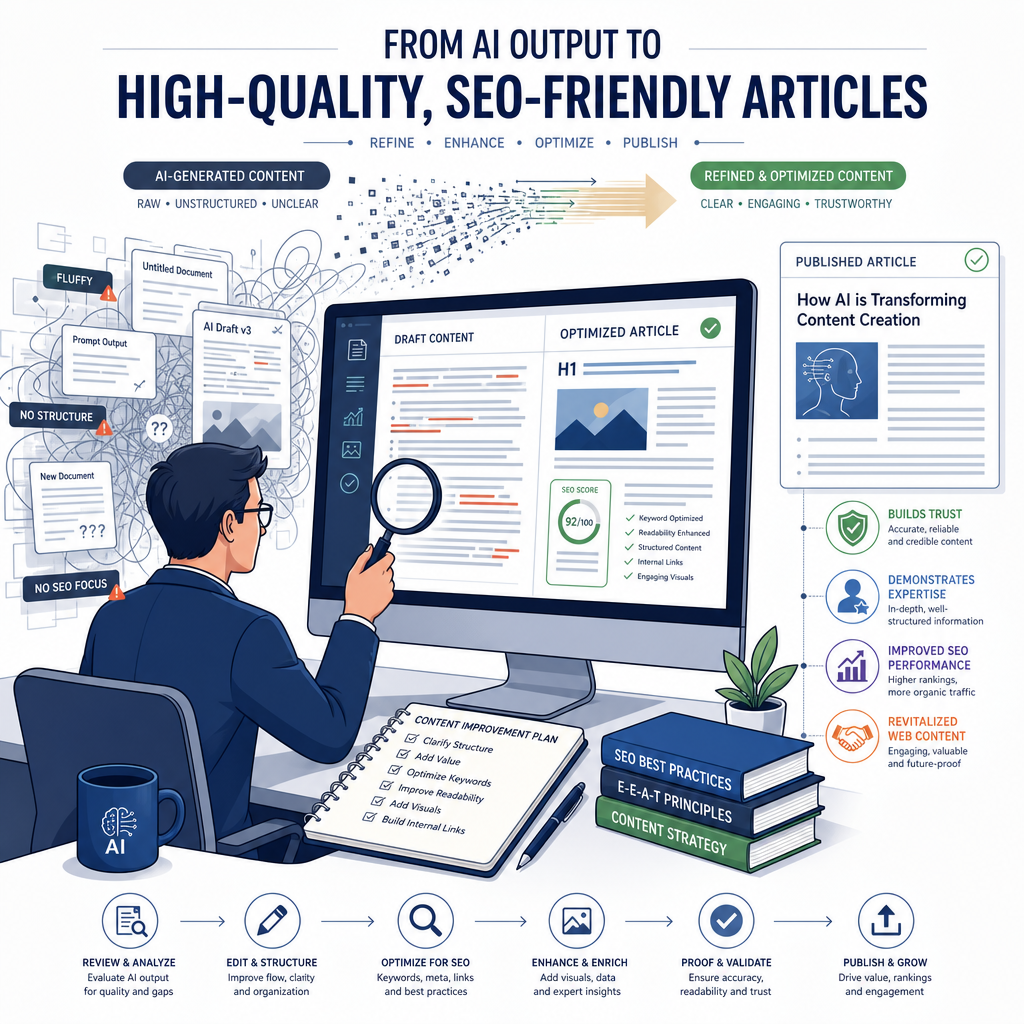
How to Clean Up AI Content for SEO: A Practical Guide for Website Owners
Learn how to clean up AI content for SEO with a practical, step-by-step process that improves quality, restores trust, and protects your rankings.
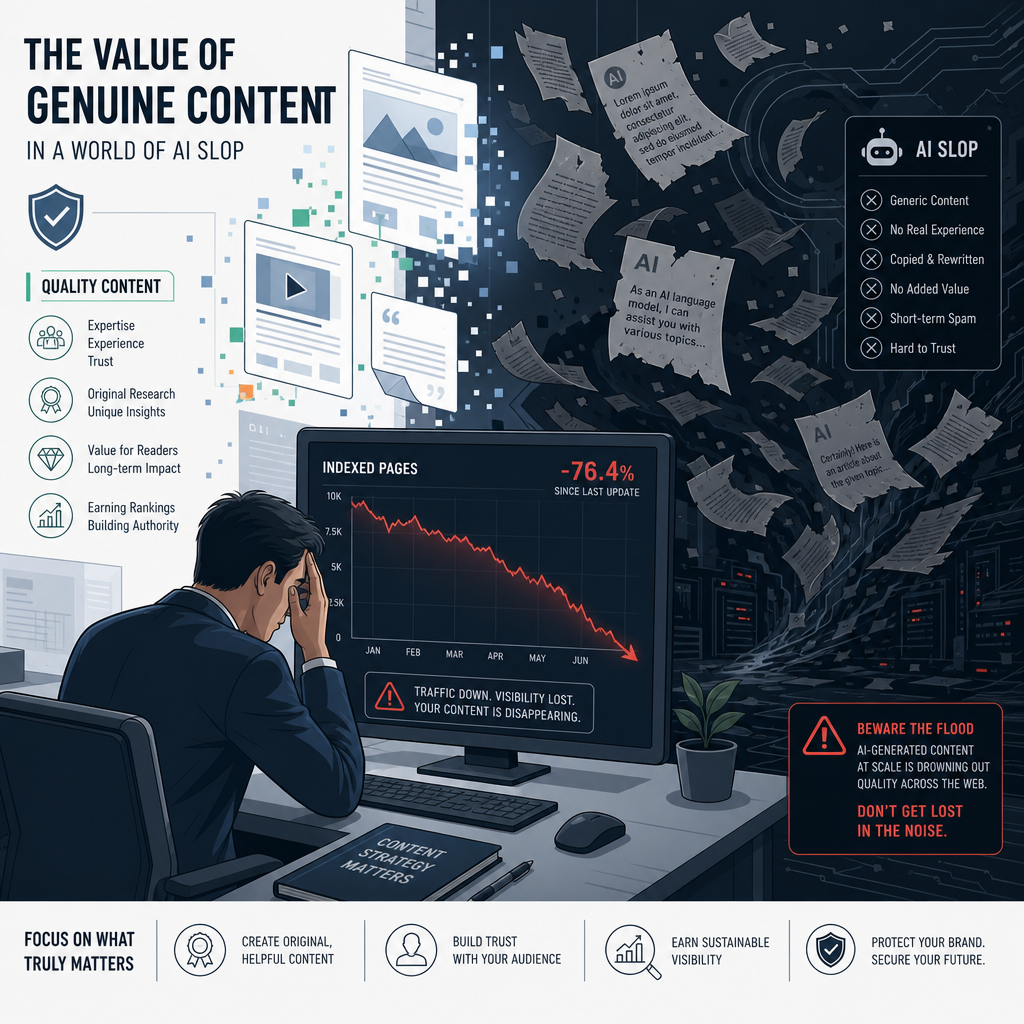
Why Google Deindexes AI Slop and How to Keep Your Pages in the Index
Understand why Google deindexes AI slop, the signals that trigger it, and the practical steps website owners can take to stay indexed and ranking.
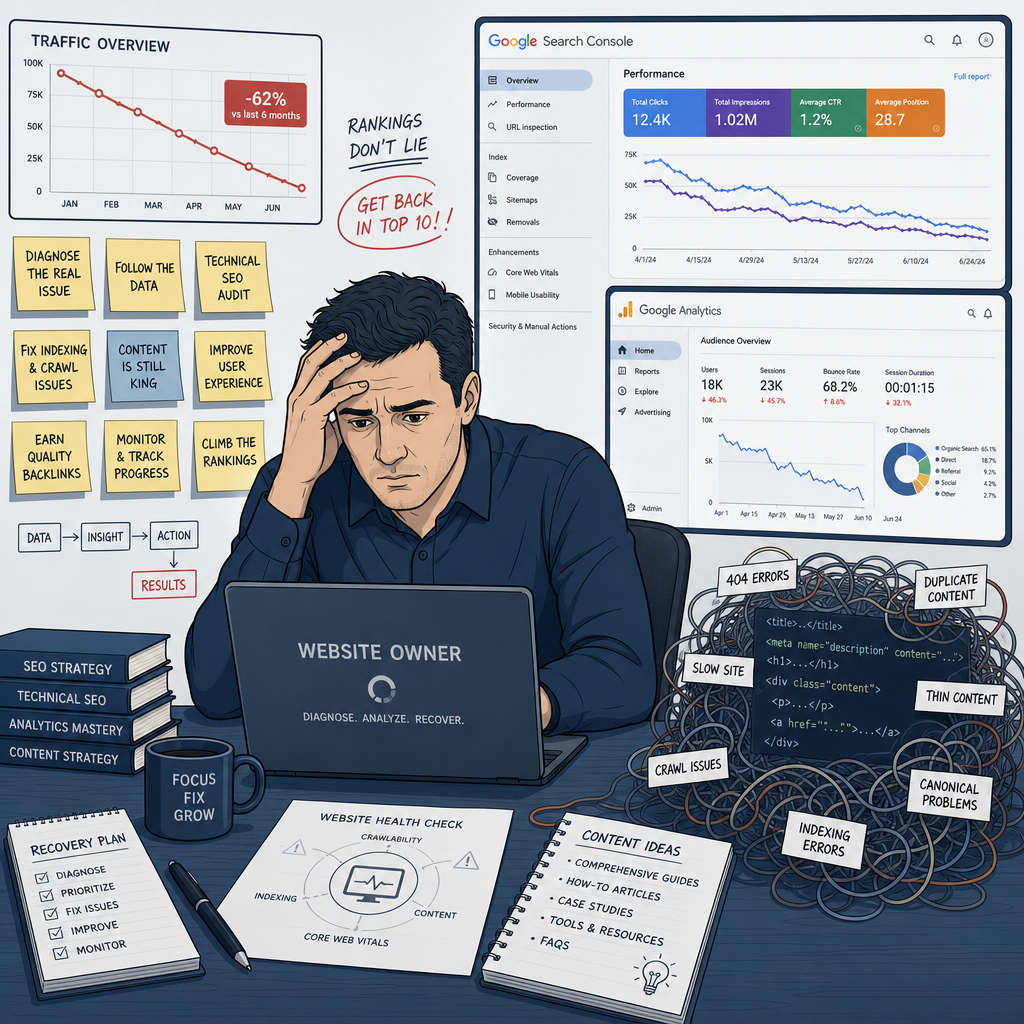
The Complete Process for Cleaning Up a Website That Has Lost Ranking
A clear, step-by-step process for cleaning up a website that lost ranking, from diagnosing the cause to recovering traffic and rebuilding trust.
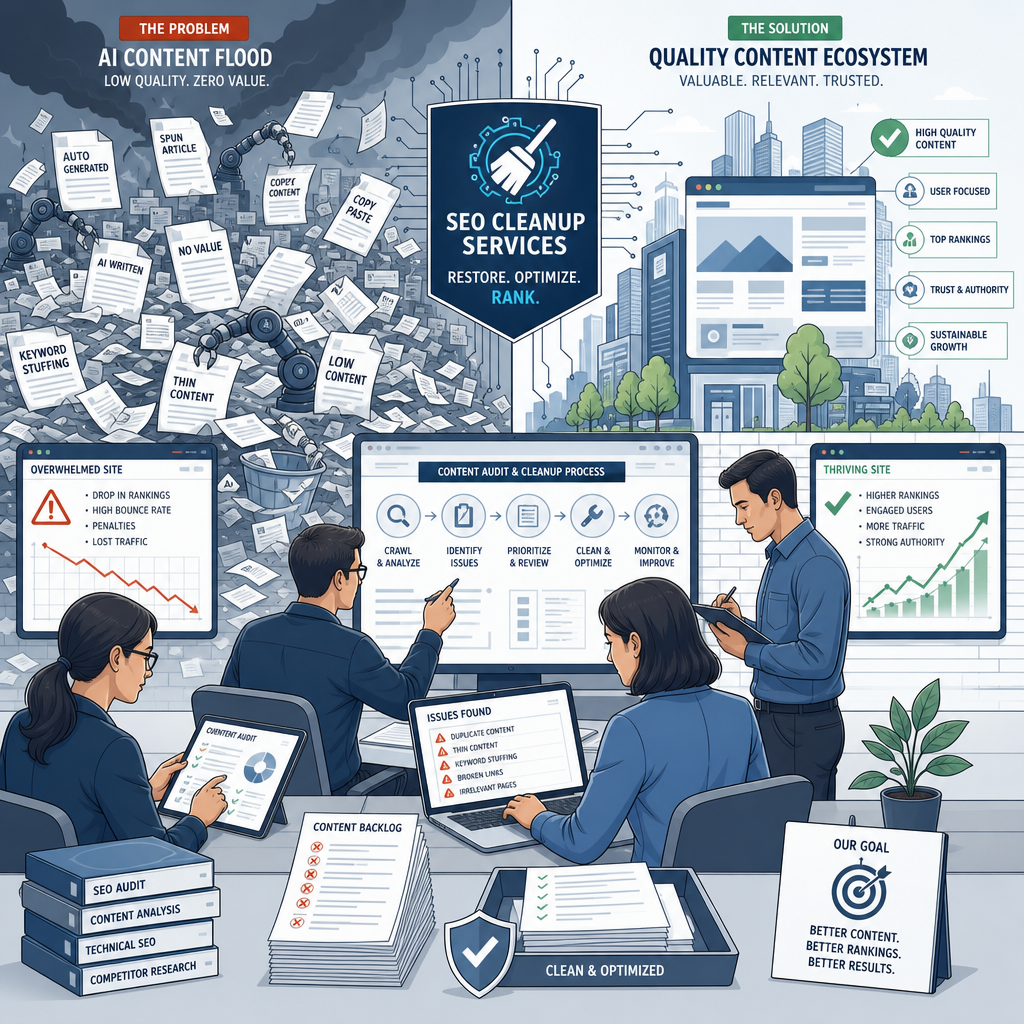
Why the Rise of AI Content Tools Could Be a Major Win for SEO Cleanup Companies
The flood of automated AI content is creating demand for a new service niche. Here is why AI content tools could be a big win for SEO cleanup companies.