
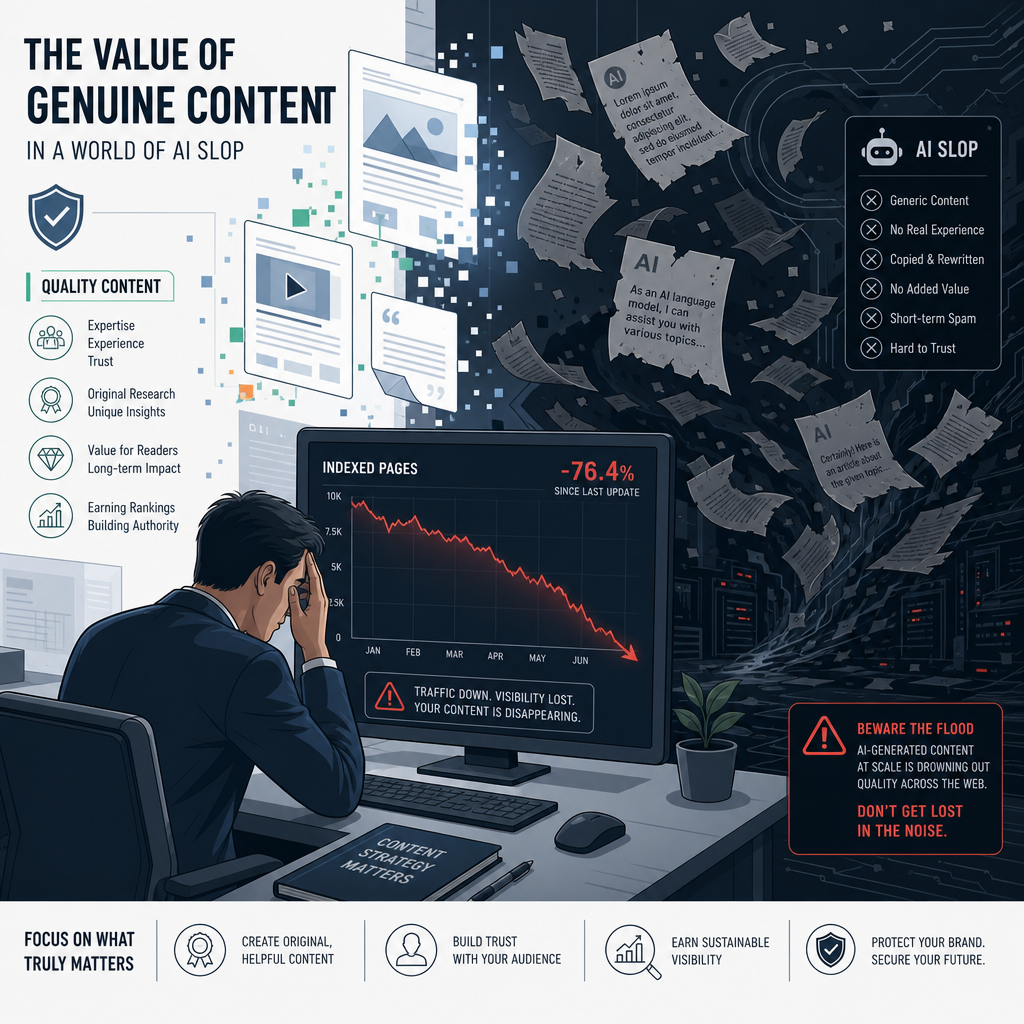
Few things are more alarming for a website owner than watching pages vanish from Google's index. One month a page is ranking and earning clicks, and the next it cannot be found at all, even when you search for its exact title. For a growing number of sites, the common thread behind these disappearances is what people have started calling "AI slop": mass-produced, low-effort content generated with little human oversight.
Google does not deindex pages arbitrarily. When it removes content from the index, it is acting on signals that the content offers little value to searchers. Understanding what those signals are, and why AI slop triggers them so reliably, is the first step toward protecting your site. This article explains the mechanics behind deindexing, the specific characteristics that put pages at risk, and what you can do to keep your content in good standing.
What "Deindexing" Actually Means
Before diving into causes, it helps to be precise about terms. Indexing is the process by which Google stores a page in its searchable database. A page that is indexed is eligible to appear in search results. Deindexing is the reverse: Google removes the page from that database, so it can no longer surface for any query.
Deindexing is different from a ranking drop. A page that has merely fallen in the rankings still exists in the index; it just appears lower or on a later results page. A deindexed page is gone entirely. You can confirm the difference by searching for a unique phrase from the page or by checking the URL directly in Google Search Console, which will report whether the page is indexed and why.
Important distinction A ranking drop means your page still exists but performs worse. Deindexing means the page has been removed from Google entirely. The fixes for each are different, so confirm which one you are dealing with before acting.Why AI Slop Gets Deindexed
Google has repeatedly stated that it does not penalize content simply for being generated by AI. What it targets is content produced primarily to manipulate rankings rather than to help people. AI slop tends to check nearly every box on Google's list of low-value signals, which is why it is so vulnerable.
The core problem is scale without substance. When a site publishes hundreds of pages quickly, each covering a keyword with generic, interchangeable text, Google's systems recognize the pattern. These pages rarely offer original information, first-hand experience, or a reason to exist beyond capturing search traffic. Over time, the algorithm and its quality systems reduce that content's visibility, and in the most severe cases remove it from the index altogether.
Several specific characteristics repeatedly push AI content toward deindexing.
- **Thin value:** the page technically answers a query but adds nothing a dozen other pages do not already say.
- **Mass production:** large numbers of similar pages published in a short window, signaling automation over care.
- **Factual unreliability:** invented statistics, fabricated citations, and confidently stated errors that erode trust.
- **Duplication and near-duplication:** pages that overlap heavily with each other or with content elsewhere on the web.
- **No demonstrated expertise:** no author credibility, no experience, and no evidence the writer actually understands the topic.
The Systems Behind the Decision
Google does not rely on a single switch to remove content. Several overlapping systems evaluate quality, and AI slop tends to run afoul of more than one at once.
The helpful content system assesses whether a page appears to be written for people or primarily for search engines. Sites with a large proportion of unhelpful content can see their overall performance suppressed, not just individual pages. Core ranking updates periodically reassess the relative quality of pages across the web, and low-value content loses ground with each pass. On top of these automated systems, spam policies address content produced at scale to game rankings, which can lead directly to removal.
The important takeaway is that these systems increasingly evaluate your site as a whole. A cluster of slop can lower the perceived quality of your entire domain, dragging down even the pages that would otherwise perform well on their own. This is why some site owners are baffled when their genuinely useful articles lose visibility at the same time as their weak ones. The strong pages were never the problem, but they share a domain with hundreds of pages that are, and the reputation of the whole is what suffers.
It also helps to understand that these evaluations happen continuously rather than as a single dramatic event. Google recrawls and reassesses content on an ongoing basis, and its major systems refresh periodically. A site can drift downward gradually as more low-value pages accumulate, then lose a large chunk of visibility all at once when a core update reprocesses the domain. Because the decline can be both slow and sudden, owners often struggle to connect the loss to its true cause, which is the sheer weight of unhelpful content they published.
Publishing low-value content is not a neutral act. Each weak page you add can lower the trust Google extends to your strongest pages.
How to Tell If Your Pages Are at Risk
You do not have to wait for pages to disappear before acting. Several warning signs indicate that your content may be drifting into slop territory and heading toward deindexing.
My indexed page count is dropping steadily A gradual decline in indexed pages, visible in Google Search Console, often means Google is quietly dropping content it considers low value. Review which URLs are affected and look for common quality patterns. Pages show "Crawled - currently not indexed" This status means Google saw the page but chose not to index it, frequently because it judged the content insufficiently valuable. A large number of these is a strong warning sign. Traffic fell sharply after a core update If a broad, site-wide decline lines up with a documented Google update, it usually points to a quality assessment rather than a technical problem. AI-heavy sites are frequently affected.What to Do If Your Content Has Been Deindexed
If pages have already been removed, the path back is real but requires genuine effort. There is no quick technical trick, because the root cause is quality rather than a broken tag or setting.
- **Confirm the cause.** Use the URL Inspection tool in Google Search Console to verify each page's index status and check for any manual actions in the Security & Manual Actions report.
- **Rule out technical issues.** Make sure the pages are not accidentally blocked by robots directives, noindex tags, or canonical errors, since these can mimic quality-based deindexing.
- **Assess the content honestly.** Ask whether each page genuinely helps a reader more than existing alternatives. If not, it needs to change or go.
- **Improve or remove.** Rewrite worthwhile pages with real expertise, verified facts, and original value. Delete or redirect pages that cannot be salvaged.
- **Request reprocessing.** Once improved, submit the pages for reindexing and give Google time to recrawl and reassess the site as a whole.
How to Keep Your Pages Indexed Going Forward
Prevention is far easier than recovery. The sites that stay comfortably in the index share a common approach: they treat publishing as a deliberate act rather than an automated one. Every page has a clear reason to exist, offers something competitors do not, and has passed through human review before going live.
Using AI to draft or research content is entirely compatible with this approach. The difference lies in what happens after the draft. Fact-check every claim, inject real experience and examples, cut anything that does not serve the reader, and publish at a pace that reflects quality control rather than raw output. A smaller library of strong pages will nearly always outperform a sprawling one filled with slop.
It also pays to think about the signals that surround your content rather than just the words on the page. Give your articles named authors with real credentials, and make it easy for readers to understand who wrote a piece and why they are qualified to. Link your content together logically so that related pages support one another and demonstrate genuine topical depth. Keep information current by revisiting older articles and updating facts, figures, and examples as they age. These practices signal to both readers and search engines that a real, accountable organization stands behind the content, which is precisely the opposite impression that anonymous, mass-produced slop conveys.
Finally, be honest with yourself about volume. If you cannot properly review and stand behind everything you publish, you are publishing too much. The sites that get deindexed are almost always the ones that prioritized output over oversight. Slowing down to a pace you can actually manage is not a limitation; it is the single most reliable protection against ever seeing your pages disappear from search results.
Conclusion
Google deindexes AI slop because that content fails the fundamental test the search engine applies to everything: does this help a real person? Mass-produced, generic, unverified pages do not, and Google's quality systems are increasingly effective at recognizing them. The solution is not to abandon AI but to abandon the low-effort habits that turn AI into a slop machine. Audit what you have, hold new content to a real standard, and prioritize genuine usefulness over volume. Do that consistently, and your pages will not just stay indexed; they will earn the trust that keeps them ranking.