
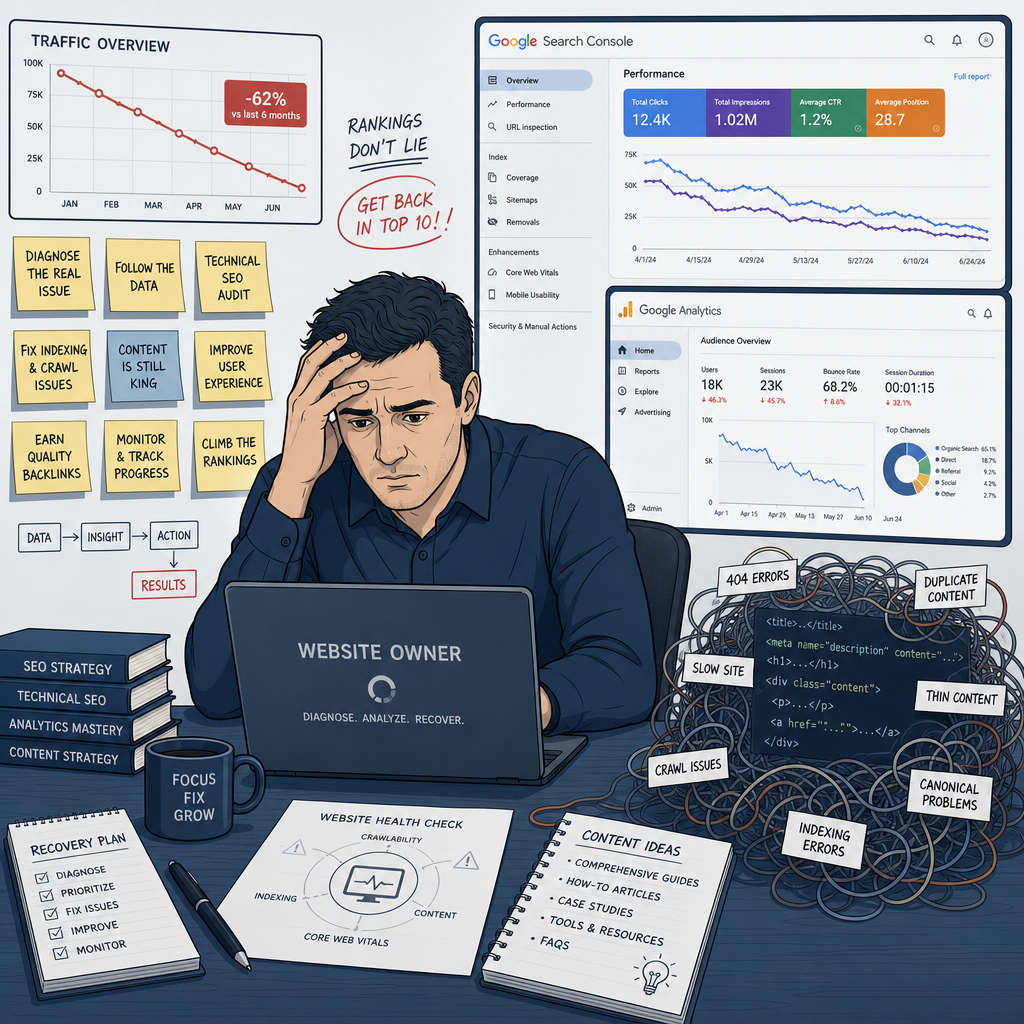
Watching your organic traffic slide is one of the most stressful experiences a website owner can face. Rankings that took months or years to build can slip in a matter of weeks, and the instinct is often to start changing things at random in the hope that something works. That instinct is understandable, but it usually makes recovery slower. A ranking loss is a symptom, and the only reliable way to reverse it is to diagnose the underlying cause before you touch anything.
This article lays out a complete, orderly process for cleaning up a website that has lost ranking. It moves from diagnosis to action to measurement, so instead of guessing you work through the possibilities systematically. Whether your decline came from a Google update, a technical problem, a wave of low-quality content, or lost backlinks, the framework below will help you find the cause and fix it methodically.
Step One: Confirm and Quantify the Loss
Before you diagnose anything, establish exactly what happened. A vague sense that traffic is "down" is not enough to guide a cleanup. You need dates, magnitudes, and the specific pages or keywords affected.
Open Google Search Console and Google Analytics and compare a recent period against a healthy baseline. Identify the precise date the decline began, because that date is your single most valuable clue. A sharp drop on a specific day points to something discrete, such as an algorithm update or a technical change you made. A slow, grinding decline over months usually indicates a gradual quality or competitiveness problem.
Note whether the loss is site-wide or concentrated in a section. A decline affecting one directory of pages tells a very different story than one spread evenly across the whole domain.
Start with the date Pinpoint the day your traffic began to fall, then check it against known Google update timelines and your own change log. Matching the drop to an event narrows the list of possible causes dramatically.Step Two: Diagnose the Cause
Most ranking losses trace back to one of a handful of causes. Working through them in order prevents you from fixing the wrong problem. Consider each of the common culprits and gather evidence for or against it.
Algorithm update A broad drop aligning with a documented Google update usually points to a quality reassessment. Technical issue Accidental noindex tags, blocked crawling, broken redirects, or slow servers can strip rankings quickly. Content quality Thin, outdated, or duplicated content, often from bulk AI publishing, drags down the whole site. Lost backlinks Losing authoritative links, or gaining spammy ones, can weaken the signals behind your rankings. Competitor gains Sometimes you did not decline; a competitor simply published something better and overtook you. Manual action A penalty for policy violations appears in Search Console and requires a specific remedy.Check for a manual action first, since it is unambiguous and appears directly in the Security & Manual Actions report in Search Console. Then rule out technical problems, because they are often the fastest to fix. Only after those are cleared should you focus on content quality and links, which are the most common causes of gradual decline.
A useful habit during diagnosis is to keep a written record of everything you find. Note the date of the drop, the pages and keywords affected, the results of each technical check, and any hypothesis you form along the way. This record does two things. It stops you from chasing the same dead ends repeatedly, and it gives you a baseline to measure against once you start making changes. Recovery work often stretches across weeks, and without notes it becomes almost impossible to remember what you have already ruled out or to tell whether a given fix actually moved the needle.
It also helps to resist the most tempting mistake in this phase, which is assuming you already know the cause. Owners frequently blame a recent Google update when the real culprit was a technical change made the same week, or blame their content when a lost backlink was responsible. Treat every possible cause as a hypothesis to be tested against evidence rather than a conclusion to defend. The discipline of gathering proof before acting is what separates a fast, targeted recovery from months of expensive guesswork.
Step Three: Fix Technical Foundations
If your diagnosis points to a technical cause, address it before anything else, because no amount of content work will help if search engines cannot properly crawl and index your site.
Verify that your important pages return a 200 status and are not accidentally carrying a noindex directive. Check your robots.txt file to confirm you are not blocking sections you meant to keep open. Test your redirects to make sure none form loops or chains that waste crawl budget. Review your site speed and core performance, since a sudden slowdown can hurt both rankings and user experience. Finally, confirm your canonical tags point where you intend, because a misconfigured canonical can quietly remove pages from competition.
Technical problems are the easiest to overlook and often the fastest to fix. Rule them out early so you do not spend weeks rewriting content when a single stray tag was the real issue.
Step Four: Clean Up Content Quality
When content quality is the culprit, which is increasingly common for sites that published large volumes of AI-generated pages, the cleanup mirrors a full content audit. Inventory every page with its traffic, rankings, and engagement, then decide the fate of each.
- **Keep** the pages that still perform and serve readers well.
- **Improve** pages with potential by adding accuracy, depth, and genuine first-hand expertise.
- **Consolidate** overlapping pages into single authoritative resources, redirecting the retired URLs.
- **Remove or redirect** thin, duplicated, or outdated pages that earn no traffic and cannot be saved.
The guiding principle is that raising your average content quality lifts the whole site. Search engines increasingly judge domains holistically, so trimming the weak pages and strengthening the strong ones sends a clearer, more trustworthy signal.
Should I delete or improve low-performing pages? Improve pages that have a real chance of helping readers and earning traffic. Delete or redirect pages that are duplicative, outdated, or have shown no traffic over a long period and offer no path to usefulness. How long until rankings recover? Recovery is rarely instant. Technical fixes can show results within days, but content and quality improvements usually take several weeks to a few months, and quality-related recoveries often align with subsequent Google updates. Can I recover from a Google update? Yes. Sites hit by quality-focused updates recover by genuinely improving the issues the update targeted. There is no shortcut, but sustained quality work does restore lost visibility over time.Step Five: Address Backlinks and Authority
If your investigation points to links, handle them carefully. Losing a few high-authority backlinks can measurably weaken pages that depended on them, so identify what you lost using a backlink analysis tool and consider whether any of those links can be reclaimed through outreach.
The opposite problem is a sudden influx of spammy or manipulative links, whether from a past bad campaign or a negative pattern. In genuine cases of harmful links you cannot remove, Google's disavow tool exists as a last resort, but use it sparingly and only when you are confident the links are damaging, since misuse can hurt more than help.
For most sites, though, the healthiest long-term response to a links problem is not defensive but constructive. Rather than obsessing over links you lost, focus on earning new ones by publishing genuinely link-worthy resources, original research, or useful tools that other sites want to reference. Authority built this way is far more durable than authority acquired through shortcuts, and it tends to lift your rankings across many pages at once rather than propping up a single one. Treat backlink recovery as a prompt to strengthen your overall reputation rather than a scramble to replace individual links.
Step Six: Monitor, Measure, and Be Patient
Once your cleanup is underway, the hardest part is often waiting. Resist the temptation to keep changing things while you wait for results, because constant changes make it impossible to know what actually worked.
Set up a simple monitoring routine and track it over the following weeks and months.
- Watch impressions and clicks for your priority pages in Search Console.
- Track average position for the keywords that matter most to your business.
- Monitor your indexed page count as removed pages drop out and improved pages stabilize.
- Note engagement metrics such as time on page and conversions for the pages you rewrote.
Give the site at least four to eight weeks to reflect meaningful change, and longer for quality-driven recoveries that depend on Google reassessing your domain. Steady, patient measurement will tell you whether your diagnosis was correct far more reliably than reacting to daily fluctuations.
Conclusion
Cleaning up a website that has lost ranking is a process of disciplined diagnosis followed by targeted repair. Confirm and quantify the loss, identify the true cause rather than guessing, fix technical foundations first, raise your content quality, tend to your backlink profile, and then measure with patience. Ranking losses feel like emergencies, but they respond to methodical work rather than panic. Follow the process, fix the root cause instead of the symptoms, and you give your site the strongest possible chance of recovering the visibility it lost, and holding it for the long term.