
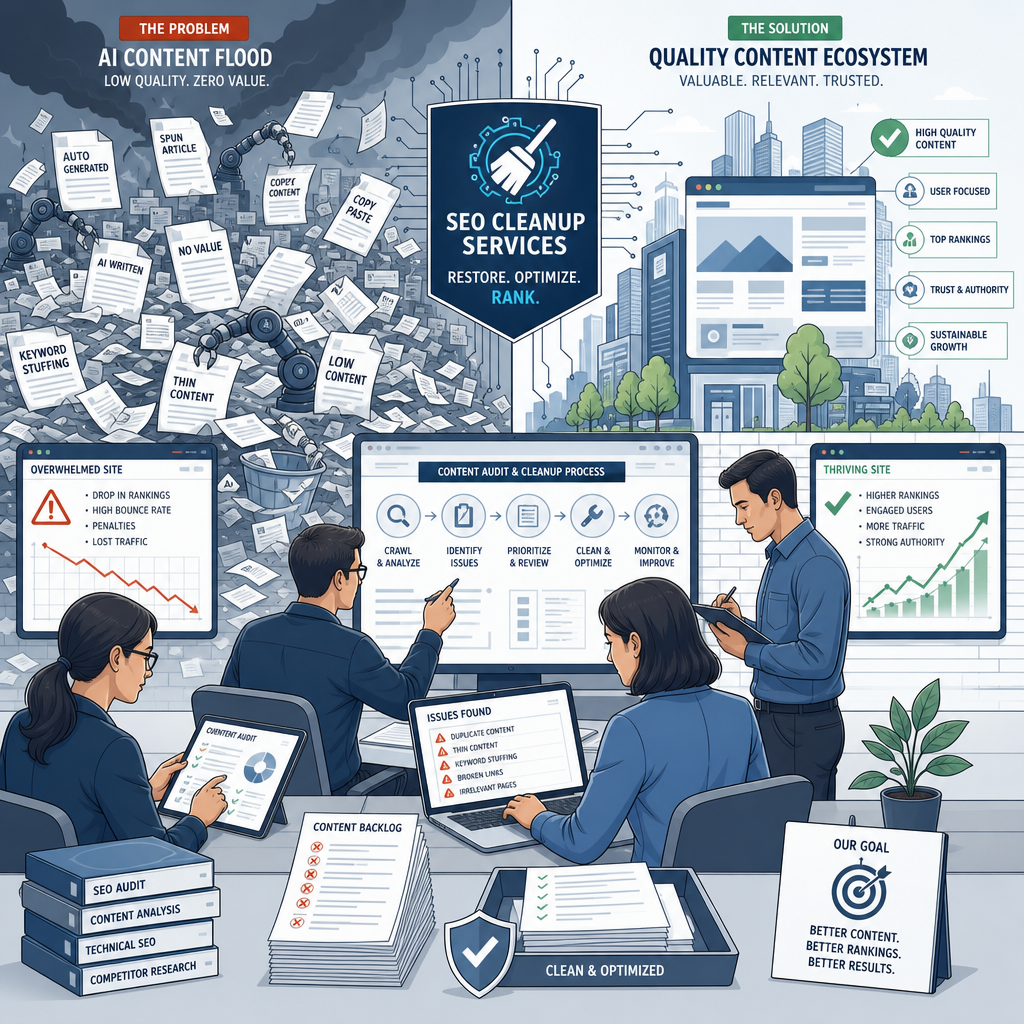
Every technology wave creates two kinds of businesses: those that ride the wave and those that clean up after it. The explosion of AI content tools has produced an enormous wave of automated writing, and websites everywhere are now drowning in the consequences. For agencies, consultants, and service providers who specialize in fixing broken content libraries, this moment represents an unusual and durable opportunity. The very tools that made it trivial to publish thousands of pages have created a growing market for the expertise required to undo the damage.
This article explores why the mass adoption of AI content generation is quietly building a strong demand pipeline for SEO cleanup companies. It looks at the mechanics of the problem, the specific services that are now in demand, and how providers can position themselves to capture a market that is likely to expand for years. For website owners, the same analysis doubles as a warning about the mess that unmanaged automation tends to leave behind.
The Wave That Created the Mess
AI writing tools removed nearly every barrier to publishing at scale. What once required a team of writers, editors, and weeks of effort could suddenly be produced by one person in an afternoon. Predictably, a great many site owners chased volume, filling their domains with hundreds or thousands of automatically generated articles in pursuit of search traffic.
For a while, some of this content ranked. Then search engines caught up. Quality-focused updates and improved detection of low-value content meant that the mass-produced pages began to underperform, get deindexed, or drag down the sites that hosted them. Owners who celebrated their content output now face declining traffic and no clear idea how to reverse it. That gap between the problem and the owner's ability to solve it is exactly where cleanup companies thrive.
The core dynamic Cheap, fast content creation generates expensive, slow content problems. The tools scale the mess faster than owners can manage it, and that imbalance is what fuels demand for professional cleanup.Why Demand Is Structural, Not a Passing Trend
Some opportunities are fads. This one has structural drivers that suggest it will last. The number of AI-generated pages on the web continues to climb, and the tools keep getting easier to use, which means the supply of low-quality content is not slowing down. At the same time, search engines keep raising their standards, so the gap between what gets published and what actually ranks widens rather than closes.
Several forces reinforce one another to sustain the market.
- **Volume keeps growing:** AI tools make it easier every year for more people to publish more pages.
- **Standards keep rising:** search engines continue refining how they identify and suppress low-value content.
- **Owners lack the skills:** most site owners can generate content but cannot diagnose or fix a quality-driven decline.
- **The stakes are real:** lost organic traffic directly costs revenue, so owners are motivated to pay for a fix.
The Services Cleanup Companies Can Offer
The opportunity is not a single product but a family of related services, many of which lend themselves to recurring engagements rather than one-off projects. A cleanup company can build an offering that meets clients wherever their mess happens to sit.
The foundational service is the content audit, in which every page is inventoried and evaluated against performance data and quality standards. From there, providers can offer consolidation projects that merge overlapping pages, rewrite services that inject accuracy and expertise into salvageable content, and pruning services that safely remove or redirect dead weight. Technical cleanup rounds out the picture, resolving the indexing, crawling, and redirect issues that often accompany bloated sites.
Because the underlying problem regenerates whenever a client resumes careless publishing, the most valuable offering may be ongoing governance: a retainer in which the company sets publishing standards, reviews new content, and keeps the site healthy over time.
There is also room for productized versions of these services that lower the barrier to entry for smaller clients. A fixed-price content audit with a clear deliverable, for example, gives a hesitant owner an affordable first step and often opens the door to a larger engagement once they see the scope of their problem laid out clearly. Similarly, a standardized pruning package with defined limits lets a provider serve many clients efficiently without custom scoping every project. The combination of high-touch strategic work for large clients and productized services for smaller ones lets a cleanup company address the full breadth of a market that ranges from solo bloggers to enterprise publishers.
The one-time cleanup earns a fee. The ongoing prevention of the next mess earns a relationship. Cleanup companies that sell governance turn a project into a recurring revenue stream.
Turning AI Into an Asset for the Cleanup Itself
There is a satisfying irony at the heart of this opportunity. The same AI tools that create the problem can dramatically accelerate the cleanup when used by skilled hands. A cleanup company that embraces AI as a productivity multiplier can serve more clients, faster, at healthier margins.
AI is excellent at the tedious, high-volume parts of a cleanup that would otherwise consume hours of human time. Providers can use it to classify large content libraries, flag likely duplicates, draft first-pass rewrites for human editors to refine, and summarize performance data into actionable priorities. The human expert still makes the judgment calls, verifies facts, and supplies the strategic direction, but the grunt work moves far faster.
This combination is what separates a scalable cleanup business from a bottlenecked one. The market opportunity is large, and the companies that can process volume without sacrificing quality will capture the most of it.
Isn't this a short-term opportunity that fades as AI improves? Unlikely. Better AI lowers the barrier to publishing even further, which increases the volume of content that needs oversight. The bottleneck has shifted from creation to quality control, and that bottleneck is where cleanup work lives. What kind of clients need cleanup services most? Publishers, affiliate sites, ecommerce catalogs, and any business that scaled content quickly with AI and then saw traffic decline. Sites hit by quality-focused search updates are especially motivated buyers. How should a cleanup company price these services? A common model combines a fixed-fee initial audit and cleanup project with a monthly retainer for ongoing content governance, aligning revenue with the recurring nature of the underlying problem.How Providers Can Position Themselves
Capturing this market takes more than technical skill; it takes positioning that speaks to the owner's pain. The clients most in need are often confused and anxious, aware that something is wrong but unable to name it. A cleanup company wins by making the problem legible and the path forward concrete.
- **Lead with diagnosis.** Offer a clear, affordable audit that shows owners exactly what is wrong and why, turning a vague fear into a defined project.
- **Quantify the stakes.** Translate the problem into lost traffic and revenue so the value of fixing it is obvious.
- **Show a repeatable process.** Owners trust providers who follow a visible, methodical framework rather than promising vague improvements.
- **Sell prevention, not just repair.** Package ongoing governance so clients avoid recreating the mess and you build recurring revenue.
- **Prove results with data.** Report on indexed pages, impressions, and rankings before and after, so improvements are measurable and defensible.
A Word of Caution for Website Owners
If you own a site and recognize yourself in this description, the lesson is not to fear AI but to respect the discipline it requires. The businesses now profiting from cleanup exist because so many owners treated content generation as a volume game with no quality control. You can avoid becoming a cleanup client by holding new content to a genuine standard, editing and fact-checking everything before it publishes, and pruning weak pages before they accumulate into a liability. Prevention is nearly always cheaper than the cure.
The economics make this especially clear. Generating a page with AI might cost pennies, but the eventual cleanup of a bloated, deindexed site can cost thousands in professional fees plus months of lost traffic and revenue while the recovery takes hold. Weighed against that, the modest discipline of reviewing content before it goes live is one of the best investments a site owner can make. The owners who internalize this lesson early will never need a cleanup company at all, and that is precisely the outcome a responsible provider should be honest enough to recommend.
Conclusion
The rise of AI content tools has created a paradox that favors those who fix problems rather than those who merely produce output. As the volume of low-quality automated content keeps climbing and search engines keep raising their standards, the demand for skilled cleanup will grow with it. SEO cleanup companies that build repeatable processes, embrace AI to work at scale, and sell ongoing governance rather than one-time repairs are positioned to capture a durable and expanding market. The wave of AI content is not slowing down, and neither, it turns out, is the need to clean up after it.