
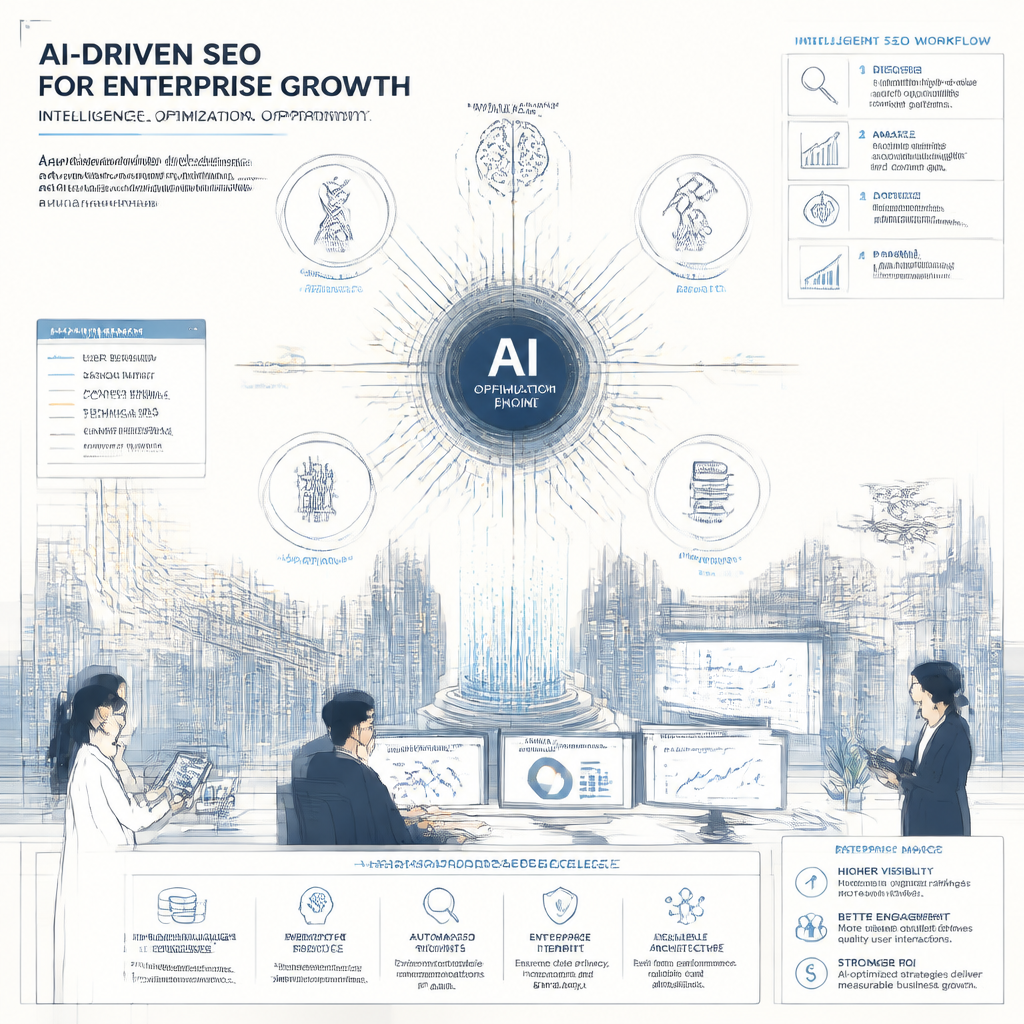
AI SEO for enterprises has moved from an interesting experiment to a serious part of digital marketing planning. For high-tech and semiconductor companies, the question is rarely whether artificial intelligence will affect search. It already has. The harder question concerns value: will AI-assisted search optimisation bring qualified opportunities, or will it create another expensive layer of content and reporting?
What does AI SEO for enterprises involve?
AI SEO for enterprises combines established search optimisation with machine learning tools, large language models and automated analysis. The work can include finding search demand, grouping related topics, reviewing competitors, improving internal links, identifying technical problems and monitoring how brand information appears in AI-generated answers.
That last area has become increasingly important. People now search through traditional results, AI summaries, industry platforms, research databases and conversational tools. A buyer might ask an AI system which companies supply a particular sensor, photonics component or chip design service. The answer draws on many sources, including company pages, technical documents, third-party publications and structured data.
Enterprise SEO consulting therefore needs a wider view of search. It has to cover the website, the information architecture and the company’s broader digital footprint. In high-tech marcoms, this often means working with product marketing, engineering, sales and regulatory teams. The material already exists in many organisations. It may sit in presentations, application notes, white papers, product databases or old PDFs. Turning that knowledge into accessible web content takes judgement.
A useful way to view the investment
AI can reduce the time spent on research and routine analysis. Experienced people still decide what deserves attention, which claims are accurate, and how technical information should be presented to a buyer.
Where enterprise AI SEO can create value
Large organisations often have a visibility problem caused by scale. Hundreds or thousands of pages may cover products, locations, applications and industries. Some pages overlap. Others are difficult for search engines to interpret. A small technical issue can affect an important section of the site for months, especially when ownership sits across several teams.
AI tools can review large datasets quickly and help surface patterns that would take a person much longer to find. They can flag pages with thin information, suggest related questions, map content to stages of a buying journey and spot gaps between a product catalogue and the language used by customers.
- Technical audits across large websites, including crawl issues, broken links, indexing signals and page templates.
- Topic research for specialist markets such as quantum computing, robotics, biotech and advanced materials.
- Content briefs that bring together search intent, technical terminology, customer questions and competitor coverage.
- Internal linking recommendations across products, applications, industries and technical resources.
- Monitoring of brand mentions and product references within AI search results and generated answers.
- Reporting that connects organic visibility with enquiries, downloads, distributor activity and pipeline influence.
This can make technical SEO services more productive. A specialist can spend less time sorting spreadsheets and more time deciding whether a page needs a rewrite, a new supporting resource or a conversation with the product team. That distinction matters. Automation finds possibilities. It does not understand every commercial detail.
Why specialist sectors need a careful approach
Generic SEO advice often struggles with high-tech subjects because the search journey is technical, slow and spread across several people. One visitor may be researching a component. Another may be comparing suppliers for a future programme. A third may be looking for proof that a manufacturer can meet reliability, packaging or compliance requirements.
A page that ranks for a broad term may still attract little commercial value. Semiconductor SEO, for example, has to account for precise terms around fabrication, design services, materials, equipment and supply chains. Search demand can be modest for a highly valuable phrase. A keyword tool may treat that phrase as insignificant, while an engineer or procurement lead treats it as a direct route to a supplier.
SEO for robotics brings another set of questions. Buyers may search by application, environment, payload, integration requirement or safety standard. SEO for biotech often involves careful handling of scientific claims, evidence and regulatory language. AI can help organise these themes, though subject matter review remains central.
| Sector | Useful SEO focus | Review needed |
|---|---|---|
| Semiconductors | Applications, capabilities, process and supply terms | Engineering accuracy and product claims |
| Robotics | Use cases, integration needs and technical specifications | Safety, performance and deployment detail |
| Biotech | Research areas, services and evidence-led resources | Scientific and regulatory wording |
How GEO fits into the enterprise picture
Generative engine optimisation, or GEO, focuses on how a company is represented in AI-generated search experiences. The work includes making important information easy to find, verify and connect. Clear product pages help. So do author information, technical references, consistent company details, well-structured data and useful third-party coverage.
GEO for semiconductor companies may involve improving the clarity of product families, manufacturing capabilities and application information. GEO for high-tech companies can extend across documentation, case studies, patents, conference material and partner pages. GEO for biotech and GEO for robotics need a similar level of care, with particular attention to evidence and specialist terminology.
AI systems do not always present the same answer to every user. Results can change with the wording of a query, the available sources and the model being used. That makes measurement less tidy than traditional rankings. A sensible programme tracks visibility over time, checks the sources being cited and looks for signs of qualified engagement.
When the investment makes commercial sense
AI SEO tends to make sense when a company has a broad product range, a long sales cycle and valuable specialist audiences. It also fits organisations with enough content and data to analyse, even when those assets need substantial improvement. International businesses can gain from consistent processes across markets, although local search language still needs human attention.
The strongest business case usually comes from several gains working together. A technical fix may help important pages appear in search. Better application content may support an engineer’s research. A clearer company profile may help an AI system connect the business with a relevant category. Each change can look modest in isolation. Over time, the effect may reach demand generation, sales enablement and customer confidence.
There is a cost, of course. Enterprise websites need specialist access, stakeholder coordination, data governance and ongoing review. AI software subscriptions add another line to the budget. Content produced without technical checks can create confusion, which is particularly risky in sectors where a small wording error changes the meaning of a specification.
What a sensible starting plan looks like
A practical programme starts with a focused assessment. Choose a product group, market or commercial priority rather than trying to change the whole website in one sweep. Review search performance, technical health, competitor coverage and the questions customers ask during sales conversations.
- Define the commercial audience and the pages that support its research.
- Check crawlability, indexing, templates, structured data and page experience.
- Map technical topics to products, applications and buying stages.
- Create or improve a small set of authoritative resources with subject matter input.
- Track organic results, AI visibility, engagement and assisted enquiries.
- Use the findings to decide where the next round of work should go.
This approach gives an enterprise team something concrete to evaluate. It also reveals whether the organisation can support the work. If product information is inconsistent or approvals take several months, the search strategy needs to account for that reality.
So, is AI SEO for enterprises worth it?
AI SEO for enterprises is worth the investment when it connects technology with a clear commercial purpose. High-tech and semiconductor companies have plenty of specialist knowledge. Search performance improves when that knowledge is organised, technically accessible and written for the people who need it.
AI can bring useful speed to research, audits and monitoring. Skilled SEO specialists provide the context, judgement and restraint that technical markets require. For companies exploring semiconductor SEO, technical SEO services, enterprise SEO consulting or GEO across biotech, robotics and advanced hardware, that combination offers a practical route towards stronger visibility.