A power semiconductor marketing agency is a specialist partner that markets power-device companies — SiC, GaN, IGBT, MOSFET, and gate-driver makers — to power design engineers by owning the efficiency, thermal, and technology-comparison narratives that decide design wins. Power semiconductors compete on measurable performance and application fit, which makes technically credible, comparison-led marketing uniquely powerful in this category. This guide covers what a specialist delivers and how to choose one.
Power electronics is in the middle of a wide-bandgap transition. Engineers are actively deciding between silicon, SiC, and GaN for EV chargers, data-centre power, motor drives, and renewables. Whoever owns those decisions in search and AI owns the shortlist. A power semiconductor marketing agency exists to win that.
Why power semiconductor marketing is comparison-driven
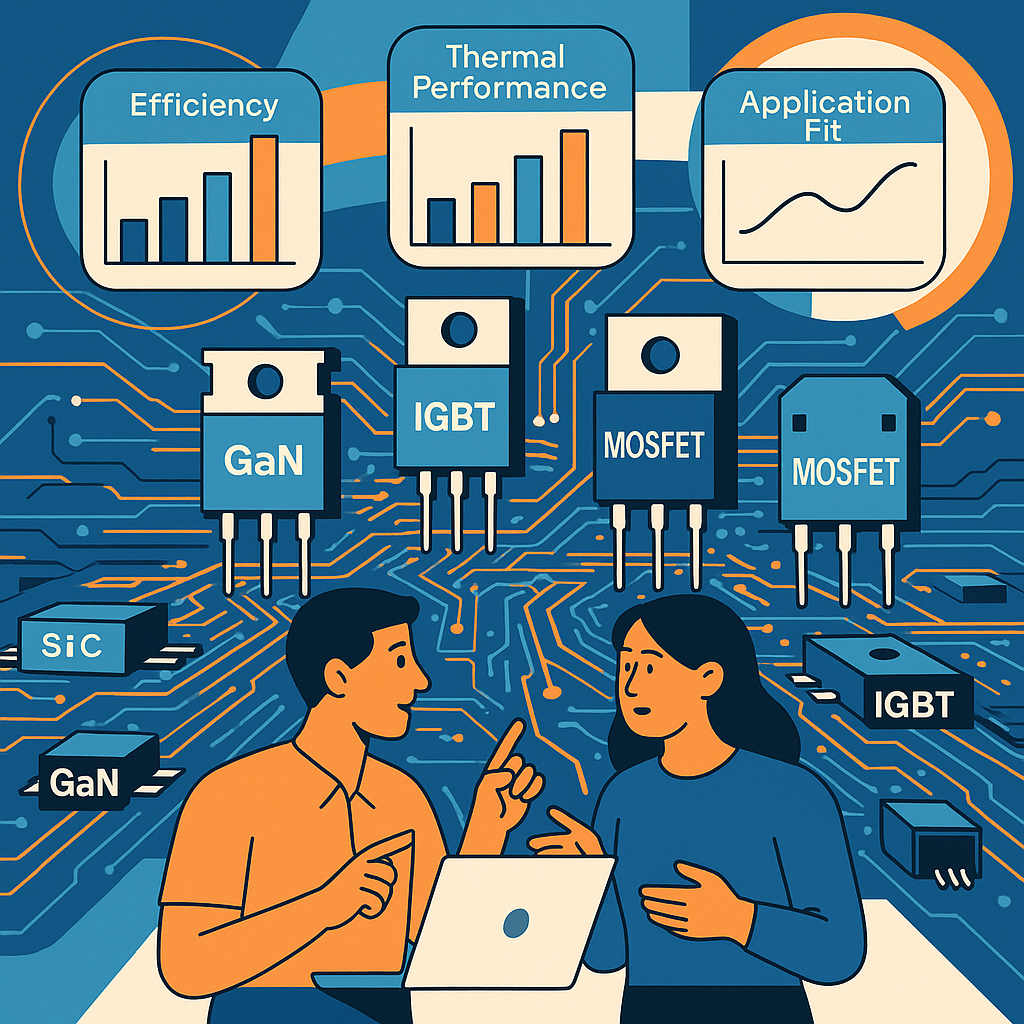
Power-device selection is a performance optimisation across efficiency, switching frequency, thermal behaviour, cost, and reliability. Three consequences follow.
First, comparison content is decisive. "SiC vs silicon MOSFET", "GaN vs SiC for fast charging", "IGBT vs SiC MOSFET for motor drive" are the exact queries engineers use to decide — and AI engines quote them heavily.
Second, measured data wins. Adjectives lose; efficiency at a stated frequency, R_DS(on) at a stated temperature, and thermal figures win.
Third, application context matters. The right device depends on the application, so marketing must map technologies to EV charging, data-centre power, motor drives, solar, and industrial supplies.
The citable power-device fact to lead with
In high-frequency power conversion, wide-bandgap devices (SiC and GaN) can cut switching losses substantially versus silicon — often enabling higher efficiency, higher frequency, and smaller magnetics — while silicon frequently wins on cost in moderate-frequency designs. Quantifying this trade-off with measured, application-specific data is what wins the comparison for both engineers and AI engines.
What does a power semiconductor marketing agency do?
- **Technology comparison content** — SiC/GaN/silicon/IGBT decisions, structured for engineers and AI.
- **Application-specific marketing** — mapping devices to EV charging, data-centre power, motor drive, renewables.
- **SEO and GEO** — winning power-device search and AI citations.
- **Datasheet and app-note discoverability** — making efficiency and thermal data findable.
- **Reference designs and tools** — loss and thermal calculators that earn links and dwell time.
- **Demand generation** — nurturing the long power-design cycle to design wins.
How do you win power-device technology comparisons?
- **Structure clean, extractable comparisons** across efficiency, switching frequency, thermal, cost, and reliability.
- **Use measured, condition-specified figures**, not marketing adjectives.
- **Be honest about trade-offs** — where silicon still wins on cost, where SiC/GaN win on efficiency. Honesty earns trust and AI citations.
- **Map to applications** so engineers self-identify with the right device.
How do you choose a power semiconductor marketing agency?
- Technical credibility in power electronics — can they write about switching losses and thermal design correctly?
- Comparison-content strength — can they own the SiC/GaN/silicon/IGBT decisions?
- GEO capability for AI citations in 2026.
- Application-domain knowledge across EV, data centre, motor drive, and renewables.
- Willingness to co-create with your applications engineers.
Frequently asked questions
What content matters most for power-device makers?
Technology comparison guides and application-specific content. These capture the decision-stage queries engineers use to choose between silicon, SiC, GaN, and IGBT — and AI engines cite them heavily.
Should we market SiC and GaN differently?
Yes, by application and performance profile. SiC often leads in higher-voltage, higher-power designs; GaN in high-frequency, lower-voltage designs. Marketing should map each to the applications where it wins.
How do we handle the silicon-vs-wide-bandgap debate honestly?
Lead with measured, application-specific data and acknowledge genuine trade-offs. Honesty about where each technology wins builds the trust that earns both design consideration and AI citations.
The bottom line
A power semiconductor marketing agency wins by owning the technology comparisons that decide design wins — SiC, GaN, silicon, and IGBT — with measured, application-specific data structured for both engineers and AI engines. Choose the partner who can write power electronics credibly and quantify the trade-offs honestly.
Written by the Heuristiq Digital team, a specialist power semiconductor and deep-tech marketing agency helping SiC, GaN, IGBT, and MOSFET makers win engineer search and AI citations.
Suggested schema: Article, Author, FAQPage.