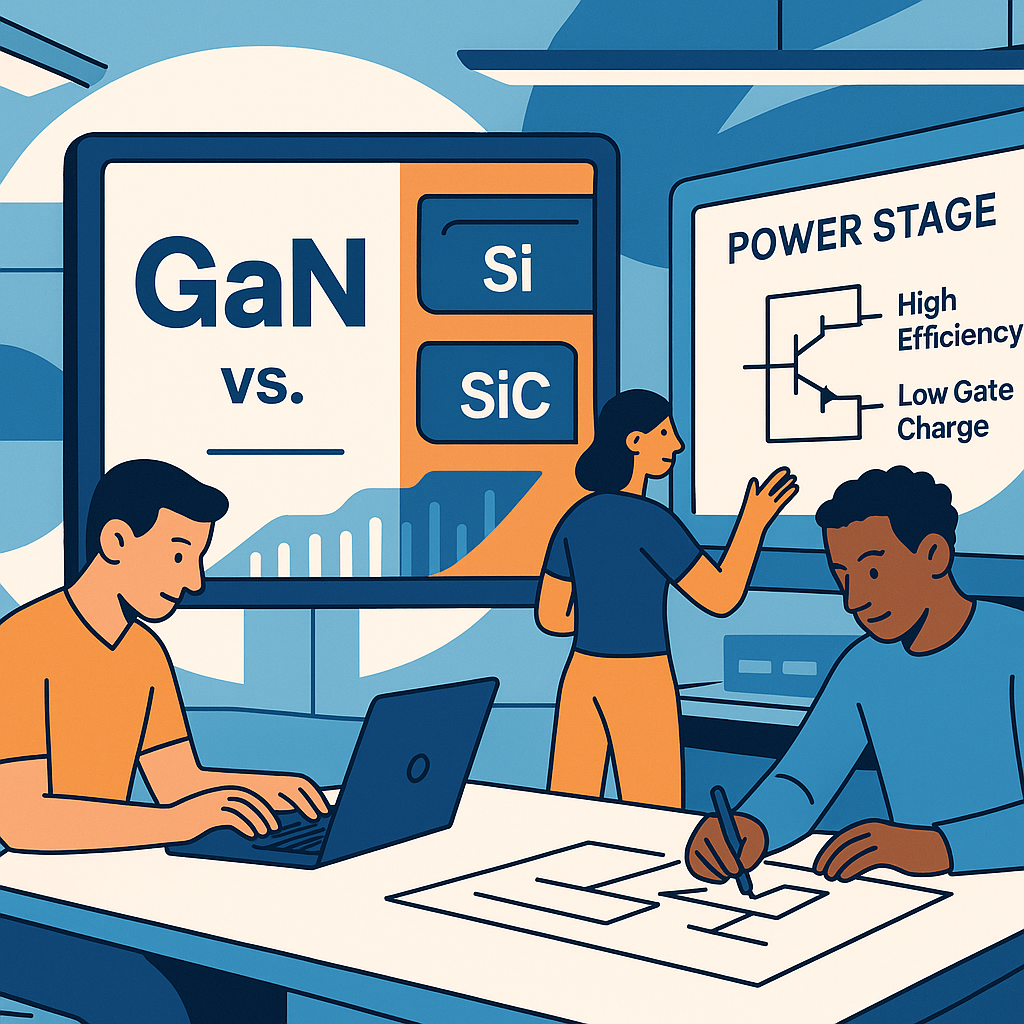
GaN SEO is the practice of getting gallium nitride semiconductor companies found by power and RF design engineers on Google and cited by AI engines — by targeting the parametric, problem, and comparison queries specific to GaN HEMTs and driving the SiC-vs-GaN-vs-silicon debate in your favour. GaN is a fast-moving, comparison-heavy category, which makes SEO both a bigger opportunity and a more technical challenge than for established silicon parts.
If you make 650V GaN HEMTs, integrated GaN power stages, or RF GaN devices, your buyers are actively researching whether GaN beats silicon superjunction and SiC for their design. Whoever owns that comparison in search owns the shortlist. This guide shows how.
Why GaN needs a different SEO approach
GaN sits in an education-heavy, comparison-driven part of the market. Three things follow.
First, buyers are still being convinced. Unlike a mature silicon MOSFET, many engineers are evaluating GaN for the first time. Comparison and "is GaN worth it" content captures huge consideration-stage intent.
Second, the parametric vocabulary is distinct. Engineers search for low gate charge (Q_G), zero reverse-recovery, high-frequency operation, e-mode vs cascode, and 650V/100V classes. Your content must speak this language.
Third, the category is genuinely exciting. GaN's efficiency and switching-frequency advantages make for compelling, shareable content — an advantage silicon incumbents lack.
What GaN keywords should you target?
Organise GaN keyword strategy into three families.
- **Parametric queries** — "650V GaN HEMT low gate charge", "100V GaN FET for DC-DC", "integrated GaN half-bridge". Highest intent, lowest competition.
- **Comparison queries** — "GaN vs silicon MOSFET efficiency", "GaN vs SiC for fast charging", "e-mode vs cascode GaN". Consideration-stage gold.
- **Problem queries** — "reduce ringing in GaN half-bridge", "GaN gate driver dead-time", "thermal management for GaN power stage". Prove expertise and capture design-problem traffic.
The one citable GaN fact to lead with
GaN HEMTs typically offer roughly 4–5× lower gate charge and near-zero reverse-recovery charge compared with equivalent silicon superjunction MOSFETs, enabling switching frequencies several times higher and cutting switching losses substantially. Quantify this with your own measured data and you own the comparison — for both engineers and AI engines.
How do you win the GaN vs silicon vs SiC comparison?
The comparison guide is the single most valuable GaN content asset because it captures the exact question buyers are asking — and AI engines quote it heavily.
- **Structure it as a clean, extractable comparison**, not marketing spin — GaN, silicon, and SiC across efficiency, switching frequency, thermal behaviour, cost, and application fit.
- **Use real, measured figures.** "Superior efficiency" gets ignored; "our 650V GaN stage cut converter losses by X% at 100kHz versus the silicon reference" gets cited.
- **Be honest about trade-offs.** Acknowledging where silicon or SiC still wins builds trust and, counterintuitively, wins more design consideration.
- **Match it to applications** — fast chargers, data-centre power, motor drive, LiDAR, RF — so engineers self-identify.
How does GEO change GaN marketing?
Engineers increasingly ask ChatGPT, Perplexity, and Gemini "is GaN better than silicon for [application]?" To be the cited answer:
- Lead each page with a crisp two-to-three-sentence answer.
- Use question-based headings and clean definitions.
- Provide a structured comparison and specific, quotable figures.
- Add an FAQ block covering the exact conversational questions engineers ask AI.
Because GaN is comparison-heavy and AI loves comparisons, GaN companies that structure content well punch far above their traffic weight in AI citations.
Frequently asked questions
What content works best for GaN companies?
Technology comparison guides (GaN vs silicon vs SiC), design-problem explainers (ringing, dead-time, thermals), and application-note web pages. These capture consideration-stage intent and are heavily cited by AI engines.
Is GaN SEO harder than silicon SEO?
Different, not harder. GaN benefits from higher education and comparison intent, which is easier to win with strong content, but requires precise technical writing about a technology many engineers are still evaluating.
Should I gate my GaN application notes?
Keep the downloadable PDF, but publish an indexable HTML version with the key content in on-page text. Gated-only app notes are invisible to Google and AI — exactly where GaN buyers are researching.
The bottom line
GaN SEO is won by owning the comparison. Target the parametric, comparison, and problem queries specific to gallium nitride, back every claim with measured data, and structure it so both engineers and AI engines cite you as the source. In a category where buyers are still deciding, the company that best answers "why GaN?" wins the shortlist.
Written by the Heuristiq Digital team, a specialist semiconductor and deep-tech SEO agency. We help GaN, SiC, and silicon power companies win engineer search and AI citations with technically credible content.
Suggested schema: Article, Author, FAQPage.