
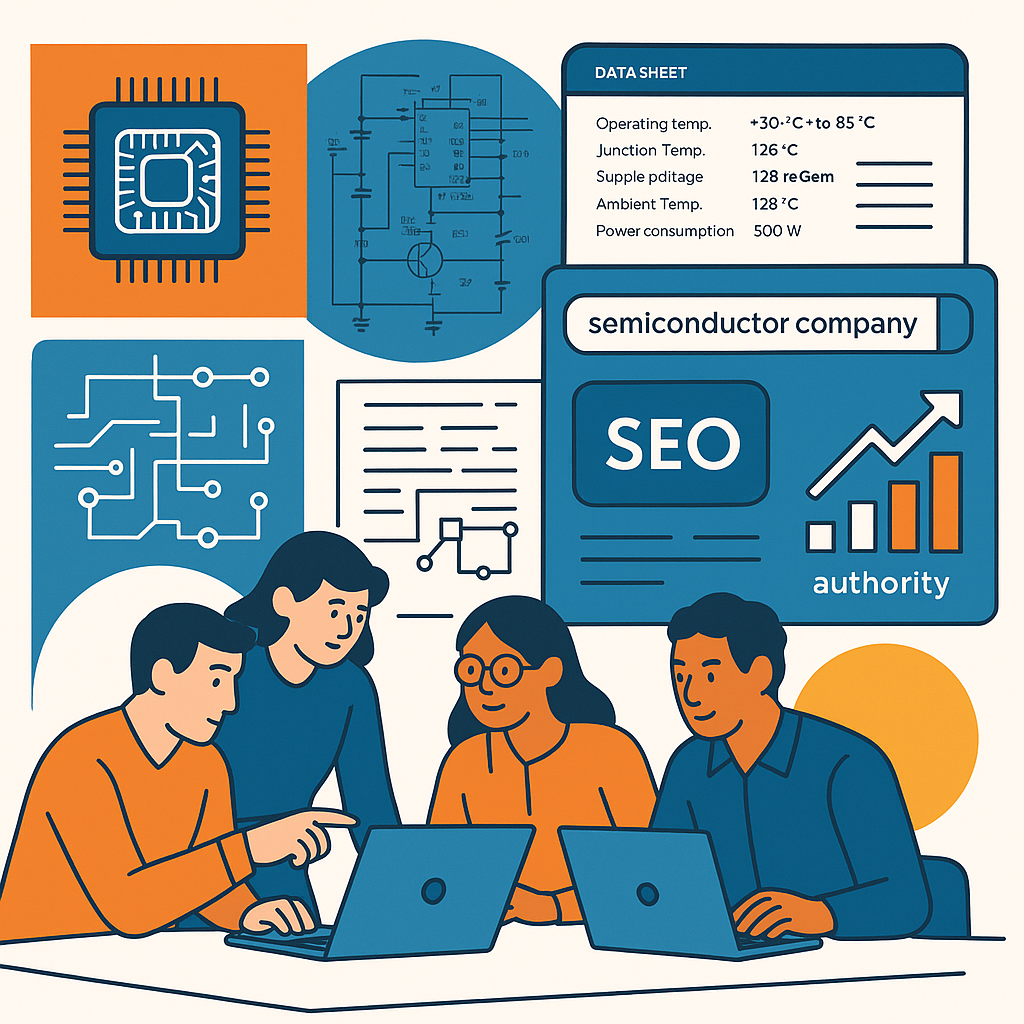
Semiconductor company SEO is the practice of making a chip, IP, or fab-services company the easiest-to-find and easiest-to-cite authority for the exact terms design engineers, procurement teams, and OEM decision-makers search. Done well, it turns a technically brilliant company that nobody finds into the default source Google ranks and AI engines quote. This guide is the one-stop resource we wish existed when we started doing this work — the full scope, in the order it actually matters.
Most semiconductor marketing content online is either generic B2B advice with the word "chip" pasted in, or fab-house brochure copy. Neither ranks. What ranks — and what gets pulled into ChatGPT, Gemini, Perplexity, and Google AI Overviews — is content that speaks the engineer's language, answers the precise question, and proves it knows the physics. That is the standard this guide holds itself to.
Why semiconductor SEO is different from ordinary B2B SEO
Semiconductor SEO is harder than typical B2B SEO for four structural reasons, and every tactic in this guide exists to solve one of them.
First, the audience is technical and skeptical. Your reader is often a design engineer comparing a gate-driver's dead-time or a MOSFET's R_DS(on) at a specific gate voltage. Vague marketing prose fails instantly. You are writing for people who will notice if your rise-time figure is wrong.
Second, the buying cycle is long and multi-stakeholder. A design win can take 12–36 months and involve engineers, procurement, and program managers. SEO has to serve the top-of-funnel "what is" query, the mid-funnel "X vs Y" comparison, and the bottom-funnel "buy / request samples / find distributor" intent — often for the same part.
Third, the content unit is the datasheet, app note, and reference design — not the blog post. Google and AI engines increasingly surface these technical documents. If yours are locked in PDFs behind a portal, you are invisible.
Fourth, search volumes are low but astronomically valuable. A term like "1200V SiC MOSFET gate driver" might get a few hundred searches a month, but each searcher could represent a six- or seven-figure design win. This is why intent precision beats traffic volume every time.
The Heuristiq definition
Semiconductor company SEO is the discipline of structuring your technical authority — datasheets, application notes, reference designs, and expert content — so that engineers and AI engines both retrieve and cite you as the definitive source for the parts and problems you solve.
What are the core pillars of a semiconductor SEO strategy?
A working semiconductor SEO program rests on six pillars. Treat them as a sequence: each one compounds the next.
1. Engineer-intent keyword architecture
Start by mapping how engineers actually search, which is rarely how marketers write. Real queries cluster into three families:
- **Parametric queries** — "650V GaN HEMT low RDSon", "automotive-grade 100A IGBT module". These are high-intent and low-competition.
- **Problem queries** — "reduce switching losses in half-bridge", "prevent latch-up in level shifter". These win the top of funnel.
- **Comparison queries** — "SiC vs silicon MOSFET efficiency", "GaN vs silicon for fast charging". These win the consideration stage.
Build a page for each meaningful cluster, anchored to one medium-tail keyword and covering the natural related terms around it. Do not spin up a thin page per part number — build authoritative hub pages that the part pages link into.
2. Technical E-E-A-T (the trust layer)
Google's E-E-A-T framework — Experience, Expertise, Authoritativeness, Trust — is not optional in a field where a wrong figure can destroy credibility. Make it visible:
- Put a real named engineer or applications specialist on the byline, with credentials.
- Show first-hand experience: measured results, oscilloscope captures, thermal images, real bench data.
- Cite standards (JEDEC, AEC-Q100/Q101, IEC) and link to primary sources.
- Keep every figure current and correct.
3. Datasheet and app-note discoverability
Your richest content is already written — it is sitting in PDFs. Make it findable:
- Publish HTML landing pages for key parts and families, not just gated PDFs.
- Add descriptive titles, parametric specs in text, and structured data.
- Cross-link app notes to the products they support and the problems they solve.
4. Topical hubs (pillar + cluster)
Organise the site into topic clusters. A pillar page ("Power semiconductors for EV charging") links to cluster pages (SiC MOSFETs, gate drivers, thermal management, reference designs). This signals topical authority to Google and gives AI engines an interconnected source to pull from.
5. Technical performance and Core Web Vitals
Engineers browse from labs and offices on fast connections, but they also bounce fast. Ship clean, fast, mobile-friendly pages. Ensure parametric selectors and interactive tools do not tank load speed.
6. GEO — getting cited by AI engines
Increasingly, engineers ask ChatGPT, Perplexity, and Gemini to shortlist parts and vendors. Being the cited source there is the new front page. That means answer-first structure, clean definitions, comparison content, and specific quotable facts. (We cover this in depth in our companion guide on GEO for semiconductor companies.)
How do you do keyword research for a chip company?
The process differs from consumer SEO because the searchers are few, expert, and precise. Here is the workflow we run.
- **Extract the parametric vocabulary from your own datasheets.** Voltage class, current rating, package, technology (Si, SiC, GaN), qualification (AEC-Q). These are your seed terms.
- **Mine engineer forums and Q&A.** EEVblog, electronics.stackexchange, Reddit r/AskElectronics, and vendor design communities reveal the exact phrasing of problems.
- **Read the SERP for each seed.** See whether Google is serving datasheets, distributor pages, app notes, or comparisons — then match that dominant format and add the missing element.
- **Layer in comparison and problem intent.** For every product family, there is a "vs" query and a "how to solve X" query. Own both.
- **Prioritise by design-win value, not volume.** A 90-search-per-month parametric term tied to a flagship part beats a 5,000-search generic term with no purchase intent.
Practitioner tip
The single highest-ROI keyword move in semiconductor SEO is turning each gated PDF datasheet into an indexable HTML page with the key parameters in on-page text. Engineers search parameters, and Google cannot index what is trapped in a login-only PDF.
What content actually ranks and gets cited in the semiconductor space?
Not all content is equal here. In our work, five content types consistently earn rankings, links, and AI citations.
- **Application notes rewritten as web pages** — the highest-value, lowest-effort win. You already have the expertise; you just need it indexable.
- **Technology comparison guides** — "SiC vs GaN vs silicon" style pieces answer the consideration-stage question and get quoted heavily by AI.
- **Design-problem explainers** — "how to minimise ringing in a GaN half-bridge" — capture problem-intent traffic and prove expertise.
- **Reference designs and calculators** — interactive tools (loss calculators, thermal estimators) earn links and long dwell time.
- **Original teardown or benchmark data** — if you measure it and publish it as an on-page study, you become the source everyone cites.
How is SEO changing with AI search (GEO)?
AI engines do not "rank" pages — they extract and cite the clearest, best-structured answer. For semiconductor companies, this changes three things.
First, structure wins citations. Answer the question in the first two or three sentences, use question-based headings, provide clean definitions, and include a comparison where relevant. AI lifts these directly.
Second, specificity is the moat. "Our GaN FETs offer superior efficiency" gets ignored. "Our 650V GaN HEMT achieves 4× lower gate charge than the equivalent silicon superjunction MOSFET, cutting switching losses by up to 50% at 100kHz" gets quoted.
Third, being the named source compounds. When AI engines repeatedly cite your definitions and figures, you become the reference — and that authority feeds back into traditional rankings.
Semiconductor SEO metrics that actually matter
Vanity traffic is a trap in this niche. Track these instead:
- **Rankings for parametric and comparison terms** tied to flagship products.
- **Sample requests, datasheet downloads, and distributor click-throughs** from organic.
- **AI citation share** — how often ChatGPT, Perplexity, and Gemini name you for your core topics.
- **Assisted design wins** — organic's role in multi-touch, long-cycle sales, tracked in CRM.
Common semiconductor SEO mistakes to avoid
- Locking every datasheet and app note behind a portal, making them un-indexable.
- Writing generic marketing prose that engineers immediately distrust.
- Chasing high-volume generic terms instead of high-value parametric ones.
- Ignoring comparison intent and ceding "vs" queries to competitors and distributors.
- Publishing studies as PDFs instead of on-page HTML (on-page data earns roughly 3× the links).
- Treating GEO as a separate future project rather than a today priority.
Frequently asked questions
How long does semiconductor SEO take to work?
Expect early parametric and problem-intent rankings within 3–6 months, with compounding authority and AI citations building over 6–12 months. Because the sales cycle is long, SEO's payoff is measured in design-win pipeline, not immediate conversions.
Should datasheets be HTML pages or PDFs?
Both. Keep the downloadable PDF for engineers, but publish an indexable HTML page with the key parameters in on-page text so Google and AI engines can read and cite the specs.
Do I need a specialist semiconductor SEO agency?
If your audience is design engineers and your differentiators are technical, yes — generalist agencies rarely understand parametric intent or the physics required to write credibly. A specialist speaks the engineer's language and protects your technical credibility.
The bottom line
Semiconductor company SEO is won by being the single most useful, most technically credible, best-structured answer for the parts and problems you own — then structuring that answer so Google ranks it and AI engines cite it. Build it once, correctly, and you get found everywhere your buyers look.
Written by the Heuristiq Digital team. Heuristiq Digital is a deep-tech and semiconductor SEO agency that helps chip, IP, and fab-services companies win engineer search and AI citations. Our practitioners come from technical B2B backgrounds and work directly with applications engineering teams to produce content that survives expert scrutiny.