
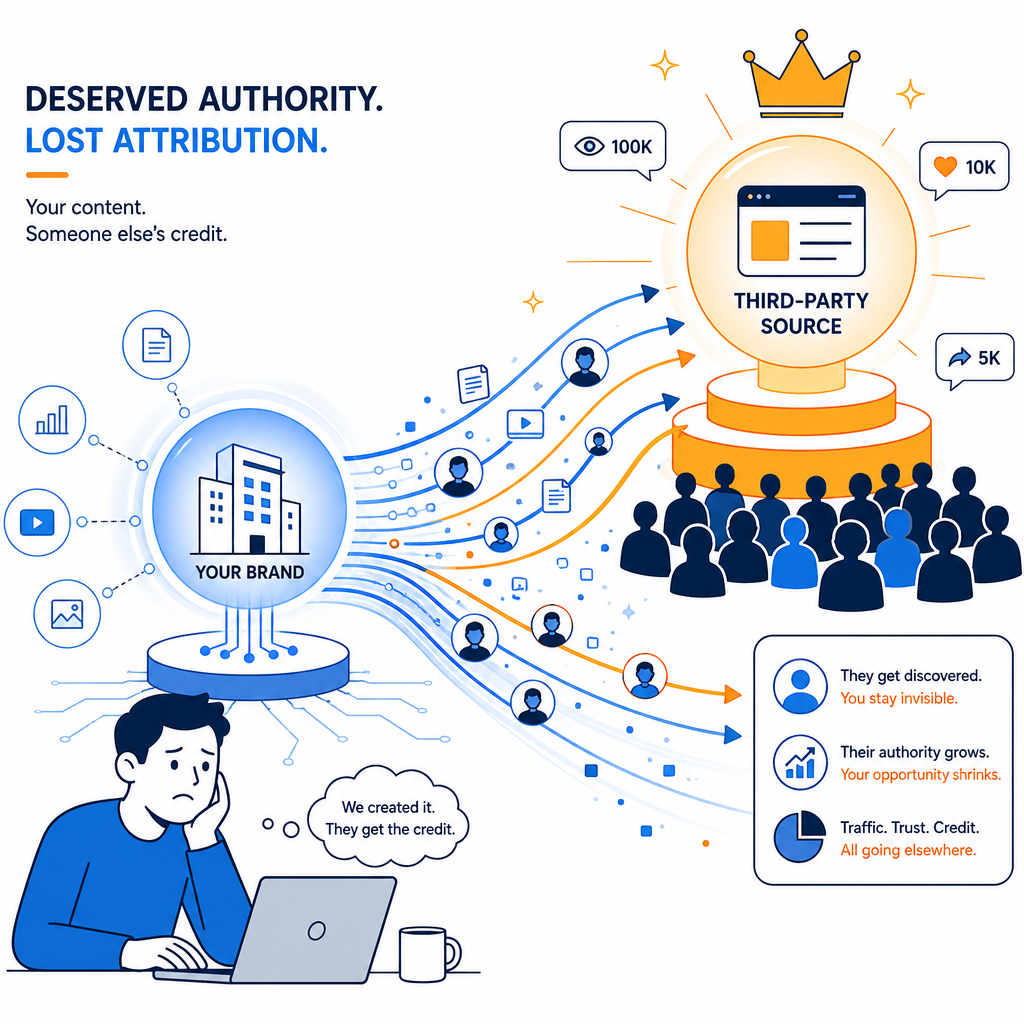
The semiconductor industry faces a critical digital visibility challenge. When potential customers ask AI assistants about quantum computing capabilities, biotech innovations, or hardware specifications, these systems often cite industry publications and third-party sources rather than the companies that actually develop these technologies. This raises a pressing question: why AI is citing third-party sources instead of your site when you're the primary source of expertise?
For high-tech companies, this isn't just a vanity metric. First-party citations from AI systems represent direct attribution to your expertise, immediate credibility with prospects, and control over how your innovations are presented to the world. When ChatGPT, Claude, or Gemini references your white papers instead of a journalist's interpretation, you maintain authority over your narrative.
Recent analysis by SEMrush reveals that AI systems show a pronounced bias towards established media outlets and aggregator sites when answering technical queries. This creates a particular challenge for semiconductor companies, where the most accurate information often lives in technical documentation, research papers, and company-published specifications rather than general technology publications.
Why AI Is Citing Third-Party Sources Instead of Your Site: The Authority Gap
AI language models make citation decisions based on training data patterns, not real-world expertise. These systems learned to associate certain domain types with credibility during their training phase. News sites, established publications, and academic sources received higher implicit trust scores than corporate websites, even when those corporate sites contain the original research.
The Citation Preference Hierarchy
AI systems typically prioritise sources in this order: 1) Academic journals and research institutions, 2) Established news publications, 3) Industry trade publications, 4) Government and standards bodies, 5) Corporate websites and documentation. This hierarchy doesn't reflect accuracy or primary source authority.
The semiconductor industry suffers particularly from this bias. When a technology journalist writes about your latest chip architecture, AI models often cite that article instead of your technical specifications or press releases. The journalist becomes the quoted authority on your own innovation.
Domain authority metrics compound this problem. Established publications accumulate backlinks and domain authority over decades. Your corporate site, regardless of technical accuracy, faces an uphill battle against these accumulated trust signals. AI training data reinforced these patterns, creating a feedback loop that favours third-party interpretation over primary sources.
Content structure plays a role too. Many semiconductor companies publish highly technical documentation that AI models struggle to parse effectively. Dense specification sheets, complex technical diagrams, and industry jargon create barriers to AI comprehension, even when the content represents definitive information.
The Business Impact of Third-Party Citation Dependence
Relying on third-party citations creates multiple business risks for high-tech companies. When journalists or industry analysts become the primary sources for information about your innovations, you lose control over messaging accuracy and positioning.
The quantum computing sector illustrates this challenge clearly. Companies spending years developing quantum processors find their breakthroughs attributed to the publications that covered them rather than their own research teams. AI systems cite the coverage date as the innovation timeline, distorting historical accuracy.
Revenue implications extend beyond brand recognition. When procurement teams use AI to research suppliers, third-party citations can influence vendor selection. A biotech company whose innovations are consistently attributed to industry publications may appear less authoritative than competitors who secure direct citations.
Talent acquisition suffers too. Engineers and researchers often use AI to evaluate potential employers. Companies that appear as secondary sources in AI responses may seem less innovative or cutting-edge than those positioned as primary authorities.
Strategic Content Architecture for First-Party Citations
Earning first-party citations requires rethinking how technical content is structured and presented. AI models favour certain content patterns, and semiconductor companies must adapt their communication strategies accordingly.
The foundation lies in creating authoritative hub pages that consolidate expertise around specific topics. Instead of burying specifications in dense technical documents, create comprehensive resources that explain your innovations in accessible language whilst maintaining technical accuracy.
- Develop topic cluster pages around your core technologies and applications
- Create glossary sections that define industry terms from your perspective
- Publish regular technical explainers that bridge complex concepts with practical applications
- Maintain detailed case studies with measurable outcomes and implementation details
- Establish thought leadership content that positions your experts as industry authorities
Content depth matters more than breadth for AI citation purposes. A comprehensive 3,000-word analysis of quantum error correction techniques carries more authority than ten brief product announcements. AI models reward thorough exploration of topics, particularly when technical concepts are explained clearly.
Citation-Optimised Content Structure
Strong Structure
Clear headlines, logical flow, defined sections, comprehensive coverage, technical accuracy with accessible explanations
Weak Structure
Scattered information, jargon-heavy text, incomplete explanations, buried key points, marketing fluff without substance
Schema markup becomes critical for semiconductor companies. Structured data helps AI models understand your content context and authority. Implement Article, Organization, and Product schemas to clearly define your role as the primary source for specific technologies or innovations.
Page architecture should mirror how AI models process information. Use clear hierarchical structures with descriptive headlines that include your focus keywords naturally. Break complex concepts into digestible sections with relevant subheadings that guide both human readers and AI interpretation.
Technical SEO Strategies for AI Citation Capture
Technical SEO for AI citations differs from traditional search optimisation. AI models evaluate content through different lenses, prioritising comprehensiveness, accuracy signals, and authoritative source indicators.
Page speed and accessibility directly influence AI training data inclusion. Slow-loading pages or sites with poor accessibility often get excluded from training datasets. For semiconductor companies with complex technical content, this means optimising performance without sacrificing depth.
Internal linking architecture signals content relationships to AI models. Create topic clusters that link related concepts together, establishing your site as a comprehensive resource for specific technology areas. When discussing quantum computing applications, link to your quantum hardware specifications, relevant case studies, and technical implementation guides.
Technical Citation Factors
Domain age, backlink quality, expertise demonstration, consistent publishing
Comprehensiveness, accuracy, original research, technical depth
Site speed, mobile optimisation, structured data, accessibility
Canonical URL management becomes crucial when your content appears across multiple formats. Research papers, press releases, and product documentation often overlap in content. Establish clear canonical signals to prevent AI confusion about which version represents the authoritative source.
Mobile optimisation affects AI training data inclusion rates. Many AI models prioritise mobile-friendly content during training. Semiconductor companies must balance desktop-heavy technical documentation with mobile accessibility requirements.
Meta data optimisation for AI differs from traditional SEO. Focus on accuracy and completeness rather than keyword density. AI models often use meta descriptions and title tags as context clues for content authority and relevance.
Building Authority Signals That AI Models Recognise
AI models evaluate authority through patterns learned from training data. Semiconductor companies must build recognisable authority signals that align with these learned preferences whilst maintaining authentic expertise demonstration.
Consistent expert attribution strengthens authority signals. When your CTO publishes technical analyses, your research team shares findings, or your product managers explain implementations, consistent byline attribution builds individual and corporate credibility patterns that AI models recognise.
Publication frequency and consistency matter for authority establishment. Regular content publication creates temporal patterns that AI models associate with active expertise. Quarterly white papers or monthly technical updates establish your organisation as an ongoing authority rather than a static information source.
Authority Building Checklist
- Establish named expert contributors with consistent bylines
- Maintain regular publishing schedules for technical content
- Cross-reference your innovations in academic and industry publications
- Participate in industry standards development and cite your contributions
- Create original research that others cite and reference
- Maintain detailed technical documentation that serves as industry reference
Citation reciprocity builds authority networks. When academic papers reference your research, industry publications quote your experts, or standards bodies cite your contributions, these create bidirectional authority signals that AI models weight heavily.
Original research publication establishes primary source authority. Semiconductor companies should publish findings, methodologies, and results that become reference materials for the broader industry. When your research becomes the cited source for others, AI models learn to recognise your authority.
Industry participation signals ongoing expertise. Standards committee involvement, conference presentations, and peer collaboration create authority patterns that extend beyond your owned content. AI models recognise these participation signals as expertise indicators.
Measuring and Monitoring AI Citation Success
Tracking AI citation performance requires new measurement approaches beyond traditional SEO metrics. Direct AI query testing, citation tracking tools, and brand mention monitoring provide insights into citation capture success.
Regular AI query testing reveals citation patterns for your industry terms. Create a list of key topics where your company should be the primary authority, then systematically test how different AI models respond to related questions. Track whether responses cite your content directly or reference third-party interpretations.
Citation attribution monitoring tracks how your innovations are referenced across AI responses. Tools like Brand24 or Mention can alert you when AI systems cite your content, allowing you to identify successful citation strategies and areas for improvement.
Content performance analysis identifies which content types achieve the highest citation rates. Technical white papers might generate more citations than press releases, or detailed case studies might outperform product specifications. Understanding these patterns informs future content strategy.
Competitive citation analysis reveals industry positioning within AI responses. Track how often competitors receive citations for topics where you have expertise, and identify gaps where neither your company nor direct competitors achieve first-party citations.
Long-term trend monitoring shows citation momentum over time. Successful authority building creates increasing citation rates and expanding topic coverage. Track quarterly changes to identify successful strategies and areas requiring additional focus.
Future-Proofing Your Citation Strategy
AI citation landscapes continue evolving as models become more sophisticated and training data expands. Semiconductor companies must build adaptable strategies that remain effective as AI citation preferences change.
Multimodal content preparation addresses emerging AI capabilities. Future models will better interpret technical diagrams, video content, and interactive demonstrations. Companies should begin creating visual content that supports their textual expertise claims.
API and structured data readiness positions content for direct AI integration. As AI models begin pulling real-time information through APIs, having structured, accessible data becomes critical for maintaining citation relevance.
Collaborative content strategies build citation networks that benefit from AI evolution. Partner with research institutions, contribute to open-source projects, and participate in industry consortiums to create citation webs that AI models recognise and value.
The shift toward AI-mediated information discovery transforms how semiconductor and high-tech companies must approach digital authority. Understanding why AI is citing third-party sources instead of your site reveals opportunities to reclaim narrative control and establish your organisation as the definitive authority on your innovations.
Success requires combining technical SEO excellence with authoritative content strategies that align with AI model preferences. Companies that adapt their content architecture, build recognisable authority signals, and consistently monitor citation performance will capture the competitive advantages that first-party citations provide.
The investment in first-party citation capture pays dividends across multiple business functions. Sales teams gain credibility tools, marketing teams control messaging accuracy, and recruitment efforts benefit from enhanced technical reputation. In an industry where innovation drives value, ensuring proper attribution for your breakthroughs becomes a strategic imperative that extends far beyond SEO metrics.