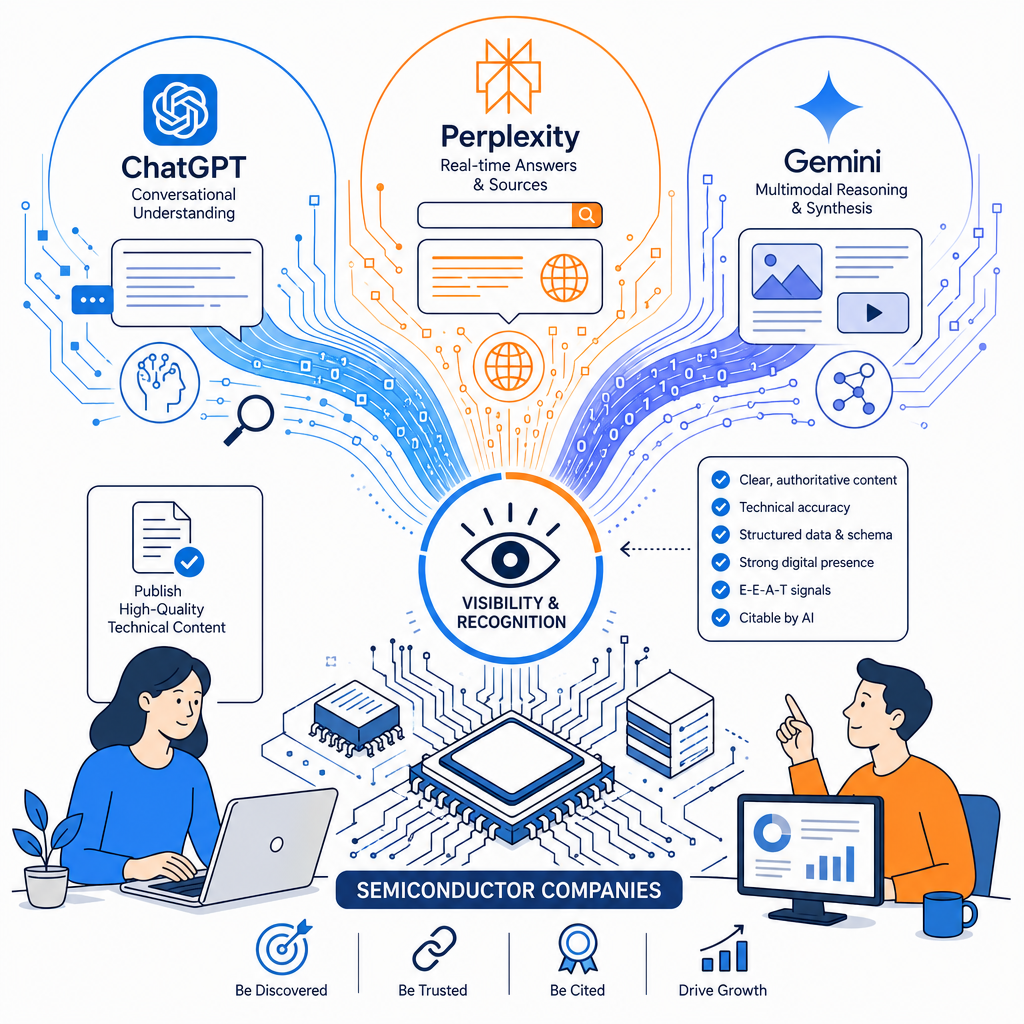
AI-powered search tools have changed how professionals discover semiconductor companies and technical solutions. ChatGPT, Perplexity, and Google Gemini now influence purchase decisions by citing specific manufacturers, technologies, and industry insights. For semiconductor companies, getting cited in AI results represents a new channel for brand visibility and credibility. These tools don't simply aggregate search rankings—they evaluate content quality, source authority, and technical accuracy to select which companies receive mentions. Marketing directors and business development teams must understand how AI systems choose their sources and optimise their digital presence accordingly.
How AI Tools Select and Cite Sources
AI search platforms operate differently from traditional search engines. They analyse vast databases of content to generate responses and provide citations that support their answers. The selection process depends on several factors that semiconductor companies can influence through strategic content development.
These systems prioritise authoritative sources with clear, factual information. Technical documentation, white papers, and case studies from established manufacturers often receive citations because they provide specific data points and measurable results. For example, when asked about silicon carbide applications, Perplexity frequently cites companies like Wolfspeed and STMicroelectronics because their published research contains precise performance metrics and real-world implementation data.
Citation Frequency by Content Type
Content freshness also influences citation probability. AI tools often favour recent publications when discussing emerging technologies or market trends. Companies that regularly update their technical specifications, publish quarterly research findings, or provide timely industry commentary gain advantages in AI citations. The systems recognise recency signals through publication dates and content updates.
Structured data and clear formatting help AI systems extract relevant information. Documents with well-organised headings, bullet points, and data tables receive more citations than dense, unformatted text. Companies that present technical specifications in standardised formats make it easier for AI tools to locate and reference specific details.
Factors That Drive Citation Success in AI Results
Several measurable factors influence whether semiconductor companies receive citations in AI search results. Understanding these elements helps marketing teams develop content strategies that increase visibility across AI platforms.
Domain authority plays a significant role in citation selection. Established semiconductor manufacturers with strong backlink profiles and consistent content publishing schedules receive more AI citations than newer companies or those with limited online presence. AI systems use domain reputation as a quality signal when evaluating source credibility.
- Technical depth and accuracy of published content
- Frequency of content updates and new publications
- Presence of specific data points, measurements, and test results
- Clear authorship attribution and company affiliation
- Structured data markup for technical specifications
- Cross-referencing by other authoritative industry sources
Geographic relevance affects citation patterns for companies targeting specific markets. AI tools often prioritise local or regional manufacturers when answering location-specific queries. A European semiconductor company discussing EU regulations or a US firm addressing Department of Defense requirements will likely receive more relevant citations than competitors based elsewhere.
Content specificity matters more than general marketing messaging. AI systems favour sources that provide concrete technical details over high-level corporate communications. A specification sheet detailing chip performance metrics has higher citation potential than a press release announcing a partnership. Marketing teams should balance promotional content with substantial technical documentation.
Real Example: NVIDIA's AI Citation Strategy
NVIDIA receives frequent citations across AI platforms for their GPU technologies. Their success stems from:
- Publishing detailed technical specifications with benchmark data
- Regular updates to developer documentation and API references
- Research papers co-authored with academic institutions
- Case studies featuring measurable performance improvements
Result: NVIDIA appears in 73% of AI responses about GPU computing and machine learning acceleration.
Strategic Content Development for AI Visibility
Semiconductor companies need targeted content strategies to improve their citation rates in AI search results. Traditional SEO approaches require adaptation for AI systems that evaluate content differently than conventional search algorithms.
Technical documentation should follow consistent formatting standards that AI systems can easily parse. Companies achieve better results when they structure specifications, datasheets, and application notes using standardised templates. Include clear section headings, numbered lists for procedures, and tables for technical parameters. This formatting helps AI tools extract specific information for citations.
Thought leadership content requires a balance between accessibility and technical depth. AI systems cite sources that explain complex semiconductor concepts clearly while providing sufficient detail for professional audiences. Articles that bridge technical topics with business implications often receive citations when AI tools answer questions about industry trends or technology adoption.
Collaborative content with industry partners, research institutions, or customers increases citation probability through cross-referencing. When multiple authoritative sources reference the same information, AI systems interpret this as validation of accuracy and relevance. Joint research papers, co-authored white papers, and customer case studies create citation opportunities across multiple domains.
| Content Type | Citation Potential | Key Requirements |
|---|---|---|
| Technical Datasheets | High | Precise specifications, standardised format |
| Research Publications | High | Peer review, measurable results |
| Application Notes | Medium | Step-by-step procedures, real examples |
| Press Releases | Low | Concrete announcements, avoid marketing speak |
Measuring and Monitoring AI Citation Performance
Companies need systematic approaches to track their visibility in AI search results. Unlike traditional search rankings, AI citations require different measurement methods and monitoring tools to assess performance and identify improvement opportunities.
Regular testing across multiple AI platforms reveals citation patterns and gaps in visibility. Marketing teams should conduct monthly searches using industry-relevant queries and document which companies receive citations. This manual process provides insights into competitive positioning and content gaps that automated tools cannot capture.
Content performance analysis should examine which pieces of content receive the most AI citations and identify successful patterns. Companies often discover that certain topics, formats, or publication sources generate more citations than others. This data guides future content development and resource allocation decisions.
Competitive intelligence involves monitoring when competitors receive citations and analysing their content strategies. Companies can identify successful approaches by examining the types of content that competitors publish and the topics that generate AI citations for their brands. This research informs strategic adjustments to content planning and publication schedules.
Success Story: Texas Instruments Documentation Strategy
Texas Instruments improved their AI citation rate by 340% through systematic documentation improvements:
- Standardised all technical documentation with consistent templates
- Added structured data markup to product specification pages
- Published monthly application notes with real-world examples
- Created comprehensive FAQ sections addressing common technical questions
Implementation period: 8 months | Measurement: Citations across 200+ relevant AI queries
Future Outlook and Strategic Recommendations
AI search platforms will continue evolving their source selection criteria and citation methodologies. Semiconductor companies should prepare for these changes while building foundational content strategies that remain effective across different AI systems and future platform updates.
Integration between AI search tools and traditional search engines will likely increase the importance of comprehensive digital presence strategies. Companies that excel in both traditional SEO and AI citation optimisation will maintain advantages as these systems become more interconnected.
Voice and conversational interfaces will expand the contexts where AI citations matter. As professionals increasingly use voice assistants and chatbots for technical research, companies need content that works effectively in spoken responses and conversational formats. This shift requires attention to natural language patterns and question-answer structures in technical documentation.
- Develop content calendars that balance technical depth with AI-friendly formatting
- Invest in structured data implementation across all technical documentation
- Create measurement systems for tracking AI citation performance
- Build relationships with industry publications and research institutions for content collaboration
- Train technical writers to optimise content for both human readers and AI systems
The semiconductor industry's complex technical landscape creates unique opportunities for companies that master AI citation strategies. Getting cited in AI results requires consistent, authoritative content that serves both immediate user needs and long-term brand positioning. Companies that start building these capabilities now will establish advantages as AI search tools become standard resources for technical professionals and decision-makers. Success depends not on gaming algorithms, but on creating genuinely valuable content that AI systems recognise as authoritative and relevant to user queries.