AI search is not replacing enterprise SEO overnight, but it is changing the job in ways that feel quite immediate. For UK teams looking into ai seo for enterprises, the challenge is usually not whether AI matters. It is how to use it without creating bland content, messy governance, or technical debt that nobody wants to own six months later.
This is especially true in high-tech markets. Semiconductor companies, quantum computing firms, robotics manufacturers, biotech platforms and hardware suppliers all deal with complex buying journeys. A procurement lead might search one way. A CTO searches another. An engineer, often the most sceptical reader in the room, searches in a completely different style. Add AI-generated answers, Google AI Overviews, Perplexity, ChatGPT, Gemini and other discovery surfaces into the mix, and old SEO habits start to look a bit thin.
Below are seven practical tactics for UK enterprise teams that want to make AI useful, not noisy. Some are strategic. Some are fairly technical. A few are the sort of things that sound obvious, but in my experience are often skipped because teams are busy, reporting cycles are short, and marcoms calendars somehow always get crowded.
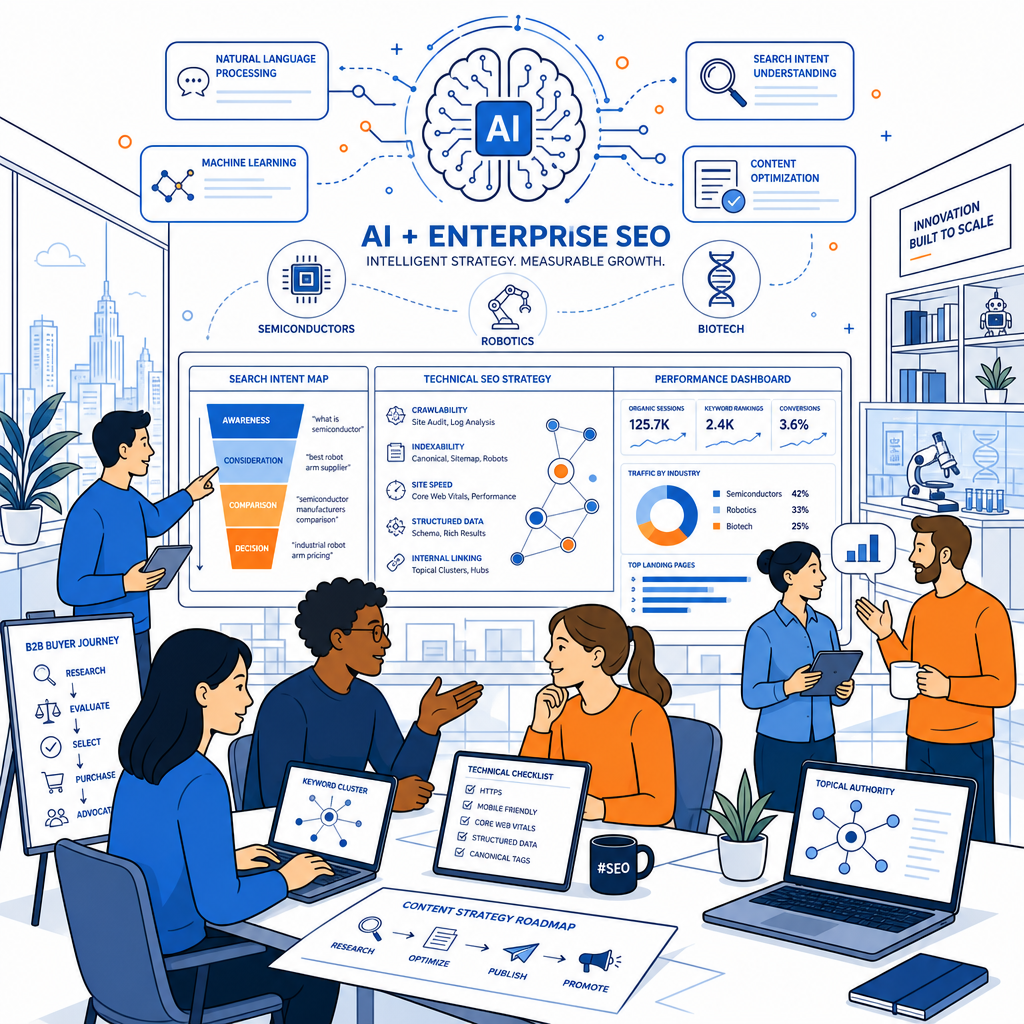
1. Start ai seo for enterprises with search intent mapping, not tools
The temptation is to begin with an AI platform. That is understandable. There are plenty of dashboards promising faster briefs, automated optimisation and predictive rankings. Useful, yes. But for enterprise SEO consulting, especially in technical markets, the better first move is to map intent in painful detail.
For a semiconductor SEO programme, for example, you may need to separate searches for wafer-level packaging, automotive-grade chips, power electronics, foundry services, supply chain risk, IP licensing and recruitment brand content. These are not just keyword groups. They are different audiences with different risk levels, approval processes and technical expectations.
- Commercial intent: buyers comparing vendors, capabilities, standards and delivery models.
- Technical intent: engineers looking for specifications, validation data, design notes or integration guidance.
- Investor or analyst intent: people trying to understand market position, category leadership and defensibility.
- Recruitment intent: candidates searching for deep technical work, lab culture, patents and team credibility.
- AI answer intent: queries likely to be answered by generative engines rather than traditional blue links.
Once this map exists, AI becomes more useful. It can cluster terms, identify content gaps, summarise SERP patterns and suggest internal linking structures. Without the map, it just generates more material. And most enterprise teams already have enough material, just not always in the right shape.
Quick intent check for high-tech SEO
| Intent type | Typical query | Best content format |
|---|---|---|
| Technical | low power edge AI processor specs | Datasheet, explainer, validation page |
| Commercial | semiconductor packaging partner UK | Capability page, case study, comparison guide |
| AI answer | what is photonic quantum computing | Structured educational page with citations |
2. Build topic authority around technical proof
AI search systems tend to reward clear, well-supported explanations. That does not mean every page must become a research paper. It does mean that vague thought leadership is less convincing than content with actual evidence, named standards, diagrams, use cases and author credentials.
For high tech marcoms teams, this can be a tricky balance. The sales team may want accessible messaging. Engineers may want precision. Legal may want caution. The best pages usually sit somewhere between all three: plain enough to read, specific enough to trust, and carefully worded enough not to overclaim.
If you offer SEO for quantum computing, SEO for robotics, SEO for biotech or SEO for hardware manufacturers, the same principle applies. Topic authority is not built by publishing twenty almost-identical blog posts. It is built through a layered content architecture: glossary pages, technical explainers, solution pages, sector pages, case studies, FAQs, schema markup and internal links that make the whole thing feel connected.
Generic claims such as “we are innovative” or “leading technology for the future”. These may be true, but AI systems and expert readers need more.
Specific applications, standards, test data, named sectors, expert authorship and links to supporting resources.
3. Use AI to speed up briefs, but keep experts in the loop
AI is excellent at creating first drafts of SEO briefs. It can review competing pages, suggest headings, identify common questions and highlight missing subtopics. This is genuinely helpful. I would not want to go back to doing every content brief manually from scratch.
But in technical SEO services for high-tech companies, AI should not be the final authority. It may misunderstand a process. It may invent a specification. It may flatten a subtle engineering distinction into something that sounds confident and wrong. That is a particular problem in biotech, robotics and semiconductor markets where accuracy is not just a nice-to-have.
A better workflow is to let AI handle the rough structure, then bring in subject matter experts for validation. Ask engineers to review the technical claims, not polish the prose. Ask product teams to confirm positioning. Ask SEO specialists to check intent, structure, schema and internal links. This may feel slower at first, but it usually prevents rework.
- Use AI to gather SERP patterns, related entities and common questions.
- Create a draft brief with target intent, audience, evidence requirements and suggested structure.
- Ask a subject matter expert to flag inaccuracies or missing nuance.
- Write or edit the content with a human reader in mind, not just a model.
- Run final checks for schema, internal links, metadata and conversion points.
4. Optimise for GEO as well as traditional SEO
Generative Engine Optimisation, or GEO, is becoming more important for enterprise teams. Traditional SEO asks, broadly, “Can we rank?” GEO asks, “Can AI systems understand, trust and cite us?” The two overlap, but they are not identical.
GEO for semiconductor companies often means making technical information easier for answer engines to parse. Clear definitions help. So do concise summaries, structured FAQs, author bios, organisation schema, product schema where relevant, and links to credible supporting materials. The same applies to GEO for high tech companies, GEO for biotech and GEO for robotics. If your expertise is buried inside a PDF from 2019, it may still be useful, but it is not doing as much work as it could.
There is a mild contradiction here. You want depth, but you also want extractability. You want nuance, but not so much that the main answer disappears. I think the sweet spot is to write pages that serve a knowledgeable human first, then add enough structure that machines can follow the logic without guessing.
Good GEO is not about writing for robots. It is about removing ambiguity where ambiguity does not help the reader.
GEO elements worth adding to technical pages
- Short answer summaries near the top of educational pages
- FAQ sections based on real sales and support questions
- Named authors with relevant technical or commercial expertise
- Schema markup for organisation, articles, products and FAQs
- References to standards, datasets, patents, papers or credible third-party sources
5. Fix the enterprise technical foundations before scaling content
There is not much point generating a hundred new pages if search engines cannot crawl, render or understand the site properly. This sounds basic, but enterprise websites often carry years of inherited issues: duplicate regional pages, old campaign microsites, JavaScript-heavy product selectors, inconsistent canonicals, slow templates and orphaned technical resources.
For UK high-tech firms selling internationally, the complexity increases. You may have UK, EU, US and APAC content. You may need hreflang. You may have distributors, partner portals and investor relations sections. You may also have compliance limitations around what can be said in different territories.
A technical SEO services audit should therefore look beyond generic site speed scores. It should examine crawl paths, indexation quality, log files, JavaScript rendering, structured data, content duplication, internal linking and template-level optimisation. AI can help identify patterns in large exports, but experienced interpretation still matters.
6. Create content that supports the whole buying committee
Enterprise technology purchases rarely depend on one person. A robotics automation project might involve engineering, operations, finance, health and safety, procurement and senior leadership. A biotech platform decision could involve scientists, data teams, regulatory specialists and commercial partners. Semiconductor purchasing may include design teams, supply chain leaders and quality assurance.
AI SEO helps here because it can expose gaps across the buying committee. If your site only speaks to technical evaluators, commercial stakeholders may leave unconvinced. If it only speaks in benefits, engineers may quietly dismiss it. A mature enterprise SEO strategy builds content for each role without making the site feel fragmented.
Practical tip: take one priority product or solution page and map it against five readers: technical evaluator, budget owner, procurement lead, end user and executive sponsor. If one reader has no useful next step, the page probably needs supporting content.
This does not mean every page must address everyone. In fact, that often makes pages heavy and unfocused. Instead, create sensible pathways. A technical reader can move from a datasheet to an integration guide. A commercial reader can move from a sector page to a case study. An executive can find the strategic argument without wading through every specification.
7. Measure AI visibility, not just rankings
Rankings still matter. Organic traffic still matters. Leads, enquiries and pipeline absolutely matter. But AI search changes measurement because some visibility may happen before a click, or without a click at all. That is frustrating, honestly, because enterprise reporting already has enough attribution gaps.
Still, teams can track useful signals. Monitor whether your brand appears in AI-generated answers for priority questions. Review referral traffic from AI platforms where available. Track branded search uplift after publishing educational content. Look at assisted conversions, content engagement, demo requests, technical downloads and the quality of enquiries from organic search.
For enterprise SEO consulting, I would usually combine classic SEO metrics with AI visibility checks. This gives leadership a more realistic view. A page may not rank number one for a huge keyword, but it may become the cited explanation for a niche, high-value technical query. In semiconductor, biotech, robotics or quantum computing markets, those niche queries can be commercially important.
Conclusion: making ai seo for enterprises practical
The best approach to ai seo for enterprises is not to chase every new AI feature or publish content at a frantic pace. It is to build a system: clear intent mapping, technically credible content, strong site foundations, GEO-ready structure and measurement that reflects how people now discover information.
For UK high-tech and semiconductor companies, that system needs extra care. Your audiences are informed, cautious and often highly specialised. They can spot thin content quickly. AI can help you move faster, but the advantage still comes from expertise, evidence and a website that makes complex technology easier to understand.
That may not sound as exciting as a fully automated SEO engine. Perhaps it is not. But it is more durable, and in enterprise technology markets, durable tends to win.