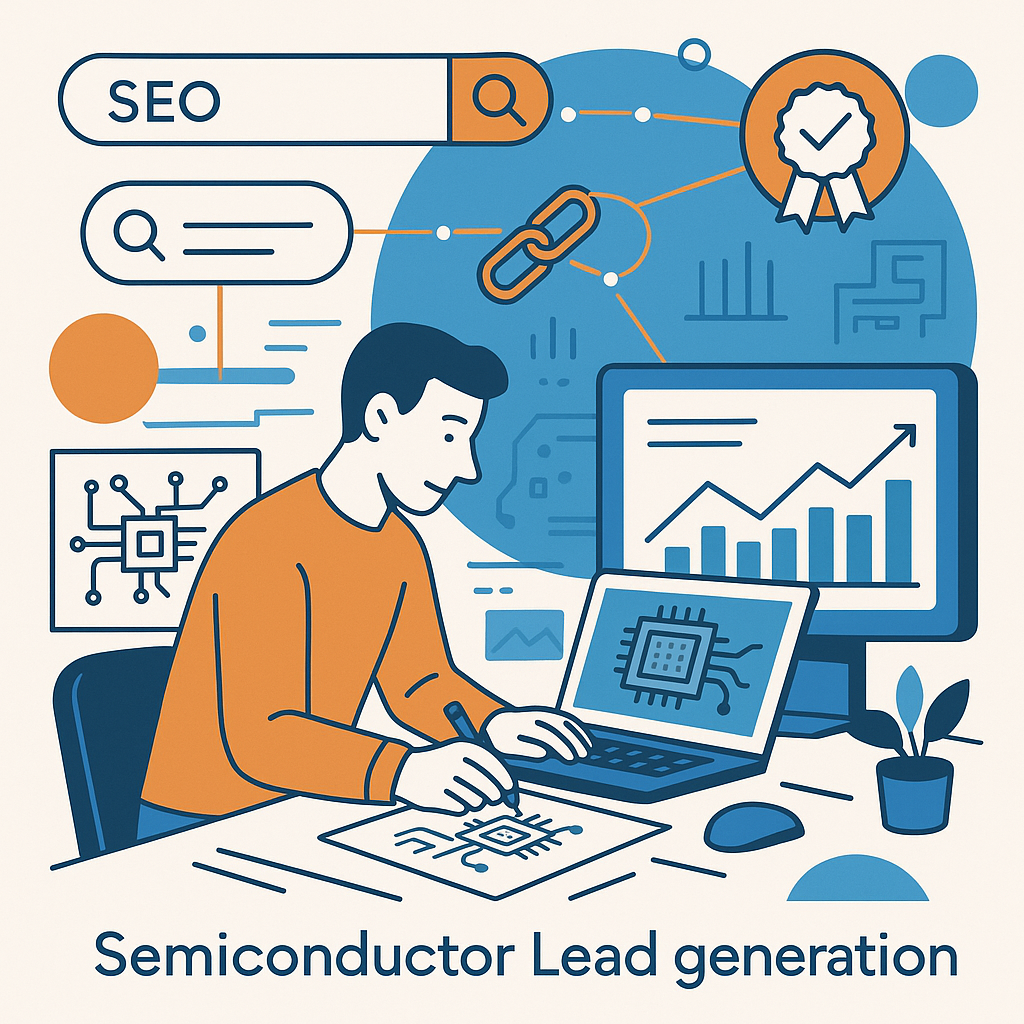
Semiconductor lead generation SEO is the practice of using search — Google rankings and AI citations — to turn engineer research into sample requests, datasheet downloads, and ultimately design wins, by capturing high-intent parametric and problem queries and converting them with the right technical assets. Unlike consumer lead gen, it targets few, expert, high-value buyers across a long cycle, so precision and technical credibility matter more than volume. This guide gives you a repeatable framework.
A "lead" in semiconductors is not a form-fill from a curious browser — it is a design engineer requesting samples for a part they are seriously evaluating. That single request can start a six- or seven-figure design win. Lead generation SEO here is about earning and converting exactly those moments.
The SPARK framework for semiconductor lead generation SEO
We use the SPARK framework to make semiconductor lead gen SEO repeatable — a five-step method from search intent to design win.
The SPARK Framework
S — Search intent capture. Target high-intent parametric, comparison, and problem queries engineers use when evaluating parts.
P — Proof of credibility. Win trust with measured data, standards, and expert authorship so engineers take the next step.
A — Asset-led conversion. Offer the right next asset — samples, datasheet, reference design, calculator — at the point of intent.
R — Reduce friction. Make sample requests and downloads fast, with no unnecessary gating on discovery content.
K — Keep nurturing. Support the long, multi-stakeholder cycle with content for every stage until design-in.
One-sentence definition: SPARK is a five-step framework — Search intent capture, Proof of credibility, Asset-led conversion, Reduce friction, Keep nurturing — for turning engineer searches into semiconductor design wins.
S — Capture the right search intent
Lead gen starts with intent. Target the queries engineers use when they are actively evaluating parts:
- **Parametric queries** — "650V GaN HEMT low RDSon", "AEC-Q101 100V MOSFET" — high purchase intent.
- **Comparison queries** — "SiC vs silicon MOSFET" — consideration stage, close to selection.
- **Problem queries** — "reduce switching losses in half-bridge" — engineers actively designing.
Prioritise by design-win value, not volume. A 90-search parametric term tied to a flagship part outperforms a generic high-volume term.
P — Prove credibility so engineers act
Engineers only request samples from sources they trust. Build that trust on-page:
- Measured performance data with test conditions.
- Cited standards (JEDEC, AEC-Q, IEC).
- Real engineer authorship with credentials (E-E-A-T).
- Honest comparisons that acknowledge trade-offs.
A — Convert with the right asset
At the point of intent, offer the next logical step, not a generic contact form:
- **Sample request** for a specific part the engineer is evaluating.
- **Datasheet download** with full parameters.
- **Reference design or calculator** for the application.
- **Design support** contact with an applications engineer.
R — Reduce friction
Do not gate discovery content — engineers will simply leave. Keep datasheets and app notes freely indexable, and reserve light forms for genuine high-intent actions like sample requests. Fast, mobile-friendly pages with clear next steps convert far better than portal walls.
K — Keep nurturing the long cycle
A design win takes 12–36 months and multiple stakeholders. Support the whole journey with content for discovery, evaluation, validation, and design-in — so when the engineer is ready, you are the obvious choice.
What metrics matter for semiconductor lead gen SEO?
- Sample requests and datasheet downloads from organic and AI referrals.
- Rankings for high-intent parametric and comparison terms.
- AI citation share for evaluation-stage queries.
- Organic and content's assisted role in design wins, tracked in CRM across the cycle.
Frequently asked questions
Should I gate datasheets to capture leads?
No — gating discovery content loses far more engineers than it captures, and makes content invisible to Google and AI. Keep datasheets indexable and reserve light forms for genuine high-intent actions like sample requests.
What counts as a lead in semiconductors?
A high-intent action from a design engineer evaluating your part — most valuably a sample request, but also a datasheet download or a request for design support. These start the design-win cycle.
How does AI search affect lead generation?
Engineers increasingly discover parts through AI engines. Being cited by ChatGPT, Perplexity, and Gemini for evaluation-stage queries feeds high-intent engineers directly into your lead funnel.
The bottom line
Semiconductor lead generation SEO turns engineer searches into design wins by capturing high-intent queries, proving credibility, converting with the right asset, reducing friction, and nurturing the long cycle. Apply the SPARK framework and you turn search visibility into sample requests and, ultimately, design wins.
Written by the Heuristiq Digital team, a specialist semiconductor and deep-tech SEO agency. We developed the SPARK framework to help chip companies turn engineer search into design-win pipeline.
Suggested schema: Article, Author, FAQPage.