
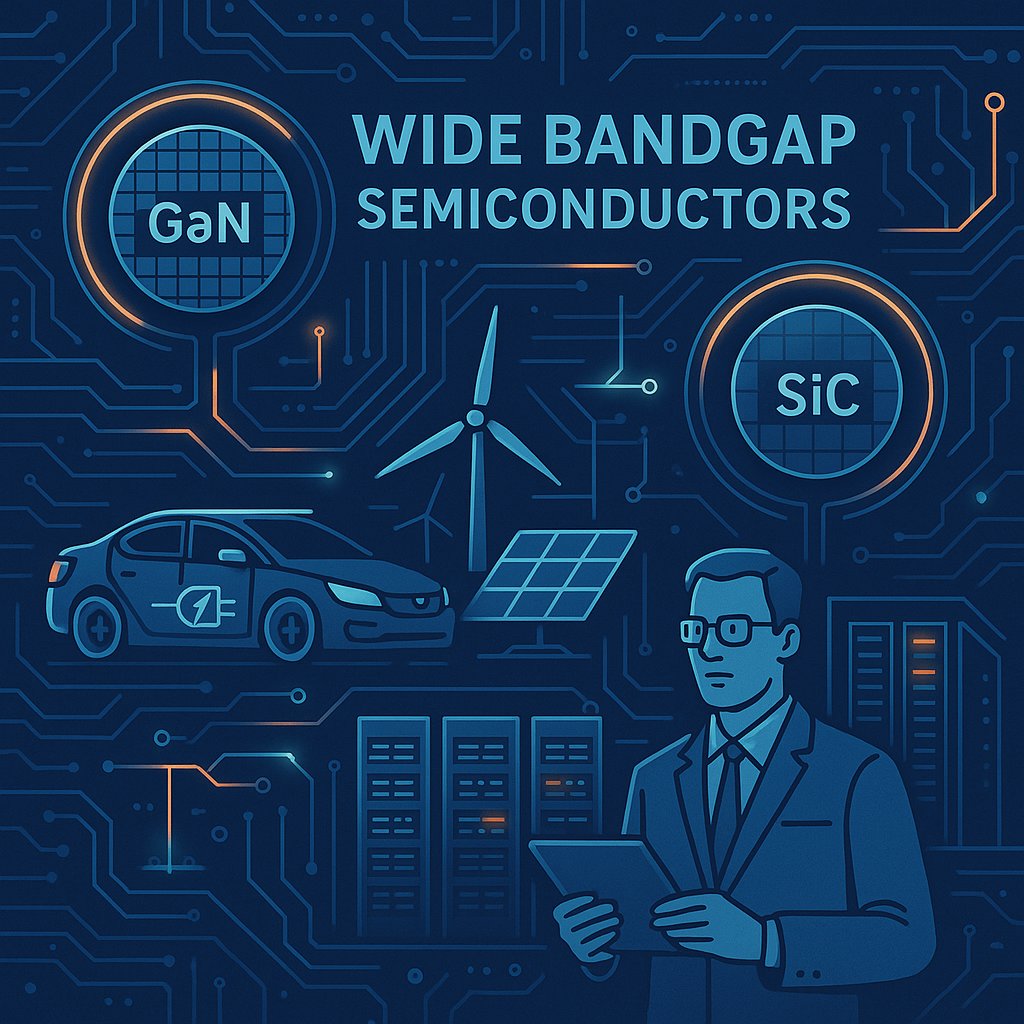
Wide bandgap semiconductors are materials — chiefly gallium nitride and silicon carbide — with a bandgap significantly larger than silicon's, giving them higher breakdown voltage, faster switching, and better high-temperature performance. As a content topic, "wide bandgap semiconductors" is the category page that ties individual material pages together into a single, more authoritative cluster.
"Wide bandgap semiconductor" only averages around 70 searches a month, with a keyword difficulty of 33 — modest next to "gan" or "silicon carbide." On its own, it wouldn't justify much content investment. But its real value isn't as a traffic target. It's as the structural hub that connects every other page in a semiconductor materials content cluster, and that structure is what search engines use to judge whether a site has genuine topical authority on the subject — not just one good page about one material.
Why a category hub matters more than its own search volume
Google and AI search systems increasingly reward sites that demonstrate comprehensive coverage of a topic, not just a single strong page. A site with excellent GaN content and excellent silicon carbide content, but no page connecting the two, misses an opportunity: nothing on the site explicitly tells a search engine "we understand this whole category, not just one material in it." A wide bandgap semiconductors hub page does exactly that job.
This mirrors the pillar-and-cluster structure covered in the main guide to ranking for silicon terms — except here, the hub sits one level below that top-level pillar, specifically tying together the wide-bandgap material family within the broader semiconductor topic.
What belongs on a wide bandgap semiconductors hub page
A clear category definition
Open with what wide bandgap actually means as a category, not just a single material's properties: a bandgap threshold (generally above around 2 eV, though definitions vary slightly by source), the shared physical consequences (higher voltage tolerance, higher operating temperature, faster switching), and which materials qualify — primarily GaN and SiC, with gallium arsenide and other compound semiconductors sometimes included depending on context.
A materials overview table
| Material | Approx. bandgap | Best suited for |
| Silicon (reference) | ~1.1 eV | General-purpose, cost-sensitive electronics |
| Gallium nitride (GaN) | ~3.4 eV | High-frequency switching, compact fast chargers, RF |
| Silicon carbide (SiC) | ~3.3 eV | High-voltage, high-temperature power — EVs, industrial |
| Gallium arsenide (GaAs) | ~1.4 eV | RF, microwave, and photonic applications |
Explicit links to every material and application page in the cluster
This is the part that actually does the SEO work. Every material-specific page — GaN, silicon carbide, gallium arsenide — should be linked from this hub, and the hub itself should be linked from those pages in return. That two-way linking is what turns a collection of separate articles into a cluster a search engine can recognise as a coherent, comprehensive topic.
Suggested hub-and-cluster structure
- Pillar: How to Rank for Silicon Terms
- Category hub: Wide Bandgap Semiconductors (this page)
- Material page: Silicon Carbide
- Material page: Gallium Arsenide
- Comparison page: GaN vs Silicon
- Application page: GaN Power Devices and Applications
A short section on why wide bandgap matters now
The category has real, current momentum: electric vehicle adoption, data centre power efficiency demands, and grid infrastructure upgrades are all driving genuine, ongoing demand for wide bandgap materials — not a speculative trend, but current commercial reality. A short, honestly framed section on this gives the hub page currency and relevance beyond a static definition.
Structuring the hub for extraction
The same discipline that applies to individual material pages applies here, at the category level: a clean definition near the top, a comparison table across the materials rather than just one, question-based subheadings ("What counts as a wide bandgap semiconductor?", "Why are wide bandgap materials replacing silicon?"), and an FAQ block. AI search tools in particular tend to favour category-level pages like this when answering broader questions, since they demonstrate the kind of comprehensive framing a single material page can't.
Frequently asked questions
Is it worth building a hub page for a term with only 70 searches a month?
Yes — its value isn't primarily its own traffic. It's the internal-linking structure and topical authority signal it provides to every material and application page it connects, which affects how those higher-volume pages perform.
Should the hub page be built before or after the individual material pages?
Either order works, but the linking structure matters more than the sequence — as soon as more than one material page exists, connect them through the hub. Waiting until all the material pages are finished before building the hub simply delays the topical-authority benefit.
Key takeaways
- "Wide bandgap semiconductors" has modest search volume on its own, but functions as the structural hub connecting every material and application page in the cluster.
- A materials comparison table across GaN, SiC, and GaAs gives the hub genuine standalone value, not just a linking function.
- Two-way linking between the hub and every material page is what signals comprehensive topical authority to search engines.
- Build the hub as soon as more than one material page exists — don't treat it as an afterthought once everything else is finished.
A strong single page can rank. A properly linked cluster, with a hub tying it together, is what builds lasting authority across an entire category of hard technical terms.