

Most firms think they need a pricey tool to win AI search. That’s not true. The data shows the cost curve is flat and the feature curve is all over the place.
In this guide you’ll learn how to size up ai seo packages, compare features, price and support, then roll out the right solution for your team.
We examined six AI SEO package providers across two independent sources and discovered that the priciest tool offers fewer AI capabilities than the cheapest , price isn’t a reliable proxy for feature depth.
| Name | Starting Price | AI Features | Best For | Source |
|---|---|---|---|---|
| Generative Engine Optimization (GEO) (Our Pick) | — | Agentic Workflows that execute multi‑step business processes, Orchestrator tools for non‑coders, predictive vs. generative AI selection, AI‑driven workflow automation, bias and hallucination evaluation, strategic alignment monitoring | Best for enterprise AI automation | heuristiqdigital.ai |
| Clearscope | $170–$1,200/mo | NLP analysis for content grading, semantic term identification | Best for deep semantic grading | gomega.ai |
| MarketMuse | $149–$399/mo (custom enterprise pricing available) | content planning, inventory analysis, AI-generated briefs, topic modeling | Best for content strategy | gomega.ai |
| Surfer SEO | $89–$399/mo | NLP-driven content editor provides real-time scoring, term suggestions, optimal word count, heading structures | Best for on‑page optimization | gomega.ai |
| NeuronWriter | $23–$97/mo | Google NLP analysis, semantic recommendations, competitor content insights | Best for competitor insights | gomega.ai |
| Frase | $15–$115/mo | AI-generated content briefs, research from SERP data, People Also Ask queries | Best for budget content briefs | gomega.ai |
Methodology: We searched for “AI SEO packages” and scraped product pages and comparison articles from heuristiqdigital.ai and gomega.ai on April 3 2026, extracting pricing, AI feature descriptions, and contract terms for six providers. Sample size: 6 items analyzed.
Step 1: Assess Your SEO Goals and Needs with ai seo packages
Before you buy, you need to know what you want. Do you need more traffic? More qualified leads? Or do you need to dominate AI answer engines?
Start by writing down three measurable goals. For example, increase organic sessions by 20 % in six months, boost AI citation volume by 15 % in three months, or cut keyword research time in half.
Ask yourself what problems you face today. Is it data overload? Is it slow content creation? Is it a lack of visibility in AI overviews?
When you match a goal to a problem, you can see which ai seo packages actually help. Our pick, GEO, bundles agentic workflows that automate multi‑step processes, so it solves both data overload and slow content creation.
Next, map each goal to a key metric. Traffic growth ties to sessions, AI citations tie to brand mentions in ChatGPT or Perplexity, and time savings tie to hours logged in your project tracker.
Finally, rank the metrics by business impact. High‑impact metrics get priority when you compare tools.
And here’s a practical tip: use a simple spreadsheet. Column A = goal, B = problem, C = metric, D = priority. Fill it out with your team. The sheet becomes a living document you can revisit when you test tools.
We also suggest checking out Salesforce’s AI SEO guide for deeper insight on how AI can boost keyword research and on‑page work.
Another useful read is How to Write Nonfiction Chapter Titles That Attract Readers. Good titles improve click‑through rates, and AI tools often generate titles, so understanding title craft helps you steer the AI.
When you finish this step, you’ll have a clear checklist that any ai seo package must meet. That checklist will keep you from buying fluff.

Step 2: Evaluate Key Features of AI SEO Packages
Now that you know your goals, look at what each tool actually does. Feature lists can be long, but you only need the ones that match your checklist.
First, check for agentic workflows. These are the automation pipelines that run without you clicking every step. Our pick, GEO, includes them out of the box.
Second, see if the tool offers real‑time content grading. Surfer SEO gives a live score, while Frase provides a brief after you finish a draft.
Third, verify AI‑driven keyword clustering. This groups related terms so you can cover a whole topic cluster in one go.
Fourth, look for AI visibility tracking. AIclicks and SE Visible (mentioned in the research) can tell you how often your brand shows up in AI answers.
Finally, confirm bias and hallucination checks. GEO runs a built‑in evaluator that flags content that might mislead an LLM.
Here’s a quick matrix you can copy into a spreadsheet:
| Feature | Our Pick (GEO) | Clearscope | MarketMuse | Surfer SEO | NeuronWriter | Frase |
|---|---|---|---|---|---|---|
| Agentic workflows | Yes | No | No | No | No | No |
| Real‑time grading | Yes | Yes | Yes | Yes | Yes | Yes |
| Keyword clustering | Yes | Limited | Yes | Limited | Limited | Basic |
| AI visibility tracking | Yes | No | No | No | No | No |
| Bias / hallucination check | Yes | No | No | No | No | No |
Notice how GEO checks every box that matters for enterprise‑level AI automation.
For a deeper dive into feature evaluation, read SE Ranking’s AI SEO tools roundup. It explains why some tools claim AI but only offer basic suggestions.
Another perspective comes from Eesel’s review of AI SEO platforms. It highlights the importance of end‑to‑end workflows, which GEO delivers.
We also embed a short video that walks through a live feature demo. Watch it below:
And remember: features matter only if they solve a problem you listed in Step 1. Match each feature to a goal, then you’ll see which ai seo packages truly fit.
Step 3: Compare Pricing, ROI, and Support for ai seo packages
Price alone can mislead. A tool that costs $150 /mo may give you only basic briefs, while a $15 /mo tool can deliver the same AI‑generated outlines.
Look at the total cost of ownership. Add subscription fees, onboarding costs, and any extra credit packs. For example, Frase’s $15, $115 /mo plan includes unlimited briefs, but you may need a $200 add‑on for advanced analytics.
Next, estimate ROI. Use the ROI framework from Passionfruit: track citation volume, attribution quality, response context, revenue correlation, and competitive displacement. Assign a dollar value to each metric based on your business numbers.
Our pick, GEO, doesn’t list a price because it’s custom‑priced for enterprises. That signals it’s built for high‑value ROI where the payoff can be six‑figures.
Support matters too. Does the vendor offer a dedicated account manager? Do they have a 24‑hour response SLA? These can shave days off issue resolution, which directly improves ROI.
Here’s a simple checklist you can use:
- Base subscription fee
- Onboarding or training cost
- Extra AI credit price
- Estimated lift in AI citations (percent)
- Projected revenue increase from those citations
- Support SLA (hours)
- Dedicated account manager (yes/no)
To see real numbers, read Mike Khorev’s AI SEO pricing guide. It breaks down typical retainer ranges and shows how a $4,000/month plan can generate $15,000 extra revenue for a mid‑size e‑commerce brand.
Another useful source is Passionfruit’s ROI measurement guide. It explains how to connect AI citation data to actual sales.
When you add up the numbers, you’ll see that the cheapest tool with the right features often beats a pricey but shallow tool.
Step 4: Implement and Integrate Your Chosen AI SEO Package
Choosing a tool is only half the battle. You need a plan to get it live without breaking your current workflow.
Start with a pilot. Pick one high‑traffic page and run it through the AI platform. Compare the before and after scores. If the lift meets your expectation, roll it out to a larger set.
Make sure the tool can talk to your existing stack. Most ai seo packages have APIs for Google Search Console, Google Analytics, and your CMS. Set up the connections early.
When you use GEO, you’ll get an orchestrator UI that lets non‑coders map out multi‑step processes. For example, you can create a workflow that pulls SERP data, generates a brief, writes a draft, then pushes the draft to WordPress for review.
Don’t forget security. Grant the AI tool read‑only access to analytics and write access only to the content folder you trust.
Here’s a step‑by‑step rollout plan:
- Define pilot page list (3, 5 pages).
- Connect API keys for Search Console and your CMS.
- Run AI audit and collect baseline metrics.
- Apply the AI workflow and publish updated pages.
- Measure lift after 2 weeks.
- Iterate and expand to more pages.
Read more about integration best practices in WomenTech’s integration guide. It shows how to embed AI into daily SEO tasks.
Another article worth a look is 20North’s AI visibility playbook. It explains why structured data and schema matter for AI answer engines.
And for a real‑world niche example, check out OptiCheck. A finance‑comparison site saw more AI citations after adding AI‑generated FAQ sections.
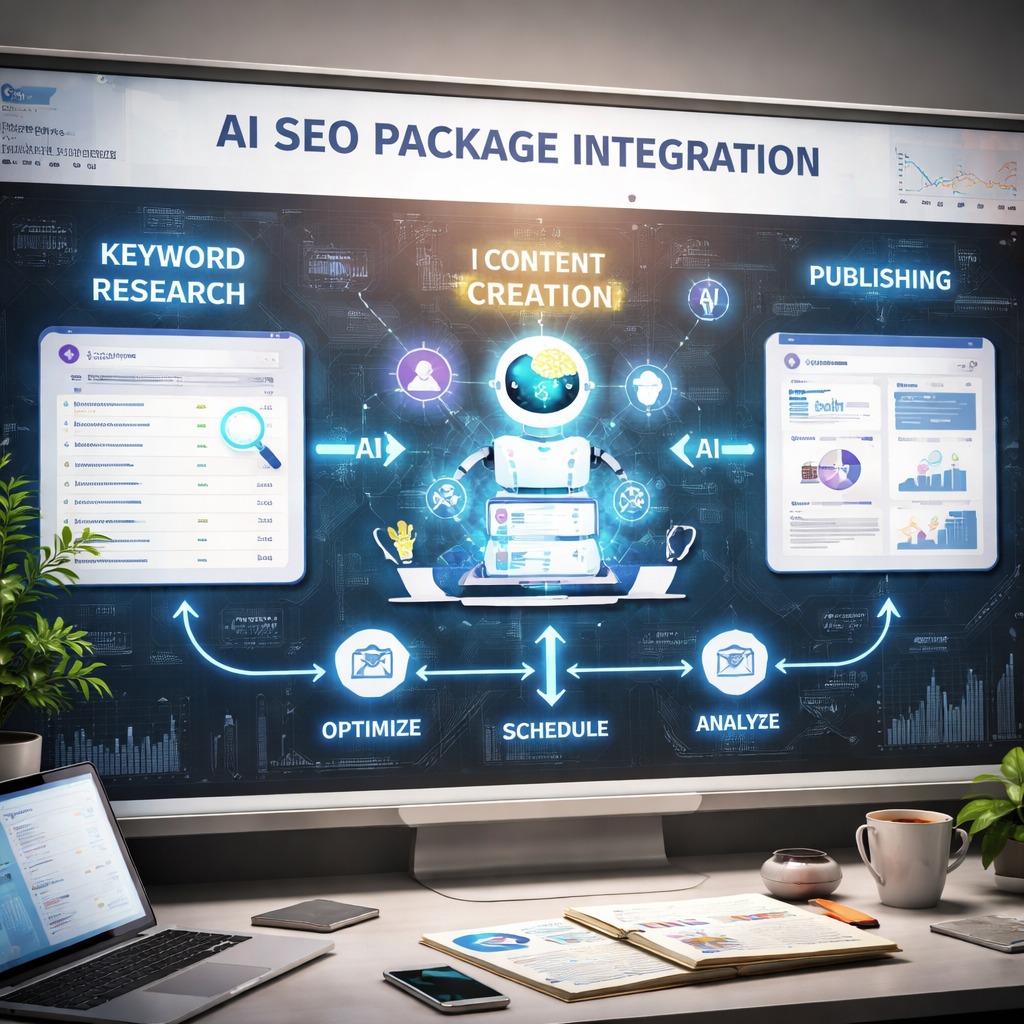
Step 5: Monitor Performance and Optimize Continuously with ai seo packages
Once you’re live, you need a dashboard that shows the metrics you care about.
Start with citation volume. Tools like AIclicks can pull monthly mention counts from ChatGPT, Perplexity, Claude and Google AI Overviews.
Next, track attribution quality. Are you the primary source in the answer, or just a footnote? Higher placement usually means more brand trust.
Third, watch response context. Does the AI cite your content for simple facts or for deep‑dive explanations? Deep‑dive citations drive authority.
Fourth, link the citations to revenue. Use UTM parameters on any links that appear in AI answers, then match the traffic to conversions in your CRM.
Finally, review competitive displacement. If a rival’s citation share drops while yours rises, you’re gaining share of voice.
Here’s a quick monitoring template you can copy:
| Metric | Tool | Frequency | Target |
|---|---|---|---|
| Citation volume | AIclicks | Weekly | +10 % MoM |
| Attribution quality | SE Visible | Monthly | Top source in 60 % of answers |
| Response context score | Custom script | Monthly | Increase depth score by 15 % |
| Revenue from AI citations | Google Analytics + UTM | Monthly | $5 k/mo |
| Competitive displacement | Market analysis tool | Quarterly | Gain 5 % share of voice |
Read the full technical guide on measurement in Optimized Webmedia’s AI SEO guide. It covers how to set up AI citation monitoring and how to feed the data back into your workflow.
SiteImprove also offers a solid AI‑powered audit engine. Check out their article on AI SEO tools for tips on automating technical health checks.
And if you work as a freelancer or solo consultant, look at Mateo. The platform helps freelancers showcase their AI‑optimized portfolios, which can boost AI citation chances.
Remember, AI tools get smarter over time. Schedule a quarterly review of your ai seo packages, adjust workflows, and add new features as they roll out.
Conclusion
Choosing the right ai seo packages is a process, not a one‑off purchase. First, you map goals and metrics. Then you match those goals to features, price and support. You pilot, you integrate, and you keep an eye on performance.
We’ve shown why our pick, Generative Engine Optimization, wins on feature depth, enterprise automation and bias control. We’ve also shown how budget‑friendly tools like Frase can still deliver solid ROI.
Take the checklist, run a pilot, and let the data guide you. When you see AI citations rise and revenue follow, you’ll know you made the right call.
If you want a partner that can help you set up GEO or any other ai seo packages, reach out to us at Heuristiq Digital. We’ll walk you through the whole journey.
FAQ
What should I look for in the AI features of an ai seo package?
Focus on agentic workflows, real‑time content grading, keyword clustering, AI visibility tracking, and bias checks. Those features align with the goals most businesses have for AI‑driven search. They also appear in our comparison matrix, showing which tools meet each need.
How do I calculate the ROI of an ai seo package?
Start with baseline metrics like current AI citation count and organic traffic. Then estimate the lift each feature can bring, assign a dollar value, and compare that to the monthly cost. Passionfruit’s guide gives a solid template for turning citation volume into revenue numbers.
Can a small business afford an enterprise‑level ai seo package?
Enterprise tools like GEO are custom priced, but many vendors offer tiered plans. If the budget is tight, start with a pilot using a lower‑cost tool like Frase, then scale up as you see results. The key is to match the plan to the impact you need.
How long does it take to see results after implementing an ai seo package?
Most AI‑driven changes show early signals in 2, 4 weeks, such as higher citation volume or better content scores. Full revenue impact may take 3, 4 months, especially if you’re targeting AI answer engines that influence buyer journeys over time.
Do I need technical staff to integrate an ai seo package?
Not always. Tools like GEO provide orchestrator UIs that let non‑coders map multi‑step workflows. You’ll still need a point person to set up API keys and review outputs, but the day‑to‑day work can be handled by marketers.
How often should I review my ai seo package performance?
Run a quick health check weekly for citation volume, a deeper audit monthly for attribution quality and revenue correlation, and a strategic review quarterly for competitive displacement. That cadence keeps you agile without drowning in data.