
How to Rank for Silicon Terms: The Content Framework Behind a Top 5 "Gallium Nitride" Ranking
The Bandgap Method is a six-step content framework for ranking a manufacturer's own website against encyclopaedias, distributors, and physics resources for hard, high-volume semiconductor material terms — built from watching what actually took a gallium nitride technology page to position 5 for "gallium nitride," and what happened when that page's URL was changed without a redirect.
"Gallium nitride" is not a forgiving keyword. It averages roughly 12,100 searches a month, carries a keyword difficulty score in the low 50s, and the page one results are dominated by Wikipedia, physics and materials-science resources, and the handful of semiconductor manufacturers who've genuinely earned their place there. A vendor's own technology page reaching position 5 for a term like that is a real result — not a fluke, and not something achieved by a thin "what is GaN" explainer.
This guide breaks down why that term is hard, what it actually takes to compete for it, and a repeatable framework — built around the physics concept that makes GaN what it is — for applying the same approach to any other difficult "silicon term" in your own content: silicon carbide, gallium arsenide, wide bandgap semiconductors, and the rest.
Why "gallium nitride" is worth studying as a hard keyword
Semiconductor material terms sit in an unusual spot in search. They're technical enough that Google leans heavily on established, authoritative sources — but popular enough, thanks to GaN's rise in fast chargers, EVs, and data centre power supplies, that the volume is real and commercially meaningful.
Two things stand out. First, the bare material name ("gan," "silicon carbide," "gallium nitride") is always harder than the qualified, more specific version ("gan technology," "gan semiconductor") — bare terms attract encyclopaedic and news competition, while qualified terms are where a manufacturer's own content has a realistic shot. Second, difficulty doesn't track volume in a straight line — "silicon nitride" has identical volume to "gallium arsenide" but a meaningfully easier difficulty score, which matters when deciding where to spend content effort first.
How hard is "gallium nitride," really?
| Keyword | Est. monthly volume | Keyword difficulty |
| gan | 27,100 | 72 |
| silicon carbide | 22,200 | 47 |
| gallium nitride | 12,100 | 53 |
| gallium arsenide | 1,300 | 41 |
| silicon nitride | 1,300 | 31 |
| gan semiconductor | 480 | 54 |
| gan technology | 390 | 34 |
Search volume and difficulty data via Semrush, US database.
What gallium nitride actually is (and why the definition matters)
Gallium nitride (GaN) is a wide-bandgap compound semiconductor — meaning the energy gap between its valence and conduction bands (around 3.4 eV, roughly three times silicon's 1.1 eV) is much larger than in traditional silicon. That wider bandgap lets GaN switch faster, handle higher voltages, and run cooler than silicon in the same footprint, which is why it's replacing silicon in fast chargers, EV power electronics, data centre power supplies, and RF amplifiers.
This single, precise definition is doing three jobs at once. It's the kind of clean, extractable statement that wins definition snippets and gets lifted directly by AI answer engines. It signals genuine technical expertise rather than marketing fluff, which matters for a manufacturer competing against physics reference sites. And it sets up the comparison to silicon that almost every real searcher for this term is implicitly asking for, even when their query doesn't say "vs silicon" outright.
The case study: position 5, then back to zero
One of the clearest examples of this playbook working is Navitas Semiconductor's GaN technology page, which held position 5 for "gallium nitride" — a term averaging over 12,000 searches a month against a field dominated by Wikipedia and materials-science publishers. For a manufacturer's own commercial page to sit inside the top five results for a term that hard is a genuinely strong outcome, and not one achieved by accident.
The page was later moved to a new URL without the old one being preserved or redirected. The ranking didn't transfer with it — it reset, and the page dropped out of contention for the term entirely. This is the part worth taking seriously in its own right: strong content doesn't protect a ranking from a careless migration. All the accumulated trust, links, and relevance signals a URL builds up live at that specific address, and moving it without a 301 redirect throws that history away rather than carrying it forward.
The Bandgap Method
The name comes directly from the physics: a wide enough bandgap is what separates GaN from ordinary silicon, and a wide enough gap between your content and the shallow "what is GaN" explainers already ranking is what separates a page that reaches position 5 from one that never breaks into the top twenty. Six steps, applied in order.
Own the definition
Lead with a precise, correct, quotable definition — the kind shown above — within the first few sentences. Don't bury it under a paragraph of introduction. This is the single highest-leverage sentence on the page for both snippet capture and AI citation.
Prove the physics
Back the definition with real, verifiable technical detail: bandgap energy, breakdown voltage, electron mobility, switching frequency, thermal characteristics. This is where genuine manufacturer expertise pulls ahead of generic explainer content — a physics resource can define GaN, but only a company that makes the devices can credibly explain how those properties translate into real device performance.
Compare the alternative
Every hard semiconductor material term carries an implicit comparison. Almost nobody searches "gallium nitride" out of pure curiosity about the material in isolation — they're evaluating it against silicon, or against silicon carbide, for a real design decision. A clear, honest comparison table (switching speed, efficiency, size, cost, typical applications) answers the question the searcher actually has, not just the one they typed.
Show the application
Abstract material properties only matter if they're grounded in what they enable. Cover the real use cases — fast chargers, EV traction inverters, data centre power supplies, RF and radar systems — with enough specificity to be useful to an engineer evaluating the material for a project, not just a marketer skimming for buzzwords.
Structure for extraction
Question-based subheadings, a clean definition near the top, a comparison table, and an FAQ block at the end. This is what lets Google's snippet system and AI answer engines lift a clean, accurate answer and attribute it to the page — increasingly how technical searches get answered before a click ever happens.
Maintain and protect the URL
Keep the content current as the technology moves, and treat the URL itself as an asset. If a redesign or migration is ever necessary, a 301 redirect from the old URL to the new one is non-negotiable — it's the difference between carrying a hard-won ranking forward and starting from zero, which is exactly what happened in the case above.
The Bandgap Method, at a glance
- Own the definition — a precise, quotable answer near the top.
- Prove the physics — real technical detail, not marketing language.
- Compare the alternative — answer the implicit "vs silicon" question directly.
- Show the application — ground the material in real, specific use cases.
- Structure for extraction — headings, tables, and FAQ built for snippets and AI.
- Maintain and protect the URL — treat the address itself as an asset worth redirecting, never abandoning.
Applying it beyond gallium nitride
The same method applies directly to every other hard silicon term in the table above. A silicon carbide page follows an identical structure — definition, physics, the SiC-vs-silicon (and SiC-vs-GaN) comparison, applications in EVs and industrial power, extraction-ready formatting, and a protected URL. The material changes; the framework doesn't.
This is also where a pillar-and-cluster structure pays off. A single strong page can't realistically rank at the top for "gan," "gallium nitride," "silicon carbide," and "gallium arsenide" all at once — each deserves its own page built to the same method, cross-linked from a central hub page that ties the whole semiconductor materials topic together. That structure signals topical authority across the full subject, not just isolated relevance to one term.
Image and diagram brief
Technical credibility on a page like this comes through visually as much as it does in the copy. These are the visual assets worth building for a page targeting a hard material term:
1. Bandgap comparison chart
A simple horizontal bar or scale showing GaN's ~3.4 eV bandgap against silicon (~1.1 eV) and silicon carbide (~3.3 eV) — makes the core technical claim instantly visual.
2. Crystal structure diagram
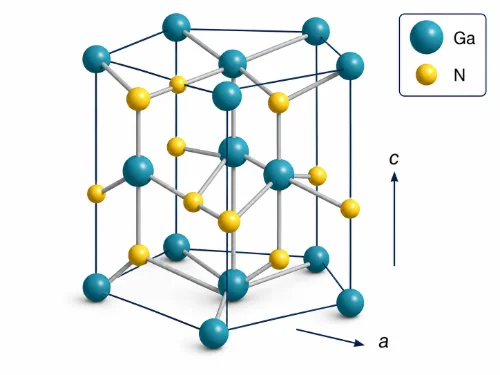
A labelled illustration of the GaN crystal lattice, ideally alongside silicon's, for readers who want the underlying materials-science picture.
3. Device cross-section diagram
A simplified GaN transistor structure diagram, showing how the material properties translate into an actual device.
4. GaN vs silicon comparison graphic
A visual companion to the comparison table — size/weight reduction in a charger, or efficiency curve, told as an image rather than only numbers.
5. Application icons/photography
Real product photography or clean iconography for each use case — fast chargers, EV inverters, data centre power, RF/radar — placed alongside the applications section.
6. Efficiency / power density chart
A chart showing power density or switching frequency gains over silicon — the kind of specific, sourced chart other sites are likely to embed and link back to.
Each of these does double duty: they make a technical page genuinely easier to understand, and well-labelled, original diagrams are exactly the kind of asset other engineering blogs and resource sites embed with a credit link — a natural source of the backlinks that hard technical terms need.
FAQs
Can a manufacturer's page really outrank general reference sites for a term like "gallium nitride"?
Not the raw, bare term at position one in most cases — that spot is usually held by encyclopaedic sources. But reaching the top five, as shown in the case above, is realistic when the page combines genuine technical depth with the structural signals Google and AI search rewards, and it captures a large share of the qualified, more specific variations along the way.
What's the single most damaging mistake for a page ranking on a hard technical term?
Changing the URL without a 301 redirect. It's the exact failure behind the case study in this guide — the content itself didn't get worse, but the ranking history tied to that specific address was lost entirely.
Should every hard material term get its own page, or one combined page?
Separate pages per material, linked together from a central hub. A single page trying to rank for "gallium nitride," "silicon carbide," and "gallium arsenide" simultaneously dilutes relevance for each one — a focused page per term, built to the same method, performs better across the board.
Your Title Goes Here
- "Gallium nitride" and terms like it are genuinely hard — high volume, high difficulty, and dominated by reference and physics sources — but a manufacturer's own page can compete with the right depth and structure.
- The Bandgap Method — definition, physics, comparison, application, extraction-ready structure, and URL protection — is the repeatable version of what took one real GaN page to position 5.
- A URL migration without a redirect can erase a hard-won ranking overnight, independent of content quality.
- The same method scales across every other difficult silicon term, built as a proper pillar-and-cluster structure rather than one page trying to cover everything.
The gap between a page that ranks for "gallium nitride" and one that doesn't isn't luck, and it isn't a secret. It's depth, structure, and treating the URL as carefully as the content itself.
More on this subject:

How High Tech Marcoms Drive UK Growth
Silicon Nitride vs Gallium Nitride: Why This Confusion Is a Content Opportunity

How to Rank for “Silicon Carbide”: Content Ideas for the Web’s Toughest Power Semiconductor Term
How to Rank for “Gallium Arsenide”: Content Ideas for RF and Photonics Search Terms

GaN vs Silicon: How to Build the Comparison Content That Actually Ranks