
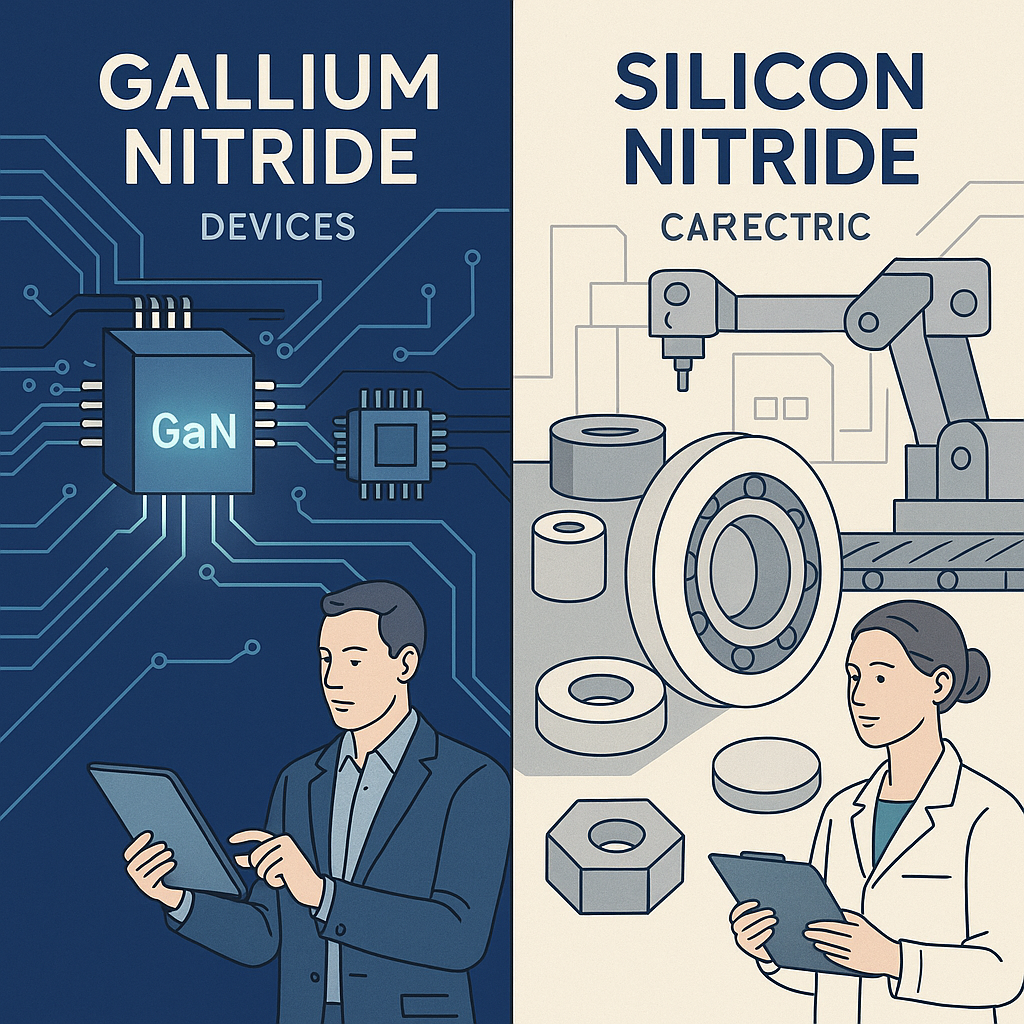
Silicon nitride (Si₃N₄) is a hard, electrically insulating ceramic compound used as a dielectric and structural material in electronics and manufacturing; gallium nitride (GaN) is a wide-bandgap semiconductor used to build power transistors and RF devices. They share part of a name and occasionally appear in the same device, but they are not variations of the same material and are not interchangeable.
"Silicon nitride" averages around 1,300 searches a month with a keyword difficulty of 31 — similar volume to gallium arsenide, and meaningfully easier than "gallium nitride" itself. Some share of that traffic is almost certainly people who mean to search for GaN, or who genuinely aren't sure which material they're looking for. That confusion, handled well, is a legitimate and underused content opportunity — a clear, accurate disambiguation page is exactly the kind of content search engines and AI answer tools favour for genuinely ambiguous queries.
Why the confusion exists
The names overlap by one word, both materials are used in semiconductor manufacturing, and — critically — silicon nitride actually does appear as a layer within GaN device structures, used as a passivation and dielectric layer. That real, technical connection is exactly what makes the confusion so persistent: it's not baseless. Someone researching GaN devices may well encounter "silicon nitride" in a datasheet or a fabrication description and reasonably wonder how the two relate.
| Silicon Nitride (Si₃N₄) | Gallium Nitride (GaN) | |
| Material class | Ceramic / dielectric insulator | Wide-bandgap compound semiconductor |
| Electrical behaviour | Electrical insulator | Semiconductor — conducts under controlled conditions |
| Typical role | Passivation layers, structural ceramics, insulating coatings | Power transistors, RF amplifiers, LEDs |
| Relationship to GaN devices | Often used as a passivation/dielectric layer within GaN device structures | The active semiconductor material itself |
What belongs on a disambiguation page like this
Answer the confusion directly, in the first few sentences
Don't bury the clarification under a long introduction — someone landing on this page wants the "are these the same thing" question answered immediately, then explained. This is the single most important design decision for this kind of content, and it's what makes it genuinely useful rather than just SEO padding.
Explain the real connection, not just the difference
The strongest version of this content doesn't just say "these are different" — it explains why they get confused, including the genuine technical link (silicon nitride as a passivation layer in GaN devices). This is what turns a simple disambiguation page into something a working engineer would actually bookmark, rather than a generic "these words look similar" article.
Link outward to both full material pages
A disambiguation page is a routing page, not a destination. Once the confusion is resolved, send GaN-focused readers to the gallium nitride pillar and readers who genuinely need silicon nitride information — passivation layers, dielectric properties, structural ceramics — toward dedicated content on that material if it exists, or clearly signal that it's outside this cluster's scope if it doesn't.
Use the format AI answer engines favour for this exact query type
"X vs Y, are they the same" queries are precisely the kind of question AI search tools are built to answer directly and concisely. A short, accurate, well-structured answer near the top of the page — the definition comparison above is a good model — has a strong chance of being the exact passage an AI tool extracts and cites.
Why this content genuinely helps the wider cluster, not just this one term
A well-built disambiguation page does two jobs the rest of the cluster can't do alone. It intercepts genuinely confused searchers before they bounce off a page that assumes they already know which material they mean, and it demonstrates a level of precision and honesty — actively pointing out where confusion is understandable rather than pretending the two terms are unrelated — that reinforces the site's credibility across every other page in the cluster.
Frequently asked questions
Is silicon nitride ever used as an alternative to gallium nitride in devices?
No — they serve entirely different roles. Silicon nitride is an insulator used for passivation and structural purposes, while gallium nitride is the active semiconductor material. Silicon nitride can appear as a layer within a GaN device, but it isn't a substitute for GaN's semiconducting function.
Is a disambiguation page worth building for a relatively low-volume, low-competition term?
Yes, particularly here — the low keyword difficulty makes it realistically winnable quickly, and its role in intercepting confused searchers and reinforcing site-wide credibility outweighs its modest standalone volume.
Key takeaways
- Silicon nitride and gallium nitride are unrelated in function — an insulating ceramic versus a semiconductor — despite the overlapping name.
- The genuine technical connection (silicon nitride as a passivation layer in GaN devices) is what makes the confusion understandable, and explaining it builds more trust than a flat "these are different" statement.
- This is a low-difficulty, quick-to-rank page that functions as a routing and credibility asset for the wider cluster, not just a standalone traffic target.
- Structure the answer for direct extraction — this exact "are X and Y the same" query type is a strong candidate for AI answer citation.
Confusion between two similarly named materials isn't a problem to work around — clarified well, it's one of the easiest, fastest wins available in a technical content cluster.