
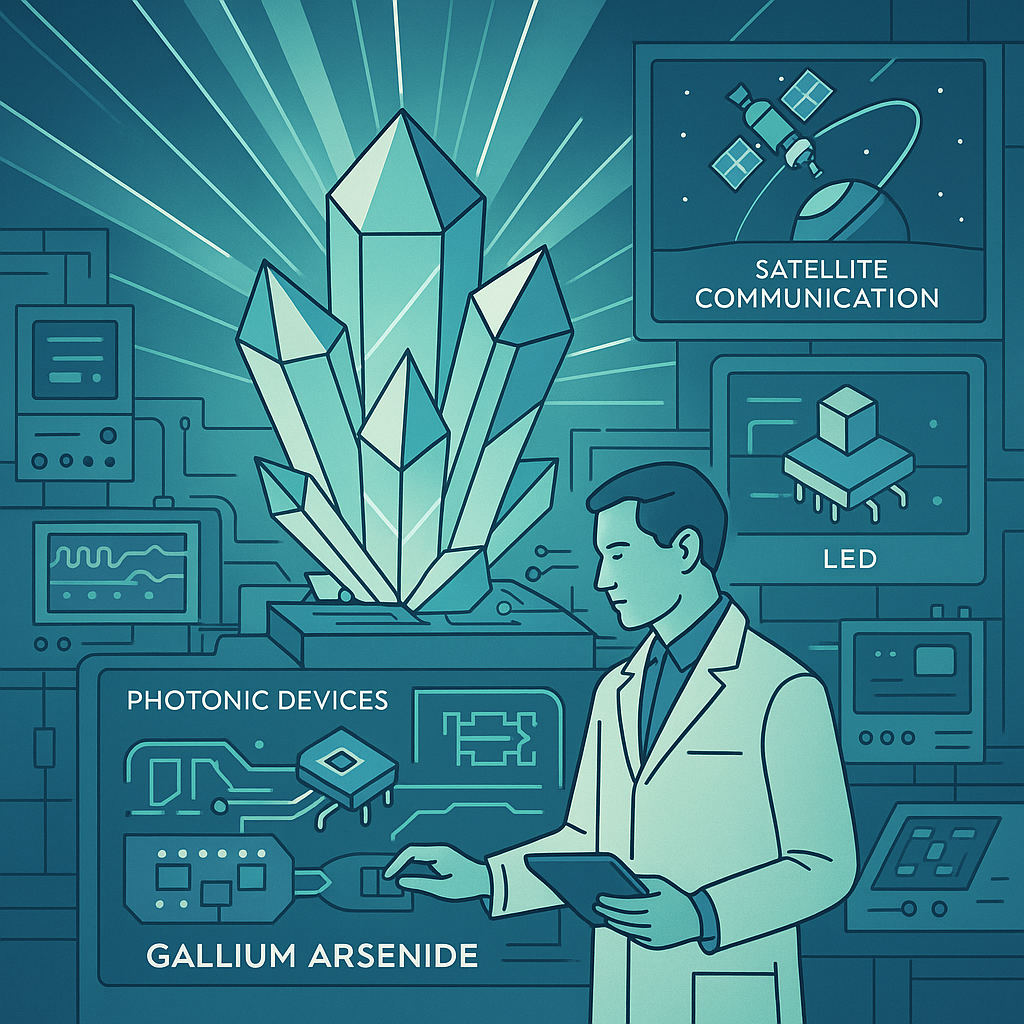
Gallium arsenide (GaAs) is a compound semiconductor with a direct bandgap of around 1.4 eV and notably higher electron mobility than silicon, which makes it the material of choice for high-frequency RF, microwave, and photonic applications — smartphones' RF front-ends, satellite communications, and LEDs among them — rather than the high-power switching roles GaN and SiC dominate.
"Gallium arsenide" averages around 1,300 searches a month with a keyword difficulty of 41 — comparable in volume to "silicon nitride," and meaningfully easier than "gallium nitride" or "silicon carbide." It's also, importantly, a different conversation entirely. Where GaN and SiC content gets built around power electronics — chargers, EV inverters, industrial power — gallium arsenide content needs to be built around RF, microwave, and photonics, because that's where the material is actually used and where real searchers are coming from.
Why gallium arsenide needs its own angle, not a repurposed GaN page
It's tempting to treat every compound semiconductor page as a variation on the same template. That's a mistake specifically with GaAs. Its defining advantage isn't voltage handling or switching frequency in the power-electronics sense — it's electron mobility and a direct bandgap, which translate into excellent high-frequency RF performance and efficient light emission, not the fast-charger and EV use cases that dominate GaN and SiC search intent.
A gallium arsenide page built with the same application section as a GaN page — chargers, EV inverters, data centre power — would be technically wrong and would signal exactly the kind of shallow, templated content that fails to compete for a term this specific.
| Gallium Arsenide (GaAs) | Gallium Nitride / Silicon Carbide | |
| Core advantage | High electron mobility, direct bandgap | Wide bandgap, high voltage/frequency handling |
| Primary domain | RF, microwave, photonics | Power electronics |
| Typical products | Smartphone RF front-ends, satellite comms, LEDs, laser diodes | Chargers, EV inverters, industrial power supplies |
Building the page: what belongs on it
Own the definition, with the right emphasis
Lead with GaAs's direct bandgap and high electron mobility — not a generic "it's a compound semiconductor like GaN" framing that borrows relevance from a different material's search intent. Precision here matters as much for topical accuracy as it does for search performance.
Prove the physics that actually matter for RF and photonics
Electron mobility figures, direct-versus-indirect bandgap behaviour (and why that matters specifically for light emission and lasers), and high-frequency performance characteristics are the technical details a genuine RF or photonics audience is looking for — not switching-loss figures that belong on a power-electronics page.
Show the real applications
- **RF front-end modules** in smartphones and wireless infrastructure, where GaAs handles the high-frequency amplification silicon struggles with.
- **Satellite and space communications**, where GaAs solar cells and RF components are standard due to efficiency and radiation tolerance.
- **LEDs and laser diodes**, which rely on GaAs's direct bandgap for efficient light emission — a genuinely different application category from anything GaN or SiC content should be claiming.
- **Microwave and defence systems**, a long-established GaAs use case worth naming specifically for technical credibility.
Compare it honestly against GaN, where relevant
There's a real, narrower overlap worth covering: GaN has increasingly moved into RF applications historically dominated by GaAs, particularly at higher power levels. A short, honest section on where GaN is displacing GaAs in RF, and where GaAs still holds its ground (cost-sensitive, lower-power RF), captures a genuine and growing search intent without pretending the two materials compete across the board the way GaN and SiC do.
Structure for extraction
The same core structure applies: a precise definition, question-based subheadings suited to this material's actual use cases ("What is gallium arsenide used for?", "Why is GaAs used in RF chips instead of silicon?"), and an FAQ block addressing the specific, recurring questions this audience asks.
Why this term rewards precision over volume
At 1,300 searches a month, gallium arsenide will never carry the raw traffic of "gan" or "silicon carbide." But its audience is unusually specific — RF engineers, photonics specialists, and procurement teams in those fields — which means well-targeted content converts disproportionately well relative to its search volume, and is more likely to earn links from specialist RF and photonics publications precisely because so little generic content gets this material right.
Frequently asked questions
Is gallium arsenide competing with GaN and SiC for the same applications?
Only partially, and mainly in RF. GaAs's core strength is high-frequency and photonic applications, while GaN and SiC dominate power electronics — there's a narrower, real overlap in RF where GaN is increasingly competitive, but treating the three as fully interchangeable misrepresents how each is actually used.
Should a gallium arsenide page link to the GaN and SiC content in this cluster?
Yes, particularly through the wide bandgap semiconductors hub and the GaN-in-RF comparison section — this signals topical breadth across the compound semiconductor category without blurring each material's distinct application focus.
Key takeaways
- Gallium arsenide's real content angle is RF, microwave, and photonics — not power electronics, which is where GaN and SiC content belongs.
- Precise, application-specific technical detail outperforms a templated "compound semiconductor" page reused across materials.
- The genuine GaN-vs-GaAs overlap in RF is worth covering honestly, without overstating how much the materials compete elsewhere.
- Lower volume here is offset by a highly specific, high-value audience that generic competing content usually gets wrong.
Getting gallium arsenide right means resisting the urge to reuse a GaN template — the material, the audience, and the questions they're asking are genuinely different.