A materials definition page answers "what is GaN." An applications page answers "what can I actually build with it" — and that second question, asked by someone much closer to a real design or purchasing decision, deserves its own content built to a different format entirely.
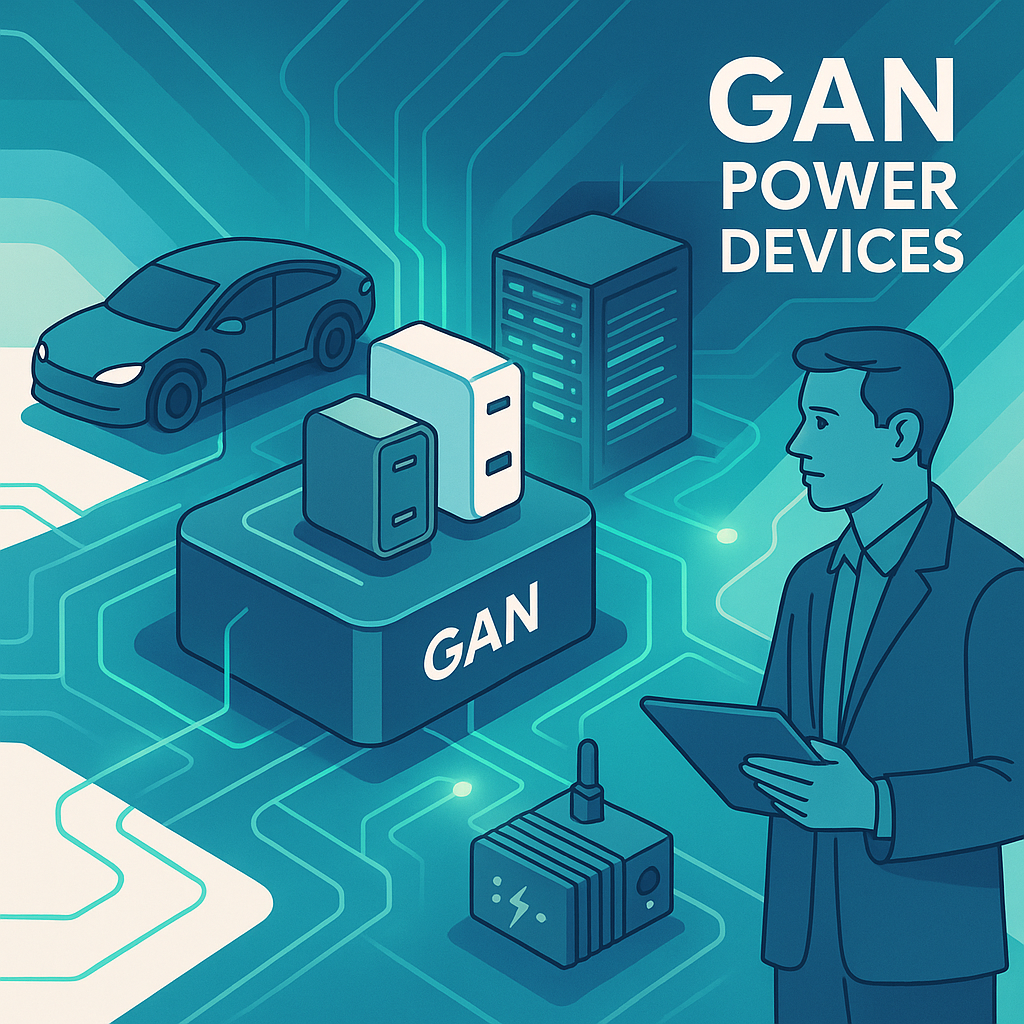
GaN power devices are transistors and integrated circuits built on gallium nitride that switch faster and run more efficiently than silicon equivalents, primarily used in fast chargers, data centre power supplies, electric vehicle power electronics, and RF amplifiers — each a distinct application with its own specific technical requirements worth covering separately.
"GaN power devices" and "GaN technology" together average several hundred searches a month, with difficulty scores in the mid-30s — meaningfully easier than the bare material terms, and populated by an audience actively evaluating GaN for a specific product category rather than researching the material in the abstract.
Why this content needs a Power List, not a definition
Every application of GaN power devices has its own specific engineering context, and treating them as a single generic list — "GaN is used in chargers, EVs, and more" — wastes the opportunity to actually rank for the specific searches each one generates. The stronger structure is a Power List: a small number of genuinely well-covered applications, each expanded with what it is, why GaN matters there specifically, and how it's actually implemented, rather than a long, shallow list padded to look comprehensive.
The applications worth building out in full
1. Fast chargers and adapters
This is GaN's most visible consumer application, and the one most searchers already have some awareness of. What it is: compact, high-wattage USB-C chargers that fit GaN transistors into a fraction of the size of an equivalent silicon charger. Why GaN matters here: higher switching frequency lets designers use smaller transformers and passive components, which is the entire reason GaN chargers can be a third the size of silicon ones at the same power output. How it's implemented: typically a GaN power stage paired with USB-C Power Delivery controllers, in multi-port designs increasingly common in premium chargers.
2. Data centre power supplies
What it is: the power conversion stages inside server power supplies and busbar systems that convert AC mains to the DC voltages servers need. Why GaN matters here: data centres are under constant pressure to improve power density and reduce energy loss at scale — even small efficiency gains compound into meaningful savings across thousands of racks. How it's implemented: GaN devices in the AC-DC and DC-DC conversion stages, often alongside silicon carbide in higher-voltage sections, allowing higher power density per rack unit.
3. Electric vehicle power electronics
What it is: on-board chargers and, in some designs, auxiliary power electronics within an EV — distinct from the traction inverter role where silicon carbide currently dominates. Why GaN matters here: faster switching improves onboard charger efficiency and reduces size and weight, which matters directly for vehicle range and packaging. How it's implemented: GaN in onboard charger power stages, with SiC still generally preferred for the higher-voltage traction inverter — a distinction worth stating clearly, since conflating the two is a common and easily corrected inaccuracy in weaker competing content.
4. RF amplifiers and 5G infrastructure
What it is: power amplifiers used in base stations and RF infrastructure that need to handle high frequencies efficiently. Why GaN matters here: GaN's combination of high electron mobility and high breakdown voltage suits the demanding power and frequency requirements of modern RF infrastructure better than silicon or, in many cases, gallium arsenide at higher power levels. How it's implemented: GaN-on-SiC or GaN-on-silicon RF power amplifier designs in base station and radar systems.
GaN applications, at a glance
| Application | Key GaN advantage |
| Fast chargers | Smaller size at high power |
| Data centre power | Higher power density, lower losses |
| EV onboard chargers | Efficiency and reduced size/weight |
| RF / 5G infrastructure | High-frequency, high-power handling |
Building each application section to rank on its own
Each of the four sections above is substantial enough, and specific enough, to eventually justify its own dedicated page as the cluster grows — a fast-chargers deep dive, a data-centre-power deep dive, and so on, each linking back to this overview and to the core gallium nitride pillar. Starting with all four covered well on one page, then splitting out the highest-performing sections later, is a more realistic build sequence than trying to launch four fully separate pages at once.
Avoid the padding trap
The Power List format fails when items get added just to hit a bigger number. Fifteen genuinely well-covered applications will always outperform fifty one-line mentions — and in GaN's case, there are realistically four to six applications with enough real depth and search demand to justify full treatment. Resist the urge to pad the list with speculative or marginal use cases just to look more comprehensive; it signals the opposite of expertise.
Frequently asked questions
Is GaN used in EV traction inverters, or is that a SiC-only application?
Traction inverters are currently dominated by silicon carbide, due to the higher voltages involved. GaN's EV role today is mainly in onboard chargers and auxiliary power electronics — a distinction worth being precise about, since blurring it is a common accuracy gap in weaker competing content.
How many applications should an applications page cover?
Enough to be genuinely comprehensive without padding — for GaN, four to six well-covered applications realistically capture the current commercial landscape. Depth per item matters far more than the total count.
Key takeaways
- Application-specific GaN searches represent buyers further down the decision path than material-definition searches, and deserve dedicated, specific content.
- A Power List format — a handful of applications, each expanded with what/why/how — outperforms a padded, shallow list.
- Precision matters: correctly distinguishing GaN's role (onboard chargers) from SiC's (traction inverters) in EVs is a genuine credibility signal.
- Strong application sections can later be split into their own dedicated pages as the content cluster grows.
The searches that matter most commercially aren't "what is GaN" — they're "what can GaN actually do for my product," and that's the question this content needs to answer specifically, application by application.