
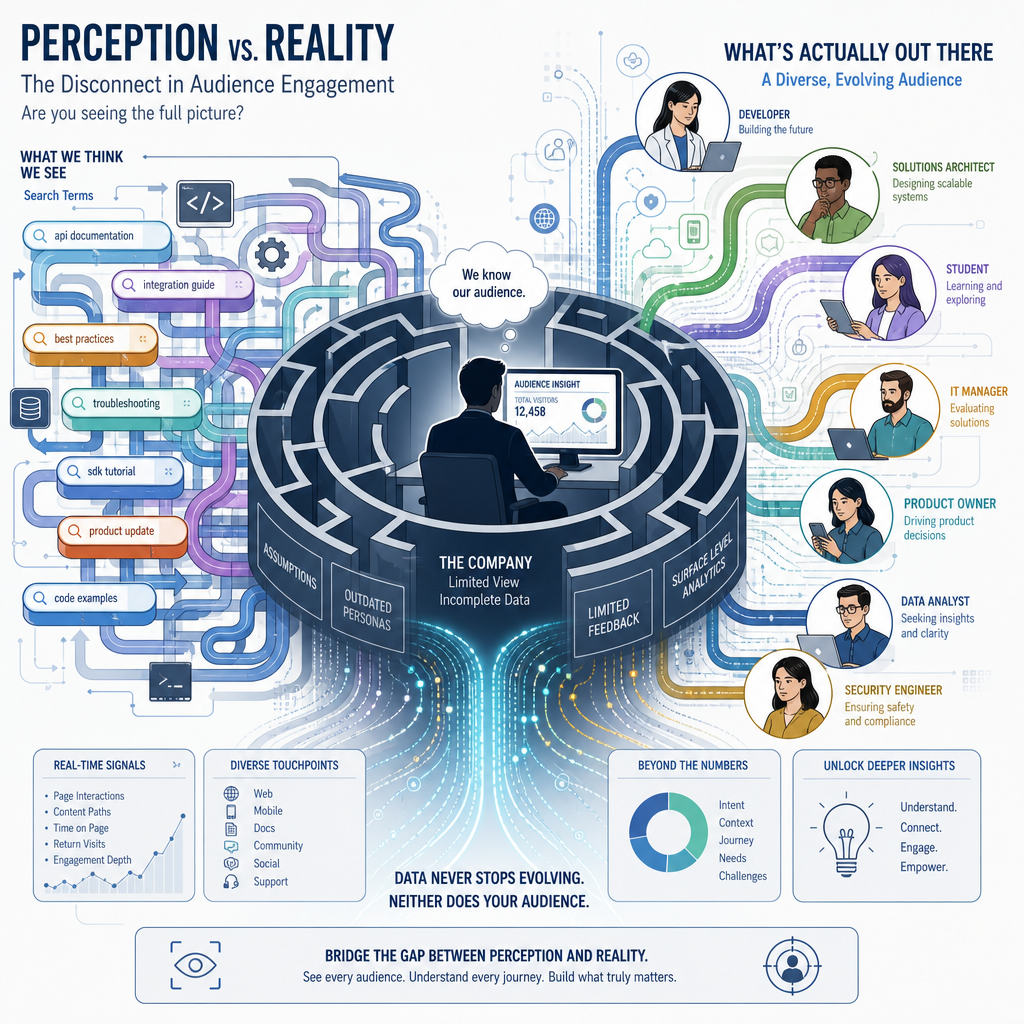
When Your Audience Isn’t Who You Think They Are, your marketing data usually gives you clues before anyone spots the problem. A semiconductor company may picture senior chip designers as its main audience, while search traffic comes from procurement teams, technical students, investors, systems engineers, or journalists trying to understand a new technology. That gap matters. It shapes the subjects you publish, the language you use, the pages you build and the search engines, including AI search tools, that can find and recommend your company.
This is a familiar issue in high-tech marcoms. Specialist businesses often understand their products in great depth, so their content follows the internal view of the company. It talks about architectures, process nodes, validation methods and performance figures. Those details have value, though they may sit several steps away from the questions people ask when they first discover a brand.
When Your Audience Isn’t Who You Think They Are
SparkToro’s article on audience perception makes a useful point: marketers often define an audience by the people they hope to reach or the buyers they already know. Search behaviour reveals a wider picture. The people engaging with a topic may include influencers, researchers, technical evaluators and curious observers. Each group brings a different need to the same subject.
For a company developing quantum computing hardware, the audience may include quantum researchers and software developers. It may also include university departments, government agencies, venture capital teams and engineers looking for a practical introduction. A robotics manufacturer might attract warehouse operators, integrators and students alongside its intended industrial buyers. These people can influence reputation and future demand, even when they never appear in a sales database.
That wider audience is especially important in technical SEO services. Search engines build a picture of a company from its public language, linked references, expert explanations and coverage across the web. AI search systems do something similar when they select sources for an answer. A narrow content profile can leave useful parts of your expertise invisible.
Why High-Tech Companies Misread Their Audience
There are practical reasons for the disconnect. Product teams tend to describe a solution through its technical specifications. Sales teams think about named accounts and buying committees. Executives focus on market categories, revenue and competitive position. Searchers arrive with their own vocabulary, which can be broader, less precise and occasionally unfamiliar to the business.
A person searching for a semiconductor supplier may begin with a use case rather than a component name. Someone researching edge computing could be looking for thermal design guidance, chip availability, power consumption data or a partner who can support production. The search journey develops as they learn. Their first query rarely contains the wording found in a product brochure.
- Technical buyers searching by application, industry or system problem
- Researchers and students looking for clear explanations of complex subjects
- Procurement teams checking supplier capability, reliability and production scale
- Journalists and analysts seeking evidence, expert commentary and market context
- Engineers comparing specifications, standards, integration requirements and documentation
The result can feel confusing in analytics. A page attracts many visitors, yet few people complete a contact form. That traffic still tells you something. It may show that the page has authority, that the topic is growing, or that the visitor needs a different next step. A content strategy becomes stronger when it treats these signals as part of the audience picture.
Use Search Data to Find the Real Audience
Start with the questions people ask around your products and technologies. Review Search Console queries, internal site searches, paid search terms, referral sources and the pages that earn links. Speak with sales and technical support teams about recurring questions. These sources rarely line up perfectly, which is useful. The gaps show where different audience groups describe the same subject in different ways.
Audience evidence to review
| Source | What it can reveal |
|---|---|
| Organic queries | Language, intent and subjects linked to your expertise |
| Sales conversations | Objections, buying roles and decision criteria |
| Referral traffic | Communities and publications already discussing your work |
| AI search visibility | Topics and sources associated with your brand in generated answers |
Group the findings by intent. Informational searches may come from people learning the basics. Commercial research often appears through comparisons, supplier searches and questions about implementation. Some visitors look for proof, such as certifications, case studies, performance data or production facilities. These patterns help you build pages around real journeys rather than an imagined customer profile.
This approach works across technical sectors. SEO for biotech may need to speak to laboratory teams, clinical researchers, investors and regulatory specialists. SEO for robotics can reach manufacturers, software engineers, facility managers and system integrators. SEO for hardware manufacturers often depends on documentation, compatibility information and evidence of dependable supply.
Audience Discovery Improves SEO and GEO
SEO becomes more useful when it connects search intent with a clear business purpose. A page about chip packaging can explain the technology, answer common design questions and guide qualified visitors towards engineering support. A glossary can introduce a subject to early-stage researchers, while a detailed technical article gives experienced readers the depth they expect.
GEO for semiconductor companies adds another layer. Generative search tools select information that appears clear, credible and well connected to the question. They need enough context to understand what your company does, where its expertise sits and which claims have supporting evidence. Pages that rely on unexplained product language may struggle to become useful source material.
For GEO for high tech companies, this means building a visible knowledge structure. Explain important concepts in plain language. Give technical terms a stable meaning across the site. Connect research, products, people and applications through sensible internal links. Publish original evidence where possible, including test methods, engineering perspectives, project lessons and customer outcomes.
A useful test: Ask whether a technically informed person outside your company could understand the page, describe its value to a colleague and find a sensible next step. That small test often exposes hidden assumptions.
Enterprise SEO consulting can help connect this work across large sites, product divisions and regional teams. The goal is a consistent market understanding that still allows each audience group to find the detail it needs. A central strategy can support separate content paths for researchers, engineers, procurement teams and senior decision-makers.
Build an Audience Profile That Can Change
An audience profile should guide decisions while leaving room for discovery. Record the questions each group asks, the terminology they use, their level of technical knowledge and the evidence that helps them move forward. Include people who influence the conversation. In a specialist market, a researcher who shares an article or a journalist who cites a company can extend reach well beyond a single buying cycle.
Review the profile every few months. New standards, funding announcements, supply chain shifts and product launches can alter search demand quickly. Quantum computing, robotics and biotech all develop through active research communities, so the audience around a subject may move before the company updates its assumptions.
- List the audiences already recognised by sales, product and leadership teams.
- Compare those groups with search queries, referral data and content engagement.
- Identify people who influence trust, research and technical evaluation.
- Create content routes that match each group’s questions and decision stage.
- Track changes in search language and AI-generated visibility over time.
A useful audience profile has a human quality. It records what people are trying to do, where they hesitate and what they need to explain internally. That detail gives writers something more practical than a demographic label. It also helps technical experts share their knowledge without turning every page into a specification sheet.
Turn the Disconnect into a Marketing Advantage
The moment a company sees its wider audience, content opportunities tend to appear. A semiconductor business may create an application guide for systems engineers, a supplier page for procurement teams and an introductory explainer for new researchers. Each page supports a different need while strengthening the wider topic area.
This work takes patience. Some pages will attract attention without producing an immediate enquiry. Others may reach a small technical audience that later becomes valuable. Keep reviewing the evidence, speak with the people closest to customers and let the market’s language inform the next content decision.
When Your Audience Isn’t Who You Think They Are, the discovery can sharpen your strategy. Search data, customer conversations and generative search results show how people encounter your expertise in the real world. For companies working in semiconductors, biotech, robotics and advanced hardware, that wider view can support stronger Semiconductor SEO, clearer technical SEO services and more useful GEO for high tech companies. Your actual audience is already leaving signals. The work is learning how to read them.