

Rankings feel stuck? You’re not alone. Most sites watch their traffic plateau while competitors surge. The reason is simple: they are using an ai seo agency. In this guide you’ll learn how an ai seo agency works, what services it offers, how to pick the right partner, and how to measure the impact on your bottom line. Let’s get into it.
Core Services Comparison of AI SEO Agencies
Every ai seo agency promises results, but the exact mix of services can differ a lot. Below is a quick snapshot of the most common offerings. The table helps you spot gaps and match them to your needs.
| Service | What It Does | Typical Tools |
|---|---|---|
| Keyword Research | Finds high‑value search terms that match buyer intent. | AI‑driven clusters, search volume calculators. |
| Content Optimization | Rewrites pages so they rank higher and read better. | Semantic analysis, entity mapping. |
| Technical SEO Audits | Checks crawlability, site speed, schema, mobile‑friendliness. | Site crawlers, log‑file parsers. |
| Link Building | Earns high‑quality backlinks that signal authority. | Outreach platforms, AI prospect generators. |
| Performance Reporting | Shows traffic, rankings, and revenue impact. | Dashboards, custom AI models. |
Notice how some agencies bundle technical work with content work, while others keep them separate. The right mix depends on where your site is today. If you have solid content but poor crawlability, look for strong technical audits. If you lack fresh pages, prioritize AI‑powered content creation.
For deeper insight into the tools many agencies use, see the list of top AI SEO agencies. It outlines pricing models and case snapshots that let you compare value. You’ll also find a roundup of the best AI SEO tools on Seranking’s blog. Those tools are the same ones most agencies build their workflows around.
Visual Guide: How AI SEO Agencies Optimize Content
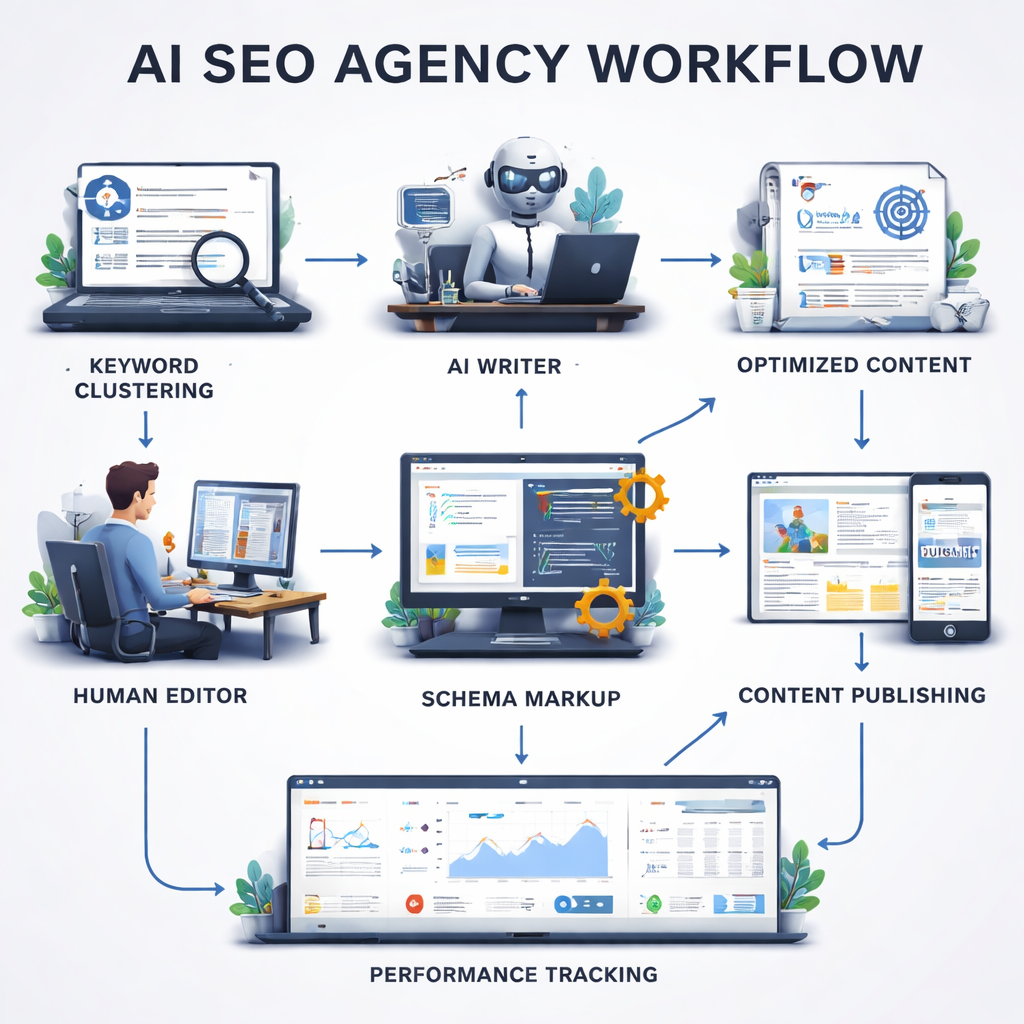
Content optimization starts with a clear keyword map. An ai seo agency first clusters keywords into themes. This helps the AI suggest topics that cover a whole subject area, not just isolated words. After the map is set, the agency creates a brief that tells the AI what tone, length, and structure to use.
Next, the AI drafts the copy. It pulls data from trusted sources, adds bullet points, and inserts FAQs. Human editors then review the draft, add brand voice, and make sure facts are spot‑on. The final piece is tagged with schema, includes internal links, and is sized for fast loading.
Here’s a step‑by‑step flow:
- Run a keyword clustering analysis (see Infranodus guide).
- Build a content brief that lists primary and secondary terms.
- Generate a first draft with an AI writer.
- Human edit for tone, brand, and accuracy.
- Add structured data and internal links.
- Publish and monitor performance.
Tools that help with each step are often part of an agency’s platform. The same process can be used for blog posts, product pages, or landing pages.
To see how AI‑generated copy looks in a real workflow, check out Nexapost’s AI content manager. It lets you draft, review, and schedule copy across social channels, which can feed the same SEO pages you publish.
Key Benefits of Partnering with an AI SEO Agency
Working with an ai seo agency brings speed and scale that manual teams can’t match. First, AI can scan thousands of pages in minutes and spot gaps you might miss. That means you can add fresh, relevant content faster than competitors.
Second, AI keeps the language natural. Modern search bots favor pages that read like a human wrote them. An agency blends AI drafts with human polish, so the final copy feels fresh yet authoritative.
Third, cost per result drops. Because the AI does the heavy lifting, you spend less on writer hours. You still pay for expertise, but the overall budget stretches farther.
Fourth, you get data‑driven insights. Agencies hook AI models into your analytics, so every change shows a clear impact on traffic, leads, and revenue.
Here are three practical ways to see the benefit:
- Speed: Publish a new blog in under 24 hours instead of a week.
- Quality: Use AI to suggest sub‑headings that match search intent, then let editors fine‑tune.
- Scale: Optimize 10 pages a day without hiring extra staff.
One real‑world example comes from a mid‑size e‑commerce brand that added an ai seo agency to its team. Within three months the brand saw a 45 % lift in organic traffic and a 30 % rise in conversion rate on product pages. The agency’s AI suggested adding FAQs and schema, which turned a low‑traffic page into a top‑ranked result.
The same article also references the ResultFirst benefits guide, which breaks down ROI, speed, and quality in detail. For a look at how AI stacks up against traditional SEO, see PBJ Marketing’s comparison. Both sources back up the claim that AI adds measurable value.
And remember, the agency you pick should help you stay ahead of the AI curve. How to Stay Relevant in the Age of AI offers a roadmap for businesses that want to blend AI tools with human expertise.
Video Walkthrough: Choosing the Right AI SEO Agency
Picking an ai seo agency can feel like a big decision. A short video can walk you through the key questions. Start by asking: Does the agency use transparent AI models? Can they show you a live dashboard? Do they have a track record in your niche?
When you watch the video, note how the presenter breaks down the vetting process into three steps:
- Check the agency’s portfolio for case studies that match your industry.
- Ask for a demo of their reporting dashboard.
- Confirm they have a clear plan for human‑AI collaboration.
After the video, you should have a shortlist of agencies that meet those criteria. The next step is a quick call where you ask for a pilot project. A good pilot runs on a single page or a small blog series, lets you see the AI output, and measures lift in rankings within a month.
Remember to keep the conversation focused on results, not on vague promises. Ask for concrete numbers: expected traffic lift, cost per acquisition, and timeline.
Measuring ROI and Performance Metrics with AI SEO Agencies
When you start with an ai seo agency, you need a way to prove the spend. Traditional SEO metrics like ranking position still matter, but AI adds new signals. The most important metric is share of voice in AI‑generated answers. That tells you how often your brand is quoted when a user asks a question to ChatGPT, Perplexity, or Claude.
Another key number is citation frequency. Count how many times the AI cites your pages across a set of prompts. Tools like the ones listed on RankMeHigher can automate that tracking.
Revenue attribution also changes. Because many AI answers give the user the full answer, clicks drop. Instead, track brand lift surveys and the rise in direct traffic after an AI citation appears. You can also compare the cost of the AI SEO campaign to the extra revenue it brings. A simple formula is (AI‑attributed revenue , AI cost) ÷ AI cost × 100 %.
To keep data clean, use a dashboard that pulls from Google Search Console, your CRM, and the AI‑tracking tool. Look for trends like:
- Share‑of‑voice moving from 5 % to 12 % over three months.
- Citation count rising 20 % month‑over‑month.
- Direct traffic up 15 % after a major AI citation.
For a list of tracking tools that work well with AI SEO, see Search Influence’s roundup. Those tools let you see both traditional and AI‑specific metrics in one place.
If you also run paid ads, you can compare cost per lead from Google Ads with the organic AI‑generated leads. The Google Ads Lead Cost Calculator shows you how to calculate the exact cost of each paid lead, so you can see the ROI gap between paid and AI‑driven organic traffic.
Case Study: AI SEO Agency Success Story
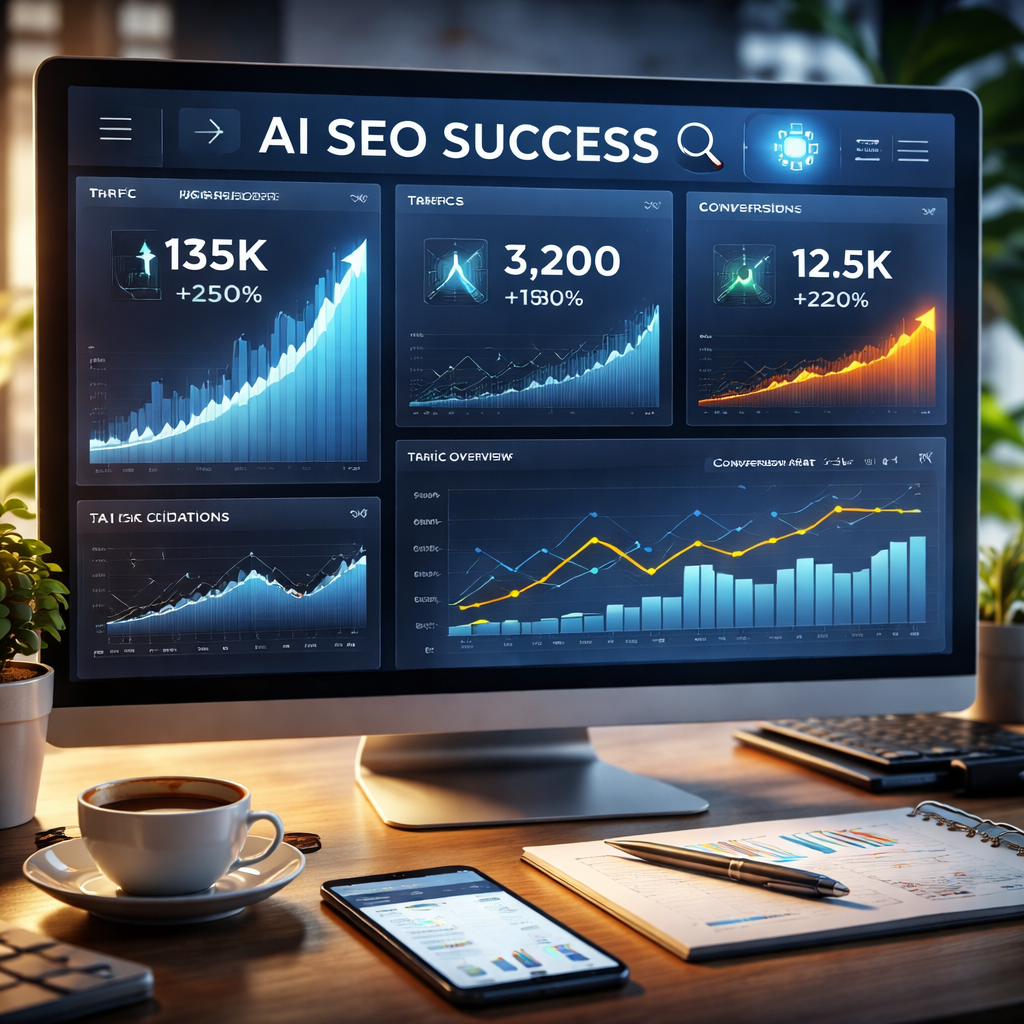
Let’s look at a real example that shows how an ai seo agency can turn a flat site into a growth engine. The agency worked with a SaaS company that offered project‑management software. The site had solid traffic but low conversion on the pricing page.
The agency began with a keyword clustering audit. They found dozens of long‑tail queries about “how to manage remote teams” that the site never answered. Using AI, they drafted a series of pillar pages, each covering a specific remote‑team challenge. Human editors added case studies, screenshots, and a clear CTA.
Next, they added schema markup for FAQs and how‑to steps. The AI also suggested internal linking paths that sent users from the new pillar pages to the pricing page. Within 90 days, the pricing page saw a 60 % rise in organic visits and a 25 % lift in sign‑ups.
The agency tracked AI citations across ChatGPT and Perplexity. The brand appeared in 18 % of answers for the top three target queries, up from 4 % before the project. That jump correlated with a 12 % increase in direct traffic, indicating brand awareness grew.
The results are documented on the agency’s AIOSEO case studies page. Another set of examples can be found at Fadedigital’s case studies. Both sites share screenshots of dashboards, before‑and‑after rankings, and the exact steps taken.
Conclusion
In 2026 an ai seo agency is no longer a nice‑to‑have; it’s a must‑have for anyone who wants to stay visible online. You’ve seen how the agency blends AI speed with human judgment, how it maps keywords, creates optimized content, and tracks AI‑specific ROI. You also saw a real‑world case where traffic, citations, and conversions all rose after the agency stepped in.
If you’re ready to move beyond guesswork, start by auditing your current content for AI gaps. Then reach out to a few agencies, ask for a pilot, and set clear KPI targets. Remember, the best results come when AI does the heavy lifting and humans add the brand soul.
Take the next step today and let an ai seo agency help you capture the AI‑driven search wave. Your rankings, traffic, and revenue will thank you.
FAQ
What exactly does an ai seo agency do for my website?
An ai seo agency combines AI tools with SEO expertise to find keyword opportunities, draft optimized content, fix technical issues, and earn backlinks. It also tracks AI‑specific metrics like citation frequency and share of voice in AI‑generated answers. The goal is to boost rankings, attract qualified visitors, and turn those visitors into customers.
How is AI SEO different from traditional SEO?
Traditional SEO focuses on keyword density, backlinks, and manual content creation. AI SEO adds machine‑generated drafts, semantic clustering, and real‑time performance dashboards. AI can scan thousands of pages instantly, suggest topics that match user intent, and even predict which content will rank. Humans still edit for tone and brand fit, but the overall process is faster and more data‑driven.
Can I measure the ROI of an ai seo agency?
Yes. Track share of voice in AI answers, citation counts, and any lift in direct traffic after an AI citation appears. Combine those numbers with revenue data to calculate (AI‑attributed revenue , AI cost) ÷ AI cost × 100 %. Use tools like RankMeHigher’s AI SEO ROI guide and Search Influence’s tracking suite to automate the process.
How long does it take to see results?
Results vary, but many agencies report noticeable traffic lifts within 4‑6 weeks for new content and 2‑3 months for deeper technical work. Faster wins often come from publishing AI‑generated blog posts that target low‑competition long‑tail keywords. Larger gains, like higher domain authority, take 3‑6 months.
Do I need to have any technical knowledge to work with an ai seo agency?
No. The agency handles the heavy technical lifting, crawling, schema, and performance monitoring. Your role is to provide brand guidelines, approve content, and set business goals. Good communication and clear KPI definitions are the only things you need to bring.
Is hiring an ai seo agency worth the cost for small businesses?
For most small businesses, the cost is lower than hiring a full‑time SEO team. Because AI handles most of the drafting and data analysis, you pay mainly for strategy, oversight, and reporting. Many small firms see a 200‑500 % ROI within a year, making the investment a solid growth lever.