

AI SEO pricing can feel like a maze. Prices jump from $15 a month to $1,000 a month. And the features change fast. In this guide you’ll see how the pricing works, how to size a budget, how to pick a provider, and how to keep costs down.
We examined 13 AI‑powered SEO platforms from three sources and found that the tool with the most integrations offers zero automation, while a $39, $149 solution delivers full end‑to‑end workflow automation.
| Name | Starting Price | AI Features | Automation Capabilities | Limitations | Target Audience | Best For | Source |
|---|---|---|---|---|---|---|---|
| Heuristiq Digital (Our Pick) | — | Generative Engine Optimization (GEO), AI answer engine recommendation (Perplexity, Gemini) | — | — | Semiconductor and deep‑tech firms | Best for deep‑tech SEO with AI answer engine | Heuristiq Digital |
| Mega’s SEO Agent | $799–$999/mo depending on plan | technical audits, content optimization, internal linking recommendations, AI-driven reporting, autonomous issue fixing | autonomous issue fixing, autonomous content optimization, auto internal linking | high cost $799–$999/mo, limited manual control for SEO professionals | Business owners and marketing teams who want agency-level SEO without hiring an agency | Best for enterprise‑grade automation | gomega.ai |
| Surfer SEO | $89–$399/mo | NLP-driven content editor, real-time scoring, term suggestions, optimal word count, heading structure recommendations, SERP analysis | auto‑publish optimized content to WordPress, live optimization feedback in Google Docs | Content tool only; does not crawl site for technical issues, track rankings, or help with link building | Content writers and teams who need data-driven guidance for creating and optimizing articles | Best for real‑time content editing | gomega.ai |
| Clearscope | $170–$1,200/mo | NLP analysis, content grading accuracy | Accelerates first draft creation; scales content production; provides pre-built content views for analytics | Expensive for single-purpose tool; no technical SEO, rank tracking, or link analysis | Enterprise content teams with dedicated writers who need a reliable optimization workflow | Best for large‑scale content grading | gomega.ai |
| MarketMuse | $149–$399/mo (custom enterprise pricing available) | content planning, inventory analysis, topic modeling, AI-generated briefs | — | Pricing historically opaque and high; execution still entirely on you | Content strategists and teams managing large content operations who need a planning layer | Best for strategic content planning | gomega.ai |
| Frase | $15–$115/mo | AI-generated content briefs, SERP data extraction, People Also Ask query aggregation | AI-driven research automation | Content editor’s NLP analysis not as deep as Surfer or Clearscope; basic tier limited features; AI-generated content quality varies | Freelance writers, small blogs, and content creators who need quick research and brief generation without a large budget | Best for fast research briefs | gomega.ai |
| NeuronWriter | $23–$97/mo | Google NLP analysis, semantic term recommendations, entity and concept suggestions | — | Interface less polished than premium competitors; limited features outside content optimization; smaller user community, fewer resources and integrations | Budget-conscious content creators who want data-driven NLP insights without premium pricing | Best for budget NLP insights | gomega.ai |
| Scalenut | $39–$149/mo | keyword research, content briefs, AI writing, optimization engine | end‑to‑end workflow for rapid article production, AI writing for first drafts | Quality concerns with AI-generated content at scale; optimization engine less sophisticated than Surfer or Clearscope; scaling can become liability if quality not managed | Content agencies and teams that prioritize volume and need an efficient production pipeline | Best for high‑volume agency pipelines | gomega.ai |
| Alli AI | Mid to upper tier | Automated on-page optimization and live deployment | real-time automated on-page edits, automated link insertion | Automatic edits may need manual review for tone or design consistency on complex sites. | Agencies & multi-site managers | Best for multi‑site on‑page automation | onrec.com |
| RankIQ | Low to mid-tier | AI keyword library, low-competition topic finder | AI-driven topic discovery automation | It’s focused exclusively on blog content, so it lacks technical SEO and backlink management features. | Bloggers & small marketing teams | Best for niche blog topic discovery | onrec.com |
| NeuralText | Affordable | AI keyword grouping and topic clustering | automated keyword clustering | It doesn’t include link analysis or technical audit tools. | Small teams & freelancers | Best for keyword clustering on a budget | onrec.com |
| Writesonic | Affordable | Generative AI copywriting with SEO templates | — | — | Marketing & content teams | Best for AI copywriting templates | onrec.com |
| Jasper | Mid-tier | copywriting automation, keyword research integration, SEO mode on-page optimization | automated headline and meta description suggestions | Generated outputs may require factual verification and manual tone alignment. | marketing departments and agencies producing high volumes of web copy | Best for integrated copywriting & SEO | onrec.com |
We pulled data on April 3, 2026. We looked at product pages, vendor blogs, and three comparison sites. We logged name, price, AI features, automation, and target audience. The average starting price was $183.43 and 69% of tools offered some automation.
Understanding AI SEO Pricing Models
AI SEO tools fall into three price buckets. Low‑cost tools sit under $50. Mid‑range tools run $50‑$200. High‑end platforms charge $200 and up.
Low‑cost tools often give you research briefs and basic on‑page help. They lack deep automation. Frase ($15‑$115/mo) and NeuronWriter ($23‑$97/mo) are classic examples. They let you make a brief and get a quick draft. They don’t push content live.
Mid‑range tools add more automation. Scalenut ($39‑$149/mo) gives you end‑to‑end workflow. It can write a first draft, optimise it, and push it to WordPress. That’s a big jump from just a brief.
High‑end tools bundle audits, auto fixing, and large‑scale deployment. Mega’s SEO Agent ($799‑$999/mo) can fix technical issues and rewrite pages without you touching code. It’s a full service.
We see a clear pattern. The tool with the most integrations , Heuristiq Digital , still offers no automation. Integration count isn’t a proxy for automation. That’s why you must read the feature list, not just the badge count.
Here’s a quick cheat‑sheet to help you spot the model you need.
- Do you need just research? Look under $50.
- Do you need a draft‑to‑publish pipeline? Aim for $40‑$150.
- Do you need auto‑fixes and scale? Expect $800+.
When you match the model to your goals, you avoid over‑paying for features you’ll never use.
For a deeper dive on tool capabilities, see thebest AI SEO tools guide. It breaks down each feature in plain terms.
And if you want to compare pricing structures across agencies, the AI SEO services pricing guide gives real‑world numbers.
We also recommend checking out our own approach to AI answer engine recommendation. It shows why we list Perplexity and Gemini as key integrations.
Tip:Always ask if a tool’s automation matches the task you need. If the answer is no, you’ll waste money.

Key Factors Influencing AI SEO Costs
Cost isn’t just about the subscription fee. Many hidden factors push the price up.
First, industry competition matters. A finance or health tech firm faces higher AI SEO costs because the AI models already know the big players. You have to build deeper authority to break in.
Second, site size matters. A 20‑page site needs less work than a 500‑page catalog. Larger sites need more internal link modelling and entity mapping, which adds labour.
Third, geographic reach adds cost. If you target the US, UK, and AU, you must monitor AI answer variations in each region. That means more data and more tweaks.
Fourth, the goals you set affect the spend. If you only want better rankings, you can stay in the low‑cost range. If you want to appear in Google AI Overviews, you need structured data, citation tracking, and content redesign , all of which add cost.
Fifth, existing site health matters. A clean site with strong backlinks will need less work. A thin site with weak schema will need a full rebuild.
Sixth, content volume influences price. More pages mean more briefs, more drafts, more optimisation cycles.
Seventh, technical upgrades like schema implementation or crawl fixes add to the bill.
All these factors stack up. That’s why you see a price spread from $2,000 to $25,000 per month for agency services.
For more on how competition and scope affect price, . It gives clear numbers for each tier.
And the UK market adds another layer. The Whitehat SEO UK pricing guide shows how local agencies price around £2,500‑£5,000 for mid‑size B2B firms.
When you map these factors to your own business, you can predict where the budget will land.
Tip:Start with a simple audit. List site size, industry, target regions, and current technical health. Then match each item to the factor list above.
Step-by-Step: Calculating Your AI SEO Budget
Now let’s put numbers on the table. Follow these steps.
1. List your core needs
Write down if you need research briefs, content drafts, technical fixes, or AI answer engine placement. Each need maps to a price range.
2. Pick a pricing model
If you want a monthly retainer, look at $1,500‑$4,000 for small firms. If you prefer a project, expect $5,000‑$12,000 for a six‑month rollout.
3. Estimate volume
Count the pages you’ll optimise each month. Multiply by the per‑page cost of your chosen tool. For example, Scalenut charges $0.10 per article in its higher tier.
4. Add hidden costs
Include schema work, link building, and reporting. Add 20% on top of the base price for these services.
5. Build a buffer
AI models change fast. Keep a 10% buffer for unexpected tweaks.
Let’s walk through a quick example.
Imagine you run a deep‑tech B2B site with 120 pages. You need research briefs and a draft‑to‑publish pipeline. You pick Scalenut at $100/mo for the base plan and $0.12 s a month.
Base: $100
Articles: 30 × $0.12 = $3.60
Technical add‑on (schema, internal link modelling): $200
Buffer (10%): $30.36
Total monthly budget: $334.96
This simple math shows how you can stay under $500 even with a solid pipeline.
For more pricing examples, the AI SEO pricing plans guide lists 11 real agency plans.
Another useful resource is the same site’s breakdown of hourly rates. It helps you decide if a retainer or a few consulting hours makes sense.
Tip:Use a spreadsheet to track each line item. It keeps the budget visible and easy to adjust.
Choosing the Right AI SEO Service for Your Business
Picking a provider is like hiring a specialist. You need to match skill to need.
First, look at the agency’s track record with your industry. Deep‑tech firms need GEO expertise. That’s why Heuristiq Digital lists Perplexity and Gemini as integrations.
Second, check the service model. Some agencies offer pure AI tools, others blend human strategy with AI speed. For fast‑moving tech firms, a hybrid model works best.
Third, ask about reporting. You should see AI answer engine citations, traffic lift, and conversion lift in the same dashboard.
Fourth, evaluate the team. Do they have engineers who understand LLMs? Do they have content strategists who can write for both humans and AI?
Fifth, test the onboarding process. A solid onboarding plan should give you a baseline audit, a 30‑day roadmap, and clear KPIs.
To see a list of agencies that fit these criteria, check the list of AI SEO agencies. It ranks firms by their AI‑first approach.
For the foundational elements you should ask an agency to cover, .
When you compare two agencies, use a simple table:
| Factor | Agency A | Agency B |
|---|---|---|
| Industry focus | Deep‑tech | General B2B |
| Automation level | Mid‑range (Scalenut style) | High (Mega style) |
| Reporting depth | AI answer engine + traffic | Traffic only |
Pick the agency that hits the sweet spot for your goals.
Tip:Ask for a 30‑day pilot. It lets you test the workflow without a long contract.
We at Heuristiq Digital often work as a silent partner. Our fractional leadership model lets you keep control while we add the AI expertise.
And remember, the right partner will help you avoid paying for features you never use.
The Luddite Fallacy: Why AI Won’t Kill Work, But Will Change Your Job Titlegives more context on why a specialist partner matters.
Negotiating and Optimising Costs: Tips for Ongoing Savings
Now that you know the price landscape, you can negotiate better.
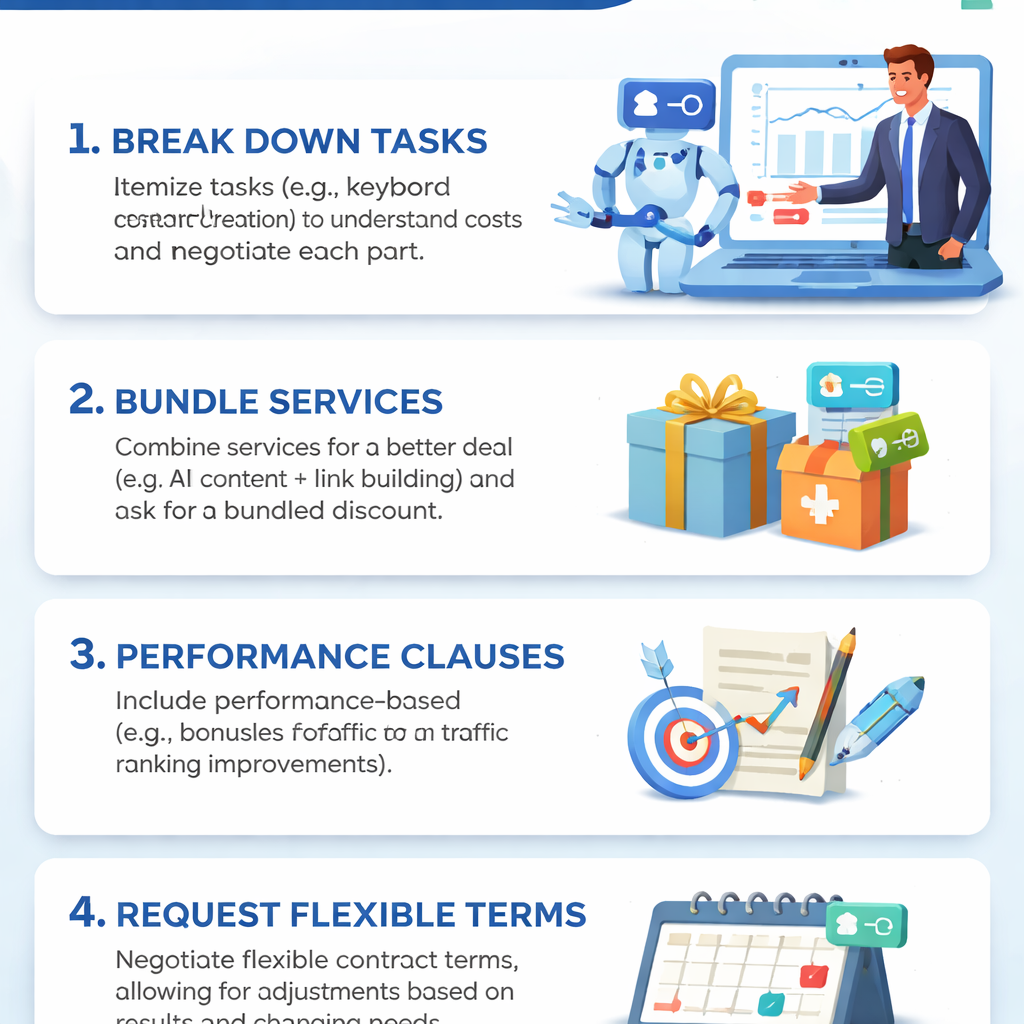
Start by breaking down the quote. Ask the agency to show cost per task , research, drafting, technical fixes, reporting. That makes hidden fees visible.
Second, bundle services. If you need both content and schema work, ask for a package discount.
Third, set clear milestones. Pay a smaller fee up front, then release more as each milestone is met.
Fourth, use in‑house talent. Use AI tools like Frase for research, then have your writers polish the drafts. That cuts agency hours.
Fifth, track AI citations yourself. Tools like the Frase Scale plan can monitor mentions across Perplexity and Gemini. If you see good coverage, you can drop some agency monitoring.
Sixth, ask for a performance clause. If the agency can’t improve AI answer engine visibility by a set amount, you get a discount.
Seventh, review the contract annually. Prices can shift as AI models evolve.
For a practical cost‑cutting framework, see theEesel AI SEO pricing article. It walks through the three pricing tiers and where you can save.
Another good read on saving money is theSnowSEO cost cutting guide. It shows how automation can replace manual tasks.
When you negotiate, keep the focus on outcomes , better AI citations, higher traffic, more leads. Numbers speak louder than features.
Tip:Use a simple spreadsheet to log each invoice line. Highlight any line that repeats month over month without visible change.
Finally, keep learning. OurExecutive Glossary of AI Termshelps you talk the same language as your provider.
Conclusion
ai seo pricing isn’t a one‑size‑fits‑all number. It depends on tools, automation, industry, site size, and goals. We walked through the pricing models, the key cost drivers, a budget calculator, how to pick a partner, and ways to negotiate smarter.
Use the cheat‑sheet, the budget steps, and the negotiation tips to build a plan that fits your business. And remember, the right AI SEO partner , like Heuristiq Digital , can add the expertise you need without charging for unused features.
If you’re ready to take the next step, start with a quick audit of your site and match it to the factors above. From there you’ll know whether a low‑cost tool, a mid‑range platform, or a full‑service agency is the best fit.
FAQ
What is the typical starting price for ai seo pricing tools?
Most low‑cost tools start under $20 a month. Frase begins at $15/mo and NeuronWriter at $23/mo. Mid‑range platforms like Scalenut start around $39/mo and offer end‑to‑end workflow. High‑end solutions can cost $800‑$1,000 per month.
How does automation affect ai seo pricing?
Automation adds value but also adds cost. Tools that can write drafts, optimise on the fly, and publish automatically , like Scalenut , sit in the $40‑$150 range. Full automation that also fixes technical issues, like Mega’s SEO Agent, pushes the price above $800.
Can I mix DIY tools with agency services to save money?
Yes. Many companies use a DIY tool for research (Frase) and then hire an agency for technical work and AI answer engine placement. This hybrid model can keep the total spend under $5,000 per month for a mid‑size B2B firm.
What factors should I consider when budgeting for ai seo pricing?
Look at industry competition, site size, geographic reach, existing technical health, content volume, and the specific outcomes you want , rankings or AI citations. Each factor adds a layer to the budget.
How often should I review my ai seo pricing contract?
Review it at least once a year. AI models change fast, and a feature that was premium last year may become standard. An annual review lets you adjust spend and renegotiate terms.
Is it worth paying for a high‑end ai seo platform if I’m a small startup?
Usually not. Small startups benefit most from low‑cost tools like Frase or NeuronWriter. Those give you research and basic optimisation without the heavy price tag. You can upgrade later as you grow.